We use Google Analytics to understand how visitors use this site. Analytics cookies are only activated with your consent. For details, read our Privacy Policy.
Profile lensThe same player, read from a different angle.
Athletic78
Acceleration
71
Pace
68
Agility
68
Strength
82
Balance
93
Jumping
68
Stamina
85
Fitness
86
Technical89
Dribbling
92
Short Passing
95
Long Passing
96
Finishing
78
Shot Accuracy
77
Shot Power
84
Shooting Technique
87
Heading
74
Tackling
68
Crossing
90
Free Kick
89
Penalties
86
First Touch
92
Mental88
Composure
92
Aggression
85
Consistency
85
Creativity
85
Leadership
86
Work Rate
87
Tactical86
Vision
93
Off the Ball
81
Defensive Positioning
74
Teamwork
92
Anticipation
82
Marking
69
Player Traits
Attacking80
Crossing
90
Finishing
78
Heading Accuracy
74
Shot Accuracy
77
Off the Ball
81
Technique92
Dribbling
92
Free Kick
89
Short Passing
95
Long Passing
96
First Touch
92
Shot Technique
87
Movement75
Acceleration
71
Pace
68
Agility
68
Balance
93
Physicality81
Shot Power
84
Jumping
68
Stamina
85
Strength
82
Fitness
86
Defending70
Marking
69
Tackling
68
Def. Positioning
74
Mentality & Game Reading87
Aggression
85
Composure
92
Penalties
86
Vision
93
Leadership
86
Work Rate
87
Teamwork
92
Anticipation
82
Consistency
85
Creativity
85
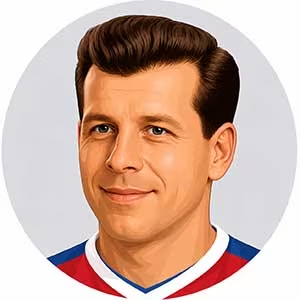
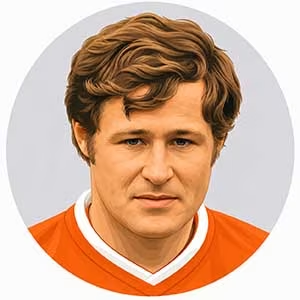
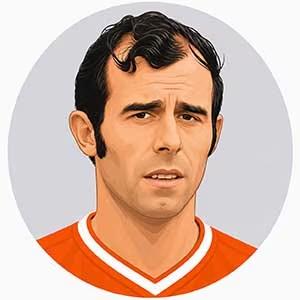
Netherlands - Centre MidfielderVan Hanegem, Willem
Few players in football history have ever wielded a single limb with the sheer geometric genius, devastating spin, and nonchalant brutality of Willem van Hanegem’s left foot. Known throughout the Netherlands as De Kromme (The Crooked) for his distinctive, hunchbacked running gait and bowed posture, the Feyenoord and Dutch national team icon dismantled the myth that elite midfield conductors needed to look like featherweight ballerinas. Van Hanegem played the game at his own deliberate, hypnotic tempo, shielding the ball with an iron upper-body frame before slicing open entire defensive lines with exquisite outside-of-the-boot curved passes (buitenkantje) that seemed to defy the laws of physics. Defensively, he was an uncompromising enforcer: executing bone-crunching, perfectly timed sliding tackles to reclaim possession before instantly transitioning into an attacking orchestrator. As the spiritual and tactical axis of Ernst Happel’s legendary Feyenoord, he claimed the 1970 European Cup and the 1974 UEFA Cup, later serving alongside Johan Cruyff as the cerebral core of Rinus Michels' Total Football side that mesmerized the world at the 1974 World Cup.
Mentally and emotionally, Van Hanegem was a deeply sensitive, anti-authoritarian romantic whose footballing soul was anchored in profound, unvarnished human truth. He carried a heavy, melancholic edge, forged during his childhood trauma when he lost his father and three siblings during the tragic 1944 allied bombing of Breskens—a reality that famously fueled his visceral, deeply emotional hostility toward West Germany during the 1974 World Cup final. On the pitch, his leadership was completely non-conformist; he had zero tolerance for superficial vanity, corporate football politics, or self-indulgent teammates, leading instead through an aura of absolute street authenticity and technical honesty. Inside the dressing room, he was a fiercely loyal protector of his peers and a beloved mentor to younger players, radiating a blue-collar Rotterdam ethos that rejected the flashier Amsterdam aesthetic. Under peak international pressure, his focus was pure, unadulterated passion mixed with stubborn defiance; he never shrank from hostile atmospheres, treating the pitch as an arena of moral justice. Toward referees and opponents, Van Hanegem was an intimidating, sharp-edged combatant who delivered heavy physical retribution when provoked, yet he remained entirely above cheap theatricality, diving, or deceit, leaving an indelible legacy as one of the most uniquely gifted and authentic figures the European game has ever known.


 All Time NetherlandsNT