We use Google Analytics to understand how visitors use this site. Analytics cookies are only activated with your consent. For details, read our Privacy Policy.
Profile lensThe same player, read from a different angle.
Athletic83
Acceleration
93
Pace
86
Agility
86
Strength
77
Balance
77
Jumping
85
Stamina
83
Fitness
79
Technical85
Dribbling
82
Short Passing
77
Long Passing
77
Finishing
93
Shot Accuracy
92
Shot Power
81
Shooting Technique
75
Heading
83
Tackling
44
Crossing
73
Free Kick
68
Penalties
77
First Touch
81
Mental79
Composure
88
Aggression
76
Consistency
75
Creativity
73
Leadership
76
Work Rate
74
Tactical84
Vision
75
Off the Ball
90
Defensive Positioning
42
Teamwork
82
Anticipation
88
Marking
42
Player Traits
Attacking86
Crossing
73
Finishing
93
Heading Accuracy
83
Shot Accuracy
92
Off the Ball
90
Technique77
Dribbling
82
Free Kick
68
Short Passing
77
Long Passing
77
First Touch
81
Shot Technique
75
Movement86
Acceleration
93
Pace
86
Agility
86
Balance
77
Physicality81
Shot Power
81
Jumping
85
Stamina
83
Strength
77
Fitness
79
Defending43
Marking
42
Tackling
44
Def. Positioning
42
Mentality & Game Reading78
Aggression
76
Composure
88
Penalties
77
Vision
75
Leadership
76
Work Rate
74
Teamwork
82
Anticipation
88
Consistency
75
Creativity
73
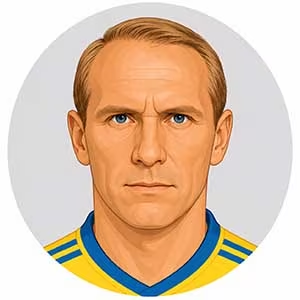
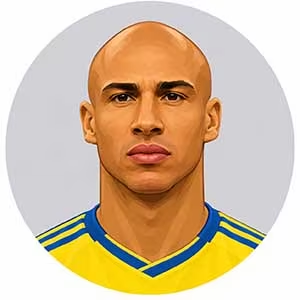
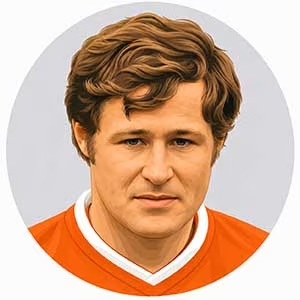
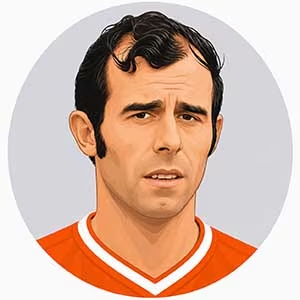
Sweden - StrikerKindvall, Ove
Kindvall was a quick, technically clean centre-forward whose scoring depended heavily on movement before possession. He was not a static target man and did not need extended involvement in build-up. His best actions began by anticipating where a pass, rebound or defensive mistake would emerge, accelerating into that zone and finishing before defenders could recover. Feyenoord’s own retrospective describes him through intelligence, technique and an exceptional instinct for goal, while Kindvall later recalled Ernst Happel giving him an unusually simple instruction: stop chasing the ball everywhere, enter the penalty area and score. Kindvall accepted the narrowing of his function and became more efficient within it. (ovekindvall.se) He won the Dutch scoring title three times and scored 129 league goals during his five years in Rotterdam, while also producing two decisive goals against France in October 1969 that effectively sent Sweden to the 1970 World Cup. (fff.fr) His game therefore combined mobility with discipline: he could move intelligently across the front, but he did not require constant possession or positional freedom for its own sake.
The limitations followed from that efficiency. Kindvall was much less valuable when the team could not progress the ball into areas where his timing and acceleration mattered. He was not a primary playmaker capable of dropping deep and reorganising possession for long stretches, nor a physically dominant striker who could compensate for poor service through repeated aerial battles. His scoring game depended on receiving the correct type of situation: forward-facing movements, combinations close to goal and transitions in which defenders had not fully stabilised. Once he returned to Sweden in 1971, the change in environment exposed this dependency. Kindvall himself noted that Feyenoord’s football had involved far greater possession and positional interchange than the game he returned to at home, while his personal retrospective acknowledges that the goals came less frequently after the move back to Norrköping. (ovekindvall.se) That decline should not be explained simply through ageing. The supporting structure had changed, and the striker who had learned under Happel to concentrate his movement around high-value zones was now operating in a less dominant attacking context.
Psychologically, Kindvall’s most discriminating feature is low status dependence combined with high competitive activation. He repeatedly produced in matches carrying extreme external stakes: two goals against France in the decisive 1969 qualifier and the winning goal three minutes from the end of a European Cup final. Decades later he summarised his own relationship with such occasions bluntly: the stronger the opponent and the larger the crowd, the more energised he felt. (svt.se) Yet that activation did not require permanent immersion in elite status. In 1971 Feyenoord wanted him to remain, but Kindvall returned to Sweden because he and his family were homesick and wanted to be closer to home; he later acknowledged that many people thought the decision absurd, but he did not reverse it. (aftonbladet.se) This is not evidence of low ambition: he had already functioned successfully at the highest European level and continued representing Sweden afterwards. It instead separates competitive intensity from institutional attachment. Kindvall could be highly activated by the match while remaining relatively unpossessive about the prestige surrounding the career. Evidence for referee conflict, retaliatory aggression, teammate blame, hostile-crowd degradation or overt authority clashes is insufficient and should remain unknown. The defensible pattern is narrower: major competitive occasions increased his engagement, while elite status itself did not appear necessary to sustain his sense of self.



 All Time SwedenNT