We use Google Analytics to understand how visitors use this site. Analytics cookies are only activated with your consent. For details, read our Privacy Policy.
Profile lensThe same player, read from a different angle.
Athletic82
Acceleration
90
Pace
84
Agility
91
Strength
73
Balance
79
Jumping
66
Stamina
85
Fitness
85
Technical85
Dribbling
87
Short Passing
82
Long Passing
80
Finishing
87
Shot Accuracy
87
Shot Power
84
Shooting Technique
79
Heading
71
Tackling
44
Crossing
72
Free Kick
83
Penalties
82
First Touch
87
Mental78
Composure
77
Aggression
82
Consistency
82
Creativity
85
Leadership
74
Work Rate
77
Tactical83
Vision
83
Off the Ball
87
Defensive Positioning
42
Teamwork
79
Anticipation
84
Marking
41
Attacking 81
Crossing
72
Finishing
87
Heading Accuracy
71
Shot Accuracy
87
Off the Ball
87
Technique 83
Dribbling
87
Free Kick
83
Short Passing
82
Long Passing
80
First Touch
87
Shot Technique
79
Movement 86
Acceleration
90
Pace
84
Agility
91
Balance
79
Physicality 79
Shot Power
84
Jumping
66
Stamina
85
Strength
73
Fitness
85
Defending 42
Marking
41
Tackling
44
Def. Positioning
42
Mentality & Game Reading 81
Aggression
82
Composure
77
Penalties
82
Vision
83
Leadership
74
Work Rate
77
Teamwork
79
Anticipation
84
Consistency
82
Creativity
85
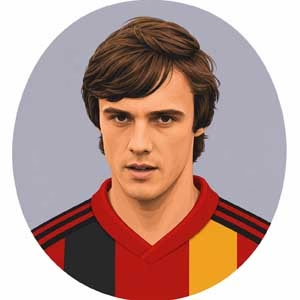
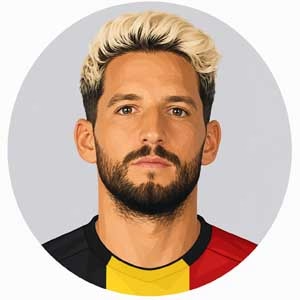
Belgium - StrikerMertens, Dries
Napoli's supporters started calling him Ciro almost as soon as he arrived — a name so specifically Neapolitan it functioned as an adoption ceremony. Dries Mertens returned the gesture with total sincerity: when his son was born, he named him Ciro too.
Born in Leuven in 1987, Mertens was rejected by Anderlecht's senior team as a teenager and moved on to Gent, where he struggled again before dropping down a level entirely, on loan to Eendracht Aalst, to find playing time. From there his path ran through the Dutch second division at AGOVV Apeldoorn, where he finally broke out, then FC Utrecht and PSV Eindhoven, where he won three Dutch titles before Napoli signed him in 2013. At just 1.70 meters, he had been doubted by scouts throughout his rise for his size rather than his ability, and he spent the rest of his career answering that doubt directly: across nine seasons in Naples he became the club's all-time leading scorer, with 148 goals in 397 appearances, surpassing legends who had come before him, and was voted into Serie A's Team of the Year after a 34-goal season in 2016–17 that included a run of seven goals in two matches — a burst even Diego Maradona, in his prime at the same club, had never matched. He later moved to Galatasaray, where he won three Turkish titles and a domestic double before retiring in 2025 at thirty-eight. For Belgium he won 109 caps and scored 21 goals, was part of the country's golden generation that reached the 2018 World Cup semifinal, and captained the side in later tournaments including the 2022 World Cup.
His limitations were connected to his size and to a game built on close control, agility and instinctive movement rather than physical presence — against the most heavily built, physically imposing defenders, he could be muscled off the ball more easily than a taller forward, and his rise through two relegations in his early career reflected genuine early doubt about whether his gifts would translate to the highest level at all.
Temperamentally he was defined, with almost total unanimity across every account of his career, by warmth, humor and a genuine, uncomplicated joy in both football and in the people around him. When journalists compared him to Maradona during his best Napoli season, he visibly bristled — not from false modesty exactly, but from a clear discomfort with a comparison that felt like it belonged to someone else's story rather than his own. He embraced Naples' famously intense football culture rather than holding it at arm's length, describing himself, with evident affection, as a kind of street dog who had adapted completely to his adopted city, and forming a personal bond with the local community that extended well beyond matchday — elderly neighbors stopping him in the street to discuss his last goal, a familiarity he clearly treasured rather than found intrusive. Teammates consistently described him as unselfish and entirely without ego despite becoming the club's greatest goalscorer, and his retirement announcement in 2025 was itself an act of loyalty rather than simple departure: he chose to play one final match not for himself but as part of a charity fixture organized for his former Napoli teammate Marek Hamšík. Playful, communally minded, and never once reported to have let his considerable fame curdle into self-importance, Mertens built a career-defining bond with a city that adopted him as completely as he adopted it.


 All Time Belgium NT