We use Google Analytics to understand how visitors use this site. Analytics cookies are only activated with your consent. For details, read our Privacy Policy.
Profile lensThe same player, read from a different angle.
Athletic82
Acceleration
91
Pace
87
Agility
82
Strength
83
Balance
76
Jumping
84
Stamina
77
Fitness
77
Technical85
Dribbling
83
Short Passing
77
Long Passing
75
Finishing
90
Shot Accuracy
90
Shot Power
81
Shooting Technique
90
Heading
86
Tackling
33
Crossing
67
Free Kick
68
Penalties
77
First Touch
85
Mental79
Composure
84
Aggression
77
Consistency
78
Creativity
78
Leadership
74
Work Rate
76
Tactical83
Vision
75
Off the Ball
90
Defensive Positioning
34
Teamwork
79
Anticipation
88
Marking
37
Player Traits
Attacking85
Crossing
67
Finishing
90
Heading Accuracy
86
Shot Accuracy
90
Off the Ball
90
Technique80
Dribbling
83
Free Kick
68
Short Passing
77
Long Passing
75
First Touch
85
Shot Technique
90
Movement84
Acceleration
91
Pace
87
Agility
82
Balance
76
Physicality80
Shot Power
81
Jumping
84
Stamina
77
Strength
83
Fitness
77
Defending35
Marking
37
Tackling
33
Def. Positioning
34
Mentality & Game Reading79
Aggression
77
Composure
84
Penalties
77
Vision
75
Leadership
74
Work Rate
76
Teamwork
79
Anticipation
88
Consistency
78
Creativity
78
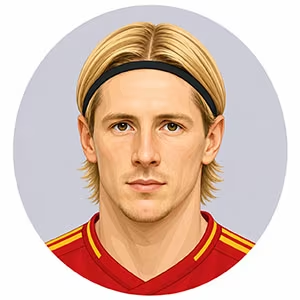
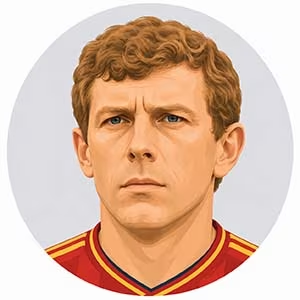
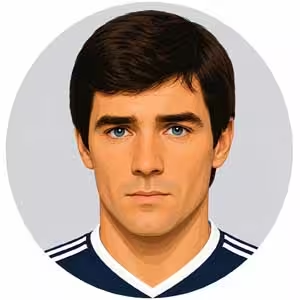
Spain - StrikerTorres, Fernando
Sprinting past a sprawling Philipp Lahm in Vienna with an explosive surge of raw pace to clip the ball over Jens Lehmann and into the far corner delivered Spain’s first major international trophy in 44 years, announcing the birth of a global dynasty. Fernando José Torres Sanz—canonized across world football as El Niño (The Kid)—was an electrifying, direct center-forward whose prime was defined by ferocious straight-line acceleration, dynamic diagonal channel-running, and a devastating ability to finish with power and precision at full sprint.Operating on the shoulder of the last defender, Torres was a nightmare for high-line defenses. He combined a broad, athletic six-foot-one frame with a blistering top-end burst over thirty yards, bullying stoppers with aggressive physical presence and striking first-time finishes with his favored right foot. Becoming the youngest captain in Atlético Madrid history at nineteen, he scored 91 goals in 244 matches to carry his boyhood club through its darkest post-relegation era, before exploding into world-class stratosphere at Rafael Benítez's Liverpool, netting 81 goals in 142 matches and finishing third in the 2008 Ballon d'Or. His subsequent £50 million move to Chelsea yielded the 2011–12 UEFA Champions League (scoring the iconic semi-final breakaway goal at Camp Nou) and the 2012–13 Europa League, before an emotional, trophy-winning return to Atlético (lifting the 2017–18 Europa League). For Spain, across 110 caps and 38 goals, he was a key figure during their historic golden treble: scoring the winning goal in the Euro 2008 final, lifting the 2010 World Cup, and winning the Golden Boot in the Euro 2012 triumph.The tragic turning point of Torres’s career, however, was a severe meniscus tear and subsequent rushed surgeries in early 2010 to make the World Cup squad. The resulting loss of that razor-sharp initial five-yard burst drastically altered his physical mechanics, stripping away the effortless acceleration that had previously allowed him to beat defenders on the outside. When forced to play with his back to goal against compact, congested low blocks without the explosive pace to separate from physical markers, his finishing confidence suffered a prolonged, high-profile crisis during his early Chelsea years.Fiercely proud, passionate, and carrying an unshakeable connection to the working-class supporters of Madrid, Torres played with an earnest, wholehearted intensity. He never hid behind excuses during his darkest scoring droughts, working tirelessly for the collective press and running defensive channels even when his individual magic abandoned him. On the pitch, his presence was all dynamic urgency: charging into open spaces with his golden hair flying, contesting physical duels without hesitation, and celebrating iconic goals with emotional knee slides. Inside the Vicente Calderón, Anfield, and Spanish national team dressing rooms, he was an adored, charismatic leader whose bravery, clutch goals in continental finals, and profound loyalty to his roots cemented an immortal legacy as one of the most explosive and beloved Spanish forwards of all time.