We use Google Analytics to understand how visitors use this site. Analytics cookies are only activated with your consent. For details, read our Privacy Policy.
Profile lensThe same player, read from a different angle.
Athletic84
Acceleration
88
Pace
86
Agility
85
Strength
84
Balance
77
Jumping
90
Stamina
83
Fitness
80
Technical87
Dribbling
89
Short Passing
80
Long Passing
76
Finishing
91
Shot Accuracy
90
Shot Power
85
Shooting Technique
90
Heading
87
Tackling
42
Crossing
70
Free Kick
75
Penalties
88
First Touch
90
Mental82
Composure
87
Aggression
76
Consistency
78
Creativity
85
Leadership
81
Work Rate
81
Tactical85
Vision
81
Off the Ball
92
Defensive Positioning
38
Teamwork
82
Anticipation
88
Marking
37
Player Traits
Attacking86
Crossing
70
Finishing
91
Heading Accuracy
87
Shot Accuracy
90
Off the Ball
92
Technique83
Dribbling
89
Free Kick
75
Short Passing
80
Long Passing
76
First Touch
90
Shot Technique
90
Movement84
Acceleration
88
Pace
86
Agility
85
Balance
77
Physicality84
Shot Power
85
Jumping
90
Stamina
83
Strength
84
Fitness
80
Defending39
Marking
37
Tackling
42
Def. Positioning
38
Mentality & Game Reading83
Aggression
76
Composure
87
Penalties
88
Vision
81
Leadership
81
Work Rate
81
Teamwork
82
Anticipation
88
Consistency
78
Creativity
85
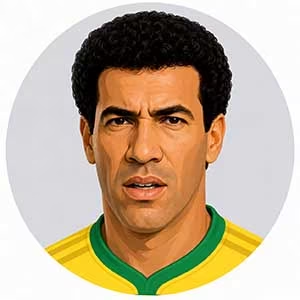
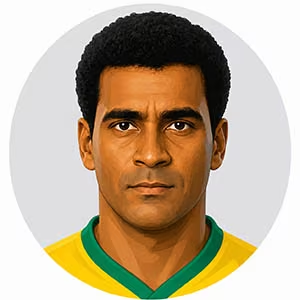
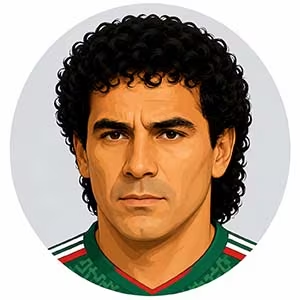
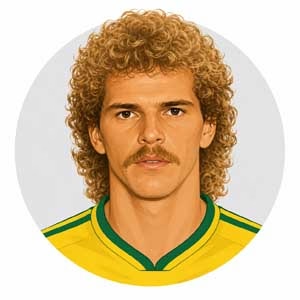
Brazil - StrikerCareca, Antônio
It takes a rare breed of attacker to share a frontline with Diego Maradona and not simply exist as an afterthought, but Antônio de Oliveira Filho pulled it off with breathtaking swagger. Rising through Guarani and São Paulo before transforming Napoli's frontline into a fearsome machine in the late 1980s, Careca was the complete South American center-forward package: explosive linear acceleration over five yards, a snake-like capacity to turn markers in tight phone-booth spaces, and a repertoire of finishes that made goalkeepers look entirely foolish. His chemistry with Maradona and Bruno Giordano—forming the legendary Ma-Gi-Ca trident—was almost telepathic, defined by sharp give-and-goes, diagonally sliced runs behind defensive lines, and sudden, venomous right-footed strikes into the roof of the net. At the 1986 World Cup in Mexico, he exploded onto the global radar with five goals, later anchoring Napoli to the 1989 UEFA Cup and the 1989–90 Scudetto during the most cutthroat era of Italian football.
Mentally, Careca was propelled by a joyful, almost buoyant competitive spirit that completely neutralized the suffocating pressure of playing in Naples during its wildest footballing chapter. He did not brood or posture; instead, his leadership came through an infectious, toothy grin paired with a relentless hunger to exploit even the slightest positional error by opposing stoppers. In the dressing room, he was the ultimate cohesive glue—lighthearted, deeply unpretentious, and fiercely protective of his teammates, striking up an enduring, brotherly bond with Maradona that transcended tactics and trophies. When the tension reached a fever pitch in European cup ties or hostile northern Italian away grounds, his pulse remained remarkably steady, treating high-stakes matches with the instinctive freedom of a kid playing on the várzea fields of Araraquara. Referees and markers found him an honorable, clean combatant; despite absorbing constant physical targeting from the era's most brutal defenders, he never descended into diving, cynical retaliation, or referee baiting, letting his breathtaking technical superiority deliver the ultimate retribution on the scoreboard.