We use Google Analytics to understand how visitors use this site. Analytics cookies are only activated with your consent. For details, read our Privacy Policy.
Profile lensThe same player, read from a different angle.
Athletic81
Acceleration
80
Pace
83
Agility
80
Strength
82
Balance
85
Jumping
82
Stamina
80
Fitness
76
Technical86
Dribbling
81
Short Passing
77
Long Passing
75
Finishing
92
Shot Accuracy
93
Shot Power
86
Shooting Technique
82
Heading
81
Tackling
44
Crossing
69
Free Kick
70
Penalties
84
First Touch
86
Mental80
Composure
86
Aggression
80
Consistency
76
Creativity
75
Leadership
82
Work Rate
72
Tactical84
Vision
75
Off the Ball
93
Defensive Positioning
44
Teamwork
75
Anticipation
91
Marking
41
Player Traits
Attacking86
Crossing
69
Finishing
92
Heading Accuracy
81
Shot Accuracy
93
Off the Ball
93
Technique79
Dribbling
81
Free Kick
70
Short Passing
77
Long Passing
75
First Touch
86
Shot Technique
82
Movement82
Acceleration
80
Pace
83
Agility
80
Balance
85
Physicality81
Shot Power
86
Jumping
82
Stamina
80
Strength
82
Fitness
76
Defending43
Marking
41
Tackling
44
Def. Positioning
44
Mentality & Game Reading80
Aggression
80
Composure
86
Penalties
84
Vision
75
Leadership
82
Work Rate
72
Teamwork
75
Anticipation
91
Consistency
76
Creativity
75
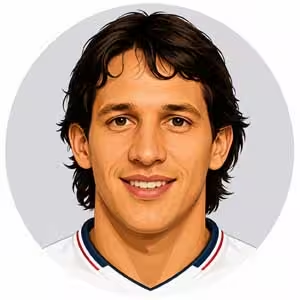
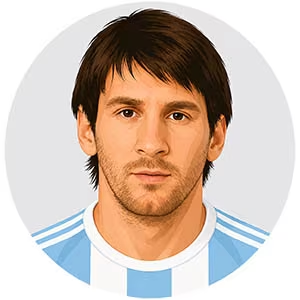
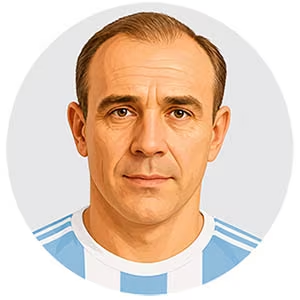
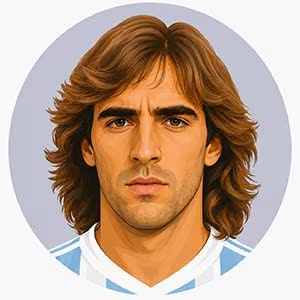
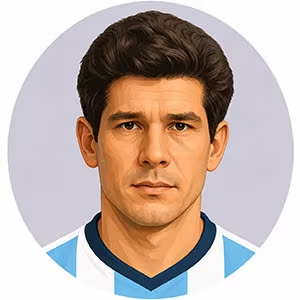
Argentina - StrikerHiguaín, Gonzalo
A razor-sharp peel off the shoulder of a center-back followed by an explosive, first-time strike hammered into the roof of the net before the goalkeeper could blink defined the devastating penalty-box mastery of a forward from Brest whose historic scoring feats were tragically shadowed by the cruelest margins of international finals. Gonzalo Gerardo Higuaín—immortalized across global football as El Pipita—was one of the most prolific, complete, and technically gifted number nines of his generation, combining lethal finishing off either foot with exquisite back-to-goal link-up play.
Possessing an exceptionally sharp movement radius inside the eighteen-yard box, great upper-body strength to shield possession, and the vision of a playmaker when dropping deep into the half-spaces, Higuaín scored over 300 career goals at the absolute summit of club football. Bursting onto the scene at River Plate, he spent seven seasons at Real Madrid (netting 121 goals in 264 matches and lifting three La Liga titles), before delivering an all-time individual masterpiece at SSC Napoli. In the 2015–16 campaign under Maurizio Sarri, he scored a staggering 36 goals in 35 Serie A matches—shattering a 66-year-old single-season Italian scoring record that culminated in a breathtaking bicycle kick against Frosinone. His high-profile €90 million move to Juventus yielded three Scudetti and two Coppa Italia titles, alongside reaching the 2017 Champions League final, before later spells at AC Milan, Chelsea (winning the 2018–19 Europa League), and Inter Miami. For Argentina, across 75 caps and 31 goals (ranking sixth all-time), he featured across three World Cups (2010, 2014, 2018), scoring a historic hat-trick against South Korea and the decisive quarter-final winner against Belgium in 2014.
The defining, painful paradox of Higuaín’s career was the heavy psychological toll inflicted by critical, agonizing misses in three consecutive major international finals—the 2014 World Cup against Germany, and the 2015 and 2016 Copa América finals against Chile. While an absolute assassin across long domestic league seasons, the immense, suffocating weight of public pressure in single-elimination finals began to erode his composure in decisive one-on-one breakaway moments. Furthermore, in the latter half of his career, a tendency to carry excess weight and a loss of sharp initial burst made him more reliant on static penalty-box service against high-tempo European pressing schemes.
Passionate, deeply emotional, and intensely sensitive to public criticism, Higuaín wore his heart on his sleeve throughout a turbulent career. He was a proud, dedicated craftsman who suffered immensely under the vicious scrutiny of social media and toxic media narratives, finding refuge in the unconditional love of his family and teammates. On the pitch, his body language was all coiled, kinetic urgency: dropping deep to execute delicate one-twos, peeling across the near post with predatory timing, and celebrating explosive goals with passionate, roaring sprints toward the corner flag. Inside the Madrid, Napoli, Juventus, and Argentine dressing rooms, he was an adored, warm-hearted professional whose work ethic, technical brilliance, and staggering goalscoring records earned the deep respect of managers like Carlo Ancelotti and Maurizio Sarri, leaving an enduring legacy as one of the most lethal pure strikers in modern football history.