We use Google Analytics to understand how visitors use this site. Analytics cookies are only activated with your consent. For details, read our Privacy Policy.
Profile lensThe same player, read from a different angle.
Athletic82
Acceleration
74
Pace
78
Agility
74
Strength
87
Balance
90
Jumping
89
Stamina
86
Fitness
79
Technical81
Dribbling
78
Short Passing
78
Long Passing
82
Finishing
72
Shot Accuracy
69
Shot Power
85
Shooting Technique
69
Heading
90
Tackling
93
Crossing
75
Free Kick
69
Penalties
68
First Touch
79
Mental80
Composure
82
Aggression
88
Consistency
85
Creativity
68
Leadership
70
Work Rate
87
Tactical84
Vision
77
Off the Ball
69
Defensive Positioning
91
Teamwork
89
Anticipation
86
Marking
87
Player Traits
Attacking75
Crossing
75
Finishing
72
Heading Accuracy
90
Shot Accuracy
69
Off the Ball
69
Technique76
Dribbling
78
Free Kick
69
Short Passing
78
Long Passing
82
First Touch
79
Shot Technique
69
Movement79
Acceleration
74
Pace
78
Agility
74
Balance
90
Physicality85
Shot Power
85
Jumping
89
Stamina
86
Strength
87
Fitness
79
Defending90
Marking
87
Tackling
93
Def. Positioning
91
Mentality & Game Reading80
Aggression
88
Composure
82
Penalties
68
Vision
77
Leadership
70
Work Rate
87
Teamwork
89
Anticipation
86
Consistency
85
Creativity
68
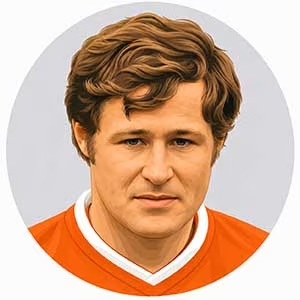
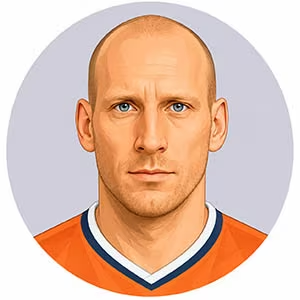
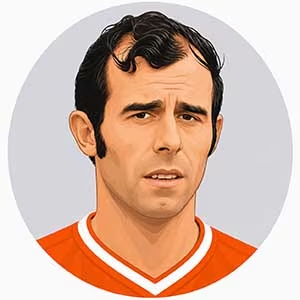
Netherlands - SweeperIsraël, Rinus
San Siro, May 6, 1970: Ernst Happel’s Feyenoord shocked European football by toppling Celtic 2–1 in extra time to claim the Netherlands' first European Cup, with their captain and defensive anchor scoring the vital equalizing header. Marinus David Israël was the uncompromising rock around which Feyenoord built their historic golden era. Operating as an aggressive, man-marking center-half or sweeping libero, IJzeren Rinus (Iron Rinus) paired exceptional aerial command with razor-sharp spatial anticipation, reading attacking trajectories and stripping possession with crushing, ball-and-all challenges. Across 240 matches for Feyenoord between 1966 and 1974, he captured three Eredivisie championships, the 1968–69 KNVB Cup, the 1970 Intercontinental Cup against Estudiantes, and the 1973–74 UEFA Cup against Tottenham Hotspur. For the Netherlands across 47 caps and three goals, he played a crucial role in qualifying for the 1974 World Cup in West Germany, though he was largely relegated to the bench during the tournament as Rinus Michels favored the Ajax-centric pairing of Arie Haan and Ruud Krol.
His rugged, heavy-set style had its limitations against high-tempo fluidity. Israël was built for direct defensive containment rather than dynamic, open-field chasing; against quick, elusive forwards who pulled him wide into thirty-yard footraces, his lack of recovery sprint pace was exposed. Furthermore, while his long-range distribution to the flanks was functional, he lacked the modern dribbling elegance to step into midfield as a deep playmaker, sticking strictly to low-risk recycling and clearances under pressure.
Grim, fearless, and forged in the tough docklands of Amsterdam, Israël was an old-school defensive warrior who governed the penalty box through sheer psychological intimidation. He did not care about aesthetics or pleasing the purists; for him, keeping a clean sheet was a brutal war of attrition. On the pitch, his presence was absolute and intimidating: he commanded Feyenoord’s backline with a sharp tongue, organizing markers and leaving opposing center-forwards bruised after their very first aerial duel. Inside the De Kuip locker room, he was the undisputed boss—a tough, respected captain whose unyielding standards set the spine for Happel’s tactical discipline, earning deep respect even from his fierce Ajax rivals in the national setup. Match officials knew he walked the thinnest line of legal physicality, but his timing was ruthless, leaving an immortal legacy as the definitive hard-man captain and defensive pioneer of Dutch football's golden dawn.