We use Google Analytics to understand how visitors use this site. Analytics cookies are only activated with your consent. For details, read our Privacy Policy.
Profile lensThe same player, read from a different angle.
Athletic80
Acceleration
75
Pace
77
Agility
74
Strength
84
Balance
77
Jumping
91
Stamina
86
Fitness
78
Technical83
Dribbling
80
Short Passing
83
Long Passing
82
Finishing
71
Shot Accuracy
72
Shot Power
86
Shooting Technique
71
Heading
90
Tackling
91
Crossing
77
Free Kick
69
Penalties
68
First Touch
81
Mental81
Composure
85
Aggression
84
Consistency
74
Creativity
72
Leadership
84
Work Rate
84
Tactical81
Vision
81
Off the Ball
78
Defensive Positioning
86
Teamwork
75
Anticipation
80
Marking
85
Player Traits
Attacking78
Crossing
77
Finishing
71
Heading Accuracy
90
Shot Accuracy
72
Off the Ball
78
Technique78
Dribbling
80
Free Kick
69
Short Passing
83
Long Passing
82
First Touch
81
Shot Technique
71
Movement76
Acceleration
75
Pace
77
Agility
74
Balance
77
Physicality85
Shot Power
86
Jumping
91
Stamina
86
Strength
84
Fitness
78
Defending87
Marking
85
Tackling
91
Def. Positioning
86
Mentality & Game Reading79
Aggression
84
Composure
85
Penalties
68
Vision
81
Leadership
84
Work Rate
84
Teamwork
75
Anticipation
80
Consistency
74
Creativity
72
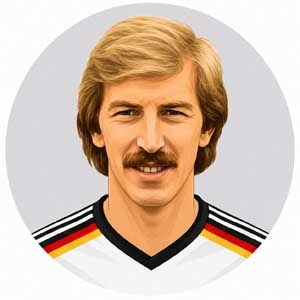
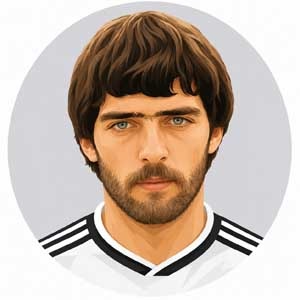
Austria - SweeperPezzey, Bruno
The 1978 and 1982 World Cups introduced the global stage to a sweeping Austrian aristocrat whose defensive timing and long-striding surges out from the back redefined the libero role for an entire generation. Bruno Pezzey was the cerebral, commanding defensive general of Austria’s modern golden era and the tactical spine of Eintracht Frankfurt and Werder Bremen in the Bundesliga. Standing over six-foot-two with exceptional aerial power and immaculate positional anticipation, Pezzey was a master of the clean turnover: stepping into passing lanes without committing fouls, dispossessing forwards with graceful slide-tackles, and immediately driving forty yards through midfield to deliver razor-sharp diagonal balls or arrive late into the penalty box to score towering headers. Across his Bundesliga peak, he captured the 1979–80 UEFA Cup and the 1981 DFB-Pokal with Frankfurt, later claiming two Austrian Bundesliga titles with FC Swarovski Tirol. For Austria, across 84 caps and nine goals, he was the defensive cornerstone of the famous 1978 side that defeated West Germany in Córdoba (Das Wunder von Córdoba), scoring against Italy and Northern Ireland across two World Cup tournaments.
His bold, attacking mindset, however, carried built-in transitional risks. When Pezzey surged deep into the opposition third, extensive defensive space opened behind him, requiring disciplined covering from his central markers to avoid conceding rapid counter-attacks. Furthermore, against hyper-agile, low-gravity wingers who attacked him in isolated one-on-one footraces along the flanks, his large turning circle could be tested if his initial reading of the play was delayed.
Noble, dignified, and possessed of deep sporting integrity, Pezzey governed the pitch through intellectual authority rather than crude violence. He was a natural gentleman who abhorred cynical hacking and gamesmanship, relying entirely on his immaculate timing and aerial supremacy to neutralize world-class forwards. On the pitch, his presence was calming and authoritative: organizing his backline with measured gestures and stepping out of defense with his head held high. Inside the Austrian and Bundesliga locker rooms, he was an immensely respected, thoughtful leader whose tragic passing at the age of 39 in 1994 sparked widespread mourning across European football, cementing an immortal legacy as one of the finest, most elegant, and complete sweepers the game has ever seen.