We use Google Analytics to understand how visitors use this site. Analytics cookies are only activated with your consent. For details, read our Privacy Policy.
Profile lensThe same player, read from a different angle.
Athletic83
Acceleration
87
Pace
85
Agility
86
Strength
76
Balance
76
Jumping
79
Stamina
87
Fitness
85
Technical85
Dribbling
89
Short Passing
87
Long Passing
87
Finishing
84
Shot Accuracy
78
Shot Power
88
Shooting Technique
80
Heading
76
Tackling
52
Crossing
86
Free Kick
78
Penalties
77
First Touch
87
Mental79
Composure
80
Aggression
78
Consistency
82
Creativity
85
Leadership
70
Work Rate
83
Tactical81
Vision
82
Off the Ball
84
Defensive Positioning
52
Teamwork
88
Anticipation
82
Marking
41
Attacking82
Crossing
86
Finishing
84
Heading Accuracy
76
Shot Accuracy
78
Off the Ball
84
Technique85
Dribbling
89
Free Kick
78
Short Passing
87
Long Passing
87
First Touch
87
Shot Technique
80
Movement84
Acceleration
87
Pace
85
Agility
86
Balance
76
Physicality83
Shot Power
88
Jumping
79
Stamina
87
Strength
76
Fitness
85
Defending48
Marking
41
Tackling
52
Def. Positioning
52
Mentality & Game Reading81
Aggression
78
Composure
80
Penalties
77
Vision
82
Leadership
70
Work Rate
83
Teamwork
88
Anticipation
82
Consistency
82
Creativity
85
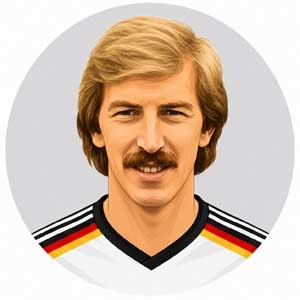
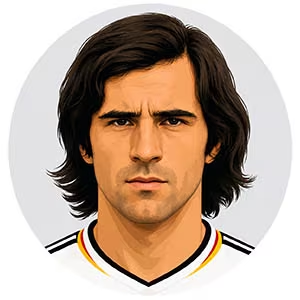
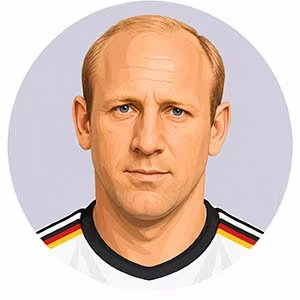
Germany - Right WingerGrabowski, Jürgen
Flank dynamics met central playmaking finesse in Jürgen Grabowski, the versatile offensive technician who spent his entire fifteen-year professional career as the indisputable creative sovereign of Eintracht Frankfurt. Comfortable operating as an orthodox outside-right, an inverted winger, or a deep-lying playmaker (Spielmacher), Grabowski combined elusive close control with an extraordinary spatial compass. He rarely relied on raw, straight-line sprinting to beat defenders; instead, he used sudden hip drops, subtle drag-backs with the sole of his boot, and an exquisite passing repertoire that sliced through compact defensive shapes. Over 555 competitive matches for Frankfurt, he captained the club through their golden domestic and European spell, lifting two DFB-Pokal trophies (1974, 1975) and orchestrating their run to the 1979–80 UEFA Cup triumph—though a brutal career-ending tackle from a young Lothar Matthäus sidelined him just before the final. On the international stage, his impact across 44 caps and five goals for West Germany was massive: after earning a reputation as the ultimate impact substitute during the legendary 1970 World Cup "Game of the Century" against Italy, he was a key protagonist in Helmut Schön’s starting XI for the Euro 1972 triumph and the 1974 World Cup victory on home soil, celebrating his 30th birthday by starting in the Munich final against the Netherlands.
A quiet perfectionist with an acute sense of tactical pride, Grabowski commanded unconditional authority through technical brilliance rather than vocal theatrics. He possessed a profound analytical understanding of match tempo, knowing exactly when to accelerate the transition or slow down possession to break an opponent's rhythm. On the pitch, his body language was upright and proud, demanding the ball in tight, high-pressure areas and visibly holding his teammates to high technical standards. Inside the Frankfurt locker room, he was an untouchable patriarch and mentor to younger talents like Bernd Hölzenbein, maintaining a serene, professional environment while serving as the primary tactical interlocutor for his coaches. When targeted by aggressive, physical full-backs who sought to disrupt his rhythm with cynical challenges, he absorbed the friction with cool detachment, letting his sudden changes of direction and immaculate first touch expose their aggression. Referees and adversaries held him in high esteem as a fair, aristocratic craftsman, leaving an enduring legacy as one of the most refined, versatile, and tactically intelligent attacking minds in the history of the Bundesliga.