We use Google Analytics to understand how visitors use this site. Analytics cookies are only activated with your consent. For details, read our Privacy Policy.
Profile lensThe same player, read from a different angle.
Athletic80
Acceleration
83
Pace
82
Agility
81
Strength
78
Balance
84
Jumping
75
Stamina
77
Fitness
76
Technical84
Dribbling
86
Short Passing
78
Long Passing
80
Finishing
89
Shot Accuracy
85
Shot Power
91
Shooting Technique
78
Heading
78
Tackling
52
Crossing
81
Free Kick
75
Penalties
82
First Touch
83
Mental82
Composure
87
Aggression
85
Consistency
76
Creativity
77
Leadership
82
Work Rate
86
Tactical79
Vision
82
Off the Ball
90
Defensive Positioning
40
Teamwork
75
Anticipation
79
Marking
38
Player Traits
Attacking85
Crossing
81
Finishing
89
Heading Accuracy
78
Shot Accuracy
85
Off the Ball
90
Technique80
Dribbling
86
Free Kick
75
Short Passing
78
Long Passing
80
First Touch
83
Shot Technique
78
Movement83
Acceleration
83
Pace
82
Agility
81
Balance
84
Physicality79
Shot Power
91
Jumping
75
Stamina
77
Strength
78
Fitness
76
Defending43
Marking
38
Tackling
52
Def. Positioning
40
Mentality & Game Reading81
Aggression
85
Composure
87
Penalties
82
Vision
82
Leadership
82
Work Rate
86
Teamwork
75
Anticipation
79
Consistency
76
Creativity
77
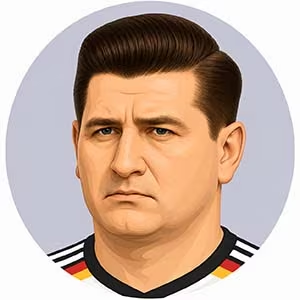
Germany - Right WingerRahn, Helmut
The sodden turf of the Wankdorf Stadium in 1954 provided the stage for Helmut Rahn to etch his name into the political and sporting fabric of post-war Germany. Operating primarily off the right wing with a robust, bull-necked frame, Der Boss broke the mold of the light-footed, crossing specialist. Rahn was a direct, punishing wide forward whose game centered on explosive linear surges, raw physical balance that allowed him to bounce off full-backs at full sprint, and a terrifying left-footed strike from distance. Developing his trade at Rot-Weiss Essen—where he won the 1953 DFB-Pokal and the 1955 German Championship—he was the focal counter-attacking outlet for Sepp Herberger’s West Germany. Across 40 international caps and 21 goals spanning two World Cups (1954 and 1958), his crowning masterclass came during the "Miracle of Bern" against Hungary: scoring the second-half equalizer before cutting inside onto his weaker left foot in the 84th minute to smash the historic 3–2 winner past Gyula Grosics. In the 1958 tournament in Sweden, he proved his longevity by netting six goals, finishing as the tournament's joint second-highest scorer and runner-up in the 1958 Ballon d'Or before concluding his career at 1. FC Köln and Meidericher SV.
Instinctive, boisterous, and fiercely self-confident, Rahn carried the unapologetic swagger of an Essen coal miner who felt entirely at home under high-stakes pressure. He was a natural non-conformist whose occasional off-field skirmishes with alcohol and traffic laws frustrated the German federation, yet Herberger tolerated his erratic habits because Rahn’s competitive nerve was indestructible on matchday. On the pitch, his body language radiated defiance: he thrived in hostile away cauldrons and heavy, rain-soaked pitches, treating rough physical challenges as invitations to increase his intensity. Inside the locker room, he was the vocal heartbeat and primary morale booster, using raw, earthy humor and unshakeable optimism to calm anxious teammates before facing seemingly invincible opponents like the Aranycsapat. When man-markers tried to kick him into submission, Rahn responded with broad-shouldered counter-charges rather than complaints to the referee. Referees and defenders found him abrasive, hard-nosed, but fundamentally straightforward, leaving behind an immortal legacy as the talismanic warrior who delivered Germany’s foundational post-war triumph