We use Google Analytics to understand how visitors use this site. Analytics cookies are only activated with your consent. For details, read our Privacy Policy.
Profile lensThe same player, read from a different angle.
Athletic81
Acceleration
93
Pace
86
Agility
95
Strength
68
Balance
80
Jumping
70
Stamina
82
Fitness
76
Technical88
Dribbling
96
Short Passing
84
Long Passing
85
Finishing
82
Shot Accuracy
86
Shot Power
90
Shooting Technique
89
Heading
68
Tackling
40
Crossing
86
Free Kick
86
Penalties
88
First Touch
93
Mental81
Composure
87
Aggression
76
Consistency
76
Creativity
92
Leadership
80
Work Rate
78
Tactical79
Vision
85
Off the Ball
85
Defensive Positioning
44
Teamwork
75
Anticipation
81
Marking
38
Player Traits
Attacking81
Crossing
86
Finishing
82
Heading Accuracy
68
Shot Accuracy
86
Off the Ball
85
Technique89
Dribbling
96
Free Kick
86
Short Passing
84
Long Passing
85
First Touch
93
Shot Technique
89
Movement89
Acceleration
93
Pace
86
Agility
95
Balance
80
Physicality77
Shot Power
90
Jumping
70
Stamina
82
Strength
68
Fitness
76
Defending41
Marking
38
Tackling
40
Def. Positioning
44
Mentality & Game Reading82
Aggression
76
Composure
87
Penalties
88
Vision
85
Leadership
80
Work Rate
78
Teamwork
75
Anticipation
81
Consistency
76
Creativity
92
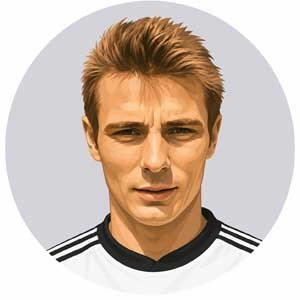
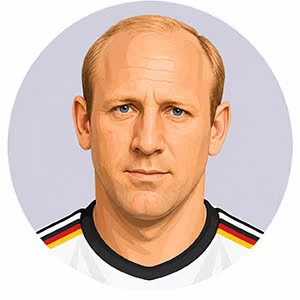
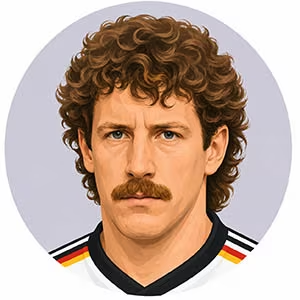
Germany - Right WingerLittbarski, Pierre
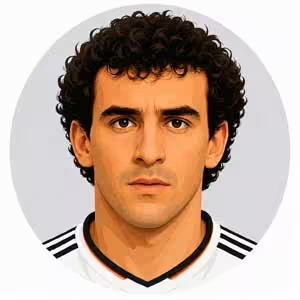
Standing a mere five-foot-six with distinct bow-legs, Pierre Michael Littbarski turned unpredictable hip swerves and sudden changes of acceleration into an elusive art form across the Bundesliga and the international arena. A cornerstone of 1. FC Köln throughout the 1980s across more than 400 appearances, Litti operated as a hybrid wide playmaker, winger, and attacking midfielder who dismantled structured low blocks through pure dribbling dynamism. He possessed an exceptionally low center of gravity, allowing him to stop dead on the wing, execute sharp double-touches with the outside of his boot, and thread disguised cut-backs into the six-yard box. With Köln, he lifted the 1983 DFB-Pokal and reached the 1986 UEFA Cup final, later spending productive years in France with Racing Paris and pioneering the early J-League era with JEF United Ichihara. Across 73 caps and 18 goals for West Germany, he belonged to the ultra-exclusive group of players who reached three consecutive World Cup finals (1982, 1986, and 1990). His international zenith came at Italia '90: serving as Franz Beckenbauer’s primary creative conduit, he started the final against Argentina in Rome, providing the technical ingenuity that unlocked congested midfields on the way to lifting the trophy.
Warm-hearted, quick-witted, and possessing an irrepressible Berlin humor, Littbarski brought a breath of fresh, unpretentious air to a German national setup frequently weighed down by tactical rigidity and internal politics. He played with visible joy, treating the pitch as an improvisational canvas while maintaining the professional work rate required to track back and cover his flank. On the pitch, his emotional baseline remained remarkably positive; rather than wilting under the brutal physical marking common in 1980s football, he used his agility to slip out of tackles, often offering a knowing grin to frustrated full-backs. Inside the dressing room, he was a natural unifier and social glue, diffusing high-tension locker-room feuds between rival club factions through humor and genuine warmth. Under the immense pressure of major tournament knockout rounds, his nerve held firm, executing crucial assists in the 1982 semi-final in Seville and maintaining his creative clarity throughout the 1990 campaign. Toward match officials and physical stoppers, Littbarski was light-hearted, respectful, and entirely devoid of malice, cementing his status as one of the most beloved, creative, and aesthetically captivating dribblers in German football history.


 All Time GermanyNT