We use Google Analytics to understand how visitors use this site. Analytics cookies are only activated with your consent. For details, read our Privacy Policy.
Profile lensThe same player, read from a different angle.
Athletic79
Acceleration
88
Pace
86
Agility
92
Strength
63
Balance
71
Jumping
80
Stamina
74
Fitness
76
Technical84
Dribbling
95
Short Passing
80
Long Passing
84
Finishing
83
Shot Accuracy
83
Shot Power
76
Shooting Technique
82
Heading
75
Tackling
33
Crossing
81
Free Kick
74
Penalties
72
First Touch
88
Mental73
Composure
76
Aggression
82
Consistency
73
Creativity
91
Leadership
72
Work Rate
66
Tactical75
Vision
79
Off the Ball
83
Defensive Positioning
36
Teamwork
72
Anticipation
78
Marking
33
Player Traits
Attacking81
Crossing
81
Finishing
83
Heading Accuracy
75
Shot Accuracy
83
Off the Ball
83
Technique84
Dribbling
95
Free Kick
74
Short Passing
80
Long Passing
84
First Touch
88
Shot Technique
82
Movement84
Acceleration
88
Pace
86
Agility
92
Balance
71
Physicality74
Shot Power
76
Jumping
80
Stamina
74
Strength
63
Fitness
76
Defending34
Marking
33
Tackling
33
Def. Positioning
36
Mentality & Game Reading76
Aggression
82
Composure
76
Penalties
72
Vision
79
Leadership
72
Work Rate
66
Teamwork
72
Anticipation
78
Consistency
73
Creativity
91
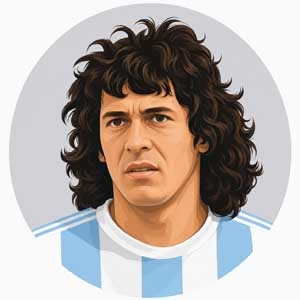
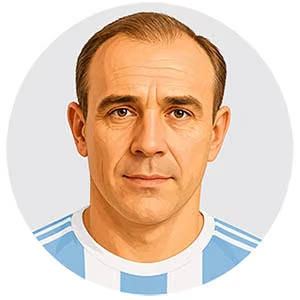
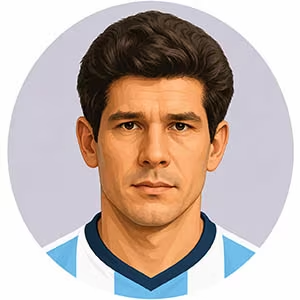
Argentina - Right WingerHouseman, René
Every account of Argentina's 1978 World Cup returns eventually to the same detail: César Luis Menotti, assembling his squad that year, chose a wing player well past his sharpest form over a gifted seventeen-year-old named Diego Maradona, because he trusted what René Houseman had given him five years earlier at Huracán more than he trusted potential. Houseman justified the faith, scoring in the 6–0 demolition of Peru that sent the hosts through to the final. Decades later, Maradona himself, by then the most famous footballer alive, would say simply that he had been a friend of the real Houseman and had loved watching him play.
Born in La Banda, in Santiago del Estero province, in 1953, Houseman moved with his family to Buenos Aires at seven, settling in a shantytown behind the Mitre railway line in Bajo Belgrano, in the shadow of one of the city's wealthiest neighborhoods. He was a right winger of explosive pace and unpredictable dribbling, small at 1.65 metres and built almost entirely around improvisation — the kind of player Argentine football describes as coming from the potrero, the vacant lot, rather than from any academy. He made his professional debut at Defensores de Belgrano before Menotti, then building Huracán into the finest attacking side of its era, made him central to the club's first-ever Primera División title in 1973. He later played for River Plate, winning a further Argentine championship, spent time at Chile's Colo Colo and South Africa's AmaZulu, and closed a domestic chapter with Independiente, contributing to a Copa Libertadores and Intercontinental Cup win in 1984 despite a marginal role by then. He retired in 1985 with a symbolic final appearance for Excursionistas, the boyhood club where it had all started. For Argentina he won 55 caps and 13 goals, playing at both the 1974 and 1978 World Cups and lifting the trophy on home soil in the latter.
His limitations, on the pitch, were the standard cost of a game built on flair rather than structure: he offered little defensively, and his end product could be genuinely inconsistent from one match to the next, a volatility that shaped his career's peaks and valleys more than any single tactical weakness did.
Temperamentally he was, by every account, defined above all by where he came from and his refusal to leave it behind, even once fame and money made distance easy. Houseman never abandoned Bajo Belgrano, according to his own sister, and described himself throughout his life in blunt, unqualified terms: a villero, someone from the slum, and something he intended to remain until he died. He continued working with and mentoring young people from Argentina's poorest neighborhoods for the rest of his active life, a commitment he maintained until his final illness. He was extroverted, unpredictable and instinctively generous by reputation, nicknamed El Loco by teammates and supporters alike — a name applied with evident affection rather than criticism, capturing a man whose football and personality both resisted convention. He died of cancer in 2018, and the tributes that followed, from Maradona to Mario Kempes to his own boyhood club, converged on the same description: joyful, beloved, and unmistakably himself in a sport that had tried more than once to make him into something more conventional.