We use Google Analytics to understand how visitors use this site. Analytics cookies are only activated with your consent. For details, read our Privacy Policy.
Profile lensThe same player, read from a different angle.
Athletic81
Acceleration
78
Pace
86
Agility
73
Strength
85
Balance
79
Jumping
87
Stamina
86
Fitness
75
Technical77
Dribbling
76
Short Passing
74
Long Passing
78
Finishing
66
Shot Accuracy
66
Shot Power
82
Shooting Technique
71
Heading
86
Tackling
86
Crossing
77
Free Kick
69
Penalties
68
First Touch
77
Mental80
Composure
80
Aggression
84
Consistency
80
Creativity
68
Leadership
80
Work Rate
84
Tactical79
Vision
74
Off the Ball
67
Defensive Positioning
83
Teamwork
85
Anticipation
81
Marking
85
Player Traits
Attacking72
Crossing
77
Finishing
66
Heading Accuracy
86
Shot Accuracy
66
Off the Ball
67
Technique74
Dribbling
76
Free Kick
69
Short Passing
74
Long Passing
78
First Touch
77
Shot Technique
71
Movement79
Acceleration
78
Pace
86
Agility
73
Balance
79
Physicality83
Shot Power
82
Jumping
87
Stamina
86
Strength
85
Fitness
75
Defending85
Marking
85
Tackling
86
Def. Positioning
83
Mentality & Game Reading78
Aggression
84
Composure
80
Penalties
68
Vision
74
Leadership
80
Work Rate
84
Teamwork
85
Anticipation
81
Consistency
80
Creativity
68
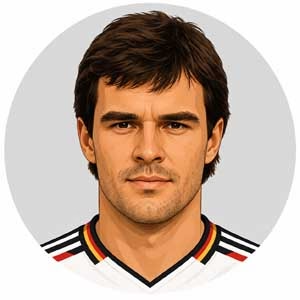
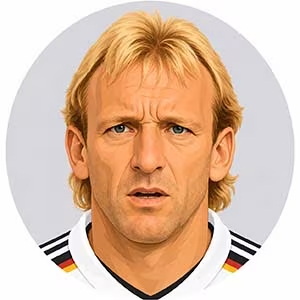
Germany - Right BackBerthold, Thomas
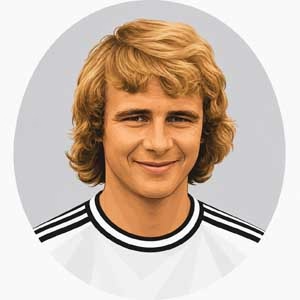
On 8 July 1990, Thomas Berthold walked onto the pitch at Rome’s Stadio Olimpico for the World Cup final against Argentina. Four years earlier he had played the same opponent in the final in Mexico City and left with a runners-up medal; now he was back, this time as part of a German defence that conceded only once in the knockout rounds. Berthold played the entire match as Germany pressed, chased and repeatedly attacked from deep before Andreas Brehme’s late penalty settled the contest. It was an appropriate setting for a player whose best football was built around physical commitment and forward momentum: a defender comfortable with responsibility, confrontation and the repeated effort of covering the length of his flank.
Berthold was primarily a right-back and wing-back, although his athleticism and defensive experience allowed him to operate in other defensive roles. Quick, strong and exceptionally energetic, he defended aggressively in individual contests and then used the same physical qualities to advance beyond midfield. He was not simply an overlapping full-back waiting for possession on the touchline: he could carry the ball forward at speed, make long supporting runs and attack space ahead of him, giving his teams an additional transition outlet. Defensively he was difficult to outrun when positioned correctly and sufficiently robust to engage powerful opponents directly. His technique was sound enough to support an expansive role but was not the source of his distinction; acceleration, stamina, determination and tactical versatility were more important. Eintracht Frankfurt developed him and gave him his Bundesliga debut before he moved to Italy in 1987, joining Verona. After two seasons there he signed for Roma, where he spent two further years and won the Coppa Italia in 1990–91. Bayern Munich brought him back to Germany for the 1991–92 season, after which he joined Stuttgart and remained there until 2000, winning another German cup in 1997. He finished his career with Adanaspor in Turkey. Internationally, Berthold became a major component of West Germany and then unified Germany across an unusually long tournament cycle. He appeared at the 1986, 1990 and 1994 World Cups and at the 1988 European Championship, earning 62 caps. He started both the 1986 and 1990 World Cup finals, giving his career a distinction that went beyond longevity: for several years he was trusted repeatedly in Germany’s highest-pressure defensive matches.
His assertiveness carried genuine costs. Berthold could become overcommitted, both positionally and physically, and his willingness to contest situations aggressively exposed him to disciplinary punishment. The clearest example came in the 1986 World Cup quarter-final against Mexico, when retaliation during an altercation with Fernando Quirarte brought a red card and left West Germany with ten men. His attacking instincts could also leave space behind him, particularly when possession was lost before he had recovered his defensive position. Against opponents capable of exploiting transitions quickly, the qualities that made him valuable going forward could therefore become a structural weakness. Later in his career declining pace reduced his margin for recovery. Most significantly, Berthold was not temperamentally suited to passive acceptance of reduced status. When coaches no longer regarded him as indispensable, disagreement could become open conflict rather than quiet adaptation, ultimately damaging his availability independently of his physical condition.
That last tendency separates Berthold from the stereotype of the compliant senior professional. He could operate inside highly structured teams and execute demanding tactical assignments, but compliance depended partly on whether he respected the sporting logic behind decisions. When he believed his status or treatment was unjustified, he did not reliably suppress the disagreement for institutional harmony. His final years at Stuttgart provide the strongest evidence. Under Joachim Löw, Berthold lost his place and the relationship deteriorated publicly; after Löw’s departure, his situation improved, but conflict returned under Ralf Rangnick. In 1999 he was effectively removed from first-team consideration and spent months training separately, becoming associated with the label “the highest-paid amateur in Germany.” He did not respond by quietly accepting marginalisation. He criticised the situation publicly, defended his own value and remained sufficiently convinced of his ability to continue rather than treating the club’s judgement as definitive. This was not merely indiscriminate volatility. Across more than a decade at international level he functioned under different coaches, survived intense tournament pressure and was repeatedly selected for decisive matches, suggesting that ordinary tactical discipline and competitive stress did not destabilise him. His more dangerous trigger was perceived loss of standing or unfair authority. Physical confrontation could also produce escalation: the retaliation against Mexico in 1986 shows that provocation was capable of crossing from emotional activation into behaviour that harmed his team. Yet major occasions themselves did not appear to create the same degradation. He returned from the humiliation of losing the 1986 final to become a starter in the side that won four years later, and his performances across three World Cups indicate that pressure generally activated rather than inhibited him. His leadership was based more on seniority, directness and personal assertiveness than on conciliating teammates or protecting institutional harmony. Berthold was prepared to challenge decisions rather than absorb them, a useful trait when independence was required but a costly one when adaptation to declining status became necessary. The contradiction is important: he possessed the discipline required to perform within elite collective structures, but not unlimited obedience to the people controlling them. Once he concluded that authority was being exercised unfairly, preserving the relationship could become less important than defending his position.