We use Google Analytics to understand how visitors use this site. Analytics cookies are only activated with your consent. For details, read our Privacy Policy.
Profile lensThe same player, read from a different angle.
Athletic80
Acceleration
82
Pace
76
Agility
73
Strength
85
Balance
79
Jumping
81
Stamina
82
Fitness
82
Technical79
Dribbling
79
Short Passing
78
Long Passing
77
Finishing
63
Shot Accuracy
66
Shot Power
85
Shooting Technique
75
Heading
82
Tackling
82
Crossing
75
Free Kick
74
Penalties
68
First Touch
80
Mental81
Composure
85
Aggression
76
Consistency
77
Creativity
72
Leadership
85
Work Rate
76
Tactical79
Vision
76
Off the Ball
71
Defensive Positioning
81
Teamwork
86
Anticipation
78
Marking
81
Attacking71
Crossing
75
Finishing
63
Heading Accuracy
82
Shot Accuracy
66
Off the Ball
71
Technique77
Dribbling
79
Free Kick
74
Short Passing
78
Long Passing
77
First Touch
80
Shot Technique
75
Movement78
Acceleration
82
Pace
76
Agility
73
Balance
79
Physicality83
Shot Power
85
Jumping
81
Stamina
82
Strength
85
Fitness
82
Defending81
Marking
81
Tackling
82
Def. Positioning
81
Mentality & Game Reading78
Aggression
76
Composure
85
Penalties
68
Vision
76
Leadership
85
Work Rate
76
Teamwork
86
Anticipation
78
Consistency
77
Creativity
72
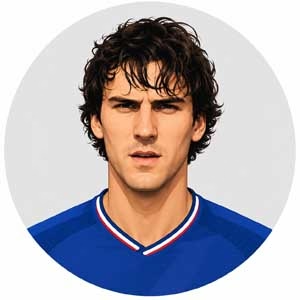
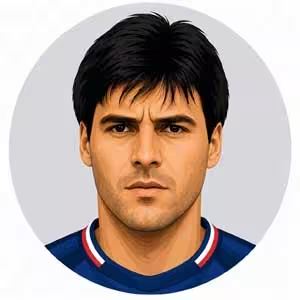
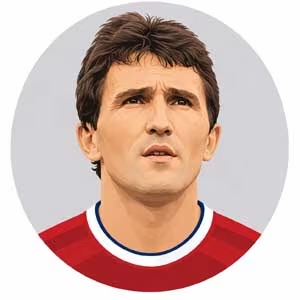
France - Right BackBattiston, Patrick
He is remembered, unfairly, as a body on a stretcher. What is far less remembered is that Patrick Battiston played 486 top-flight matches, won five French championships across two different great teams, appeared at three World Cups, and was for most of the 1980s the most tactically intelligent defender in France. The night in Seville took ninety seconds of a fifteen-year career and swallowed the rest of it whole.
Born in Amnéville, in Lorraine, in 1957 to a family of Italian descent, Battiston came through FC Metz and became a defender of unusual versatility: he played right-back, centre-back and defensive midfield at the highest level, and did all three well enough that no coach ever settled the question definitively. At 1.83m he was strong in the air and quick enough to defend space, but his real quality was cerebral — anticipation, positional discipline, and a calm in possession that let him step out of defence and start attacks in an era when French football was being rebuilt around technical control. He was clean in the tackle to an unusual degree for the period, winning the ball by timing rather than force. After Metz he joined Saint-Étienne in 1980, playing alongside Michel Platini in the last years of Les Verts' great era, then moved to Bordeaux in 1983, where he became a cornerstone of Aimé Jacquet's dominant side, winning three Ligue 1 titles (1984, 1985, 1987) and two Coupes de France, before returning to Monaco and closing his career back at Bordeaux. For France he collected 56 caps and played in the World Cups of 1978, 1982 and 1986, winning the 1984 European Championship on home soil — the tournament that finally gave that generation the trophy it had been denied.
His versatility carried a cost. Battiston was excellent everywhere and irreplaceable nowhere, and the shifting between roles meant he was often the player moved to accommodate someone else's best position rather than occupying his own. He was not a physically dominant stopper against the biggest centre-forwards, offered little going forward beyond his first pass, and after 1982 he carried the accumulated effects of serious injury: the neck damage and lost teeth from Seville, and later a broken leg, left him with recurring physical fragility through the second half of his career.
What defines him psychologically is what happened afterwards, and how little of it there was. Seville, 8 July 1982: Platini's through ball, Battiston clean through, Harald Schumacher leaving his line and arriving hip-first at full speed, and a collision that broke three of Battiston's teeth, damaged vertebrae and left him unconscious on the pitch while the Dutch referee awarded a goal kick. Platini held his hand and believed he was dying. He never played again in that match, France lost the semi-final on penalties, and in the decades that followed Battiston declined, repeatedly and consistently, to build any part of his identity on it. He accepted Schumacher's apology, refused to campaign, and spoke about the incident when asked with a matter-of-factness that visibly frustrated interviewers looking for grievance. That composure was not a response to the event; it was simply who he was. On the pitch he was quiet, unfailingly correct, almost never booked, and entirely without theatre — he did not protest, did not simulate, and organised teammates through short instruction rather than confrontation. He was popular in every dressing room he entered without ever leading one, respected as the professional's professional in a generation of larger personalities. Away from football he was reserved, private, modest to the point of self-effacement, and later worked in youth development at Bordeaux with no appetite for the spotlight the injustice had permanently offered him. Dignified rather than dramatic, Battiston was a very good footballer who refused, for forty years, to become a symbol.