We use Google Analytics to understand how visitors use this site. Analytics cookies are only activated with your consent. For details, read our Privacy Policy.
Profile lensThe same player, read from a different angle.
Athletic82
Acceleration
74
Pace
80
Agility
72
Strength
89
Balance
79
Jumping
87
Stamina
86
Fitness
91
Technical77
Dribbling
75
Short Passing
75
Long Passing
76
Finishing
64
Shot Accuracy
70
Shot Power
82
Shooting Technique
70
Heading
87
Tackling
83
Crossing
75
Free Kick
63
Penalties
64
First Touch
76
Mental82
Composure
81
Aggression
84
Consistency
80
Creativity
68
Leadership
85
Work Rate
87
Tactical78
Vision
73
Off the Ball
74
Defensive Positioning
79
Teamwork
80
Anticipation
82
Marking
82
Player Traits
Attacking74
Crossing
75
Finishing
64
Heading Accuracy
87
Shot Accuracy
70
Off the Ball
74
Technique73
Dribbling
75
Free Kick
63
Short Passing
75
Long Passing
76
First Touch
76
Shot Technique
70
Movement76
Acceleration
74
Pace
80
Agility
72
Balance
79
Physicality87
Shot Power
82
Jumping
87
Stamina
86
Strength
89
Fitness
91
Defending81
Marking
82
Tackling
83
Def. Positioning
79
Mentality & Game Reading78
Aggression
84
Composure
81
Penalties
64
Vision
73
Leadership
85
Work Rate
87
Teamwork
80
Anticipation
82
Consistency
80
Creativity
68
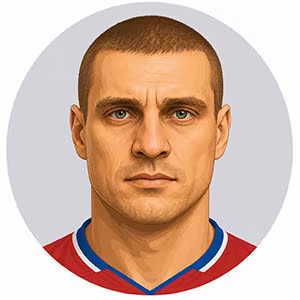
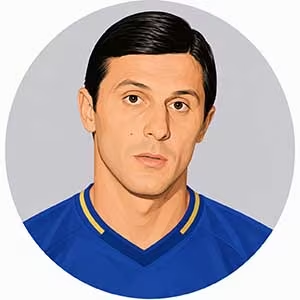
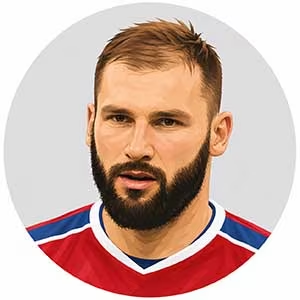
Serbia - Right BackIvanović, Branislav
On 15 May 2013, Chelsea and Benfica were still level in the Europa League final when Juan Mata took a corner in the third minute of stoppage time. Branislav Ivanović drifted away from his marker toward the far post, waited for the ball to reach its highest point and sent a looping header back across goal beyond Artur. There was no time for Benfica to recover. Chelsea had won another European trophy, and Ivanović had decided a final one year after suspension had kept him out of the Champions League victory in Munich. He called the Amsterdam goal the greatest moment of his career. The opportunity had returned; this time he was physically present to take it.
Ivanović was a defender capable of operating both as a right-back and centre-back, combining the strength of the latter with far greater attacking output than his build suggested. At around 1.85 metres, broad and exceptionally powerful, he defended through contact, close marking and assertive challenges rather than avoiding duels. At full-back he was not a smooth dribbler but advanced relentlessly, using direct runs, combinations and aggressive movement toward the far post. His aerial ability became a major attacking weapon. Two headers at Anfield in the 2009 Champions League quarter-final effectively announced his Chelsea career after a difficult first year in England, and he eventually scored 34 times for the club, an extraordinary return for a defender. After developing with Srem and OFK Beograd, Ivanović moved to Lokomotiv Moscow before Chelsea signed him in January 2008. He initially struggled for minutes but ultimately made 377 appearances across nine years, winning two Premier League titles, three FA Cups, the League Cup, Champions League and Europa League. Later he joined Zenit, quickly became captain and won consecutive Russian league titles before finishing his career with West Bromwich Albion. For Serbia he earned 105 caps, captained the national team and played at the 2010 and 2018 World Cups.
His physical assertiveness carried obvious costs. Ivanović wanted to engage opponents rather than simply contain space, and faster wingers could exploit him when they forced him to turn and recover toward his own goal. This vulnerability became particularly visible in 2015–16, when declining acceleration made the aggressive positioning that had once been a strength increasingly dangerous. Chelsea opponents repeatedly isolated him on the outside, and his form became one of the most publicly discussed problems in a collapsing title defence. His forward commitment could also expose the channel behind him, while at centre-back he was more comfortable defending direct confrontation than managing constant movement around him. Emotional intensity occasionally added another risk. Ivanović was usually disciplined, but he was willing to enter mass confrontations and could become highly physical once disputes escalated; his clash with James McCarthy during a Chelsea–Everton melee in 2015 was investigated by the FA, although he was not ultimately charged with violent conduct. His toughness therefore did not mean perfect emotional neutrality.
Psychologically, Ivanović’s strongest pattern is a willingness to subordinate discomfort and individual status to collective obligation. During Chelsea’s 2015 League Cup semi-final against Liverpool he suffered a deep foot wound, continued playing with blood inside his boot and then scored the extra-time winner; Mourinho later suggested preserving the boot as an example for younger players. The episode was extreme but consistent with how Ivanović understood leadership. When Chelsea’s 2015–16 season collapsed and his own performances drew heavy criticism, he did not publicly demand protection or isolate teammates as the cause. Mourinho continued to use him as captain in John Terry’s absence and described him as capable of carrying the role because of the respect he commanded within the dressing room. Ivanović himself responded to Diego Costa’s frustration at being benched by insisting that losing could not be reduced to one or two individuals and that players had to accept periods outside the team. The statement is especially revealing because Ivanović was making it while his own position was under scrutiny: he applied the collective rule while personally vulnerable to it. Criticism therefore appears to have produced work and responsibility more often than defensive self-presentation. Mourinho said openly that mistakes were discussed inside the group and specifically defended Ivanović as someone able to accept that process. Physical hostility was even less likely to inhibit him. His game depended upon repeated collisions, and pain frequently increased rather than reduced his willingness to engage. Yet high tolerance for contact should not be confused with low aggression. Ivanović could join confrontations forcefully when teammates were involved, suggesting that collective conflict activated a protective response that ordinary fouling did not. His leadership was similarly protective and normative rather than inspirational in style. He rarely sought attention, but expected teammates to remain available, accept criticism and place the group above individual frustration. Major occasions generally increased his effectiveness: goals at Anfield, in the Europa League final and repeatedly in decisive domestic matches emerged from a defender willing to enter dangerous spaces when consequences were highest. His competitive stability was therefore built around duty. Individual discomfort could be absorbed; public criticism could be tolerated; but once the team itself entered confrontation, restraint became less automatic.


 All Time ChelseaClub