We use Google Analytics to understand how visitors use this site. Analytics cookies are only activated with your consent. For details, read our Privacy Policy.
Profile lensThe same player, read from a different angle.
Athletic81
Acceleration
83
Pace
83
Agility
80
Strength
78
Balance
77
Jumping
84
Stamina
85
Fitness
76
Technical75
Dribbling
77
Short Passing
75
Long Passing
74
Finishing
62
Shot Accuracy
60
Shot Power
76
Shooting Technique
69
Heading
77
Tackling
80
Crossing
73
Free Kick
63
Penalties
60
First Touch
76
Mental84
Composure
85
Aggression
80
Consistency
85
Creativity
64
Leadership
83
Work Rate
85
Tactical78
Vision
71
Off the Ball
69
Defensive Positioning
82
Teamwork
82
Anticipation
82
Marking
83
Player Traits
Attacking68
Crossing
73
Finishing
62
Heading Accuracy
77
Shot Accuracy
60
Off the Ball
69
Technique72
Dribbling
77
Free Kick
63
Short Passing
75
Long Passing
74
First Touch
76
Shot Technique
69
Movement81
Acceleration
83
Pace
83
Agility
80
Balance
77
Physicality80
Shot Power
76
Jumping
84
Stamina
85
Strength
78
Fitness
76
Defending82
Marking
83
Tackling
80
Def. Positioning
82
Mentality & Game Reading78
Aggression
80
Composure
85
Penalties
60
Vision
71
Leadership
83
Work Rate
85
Teamwork
82
Anticipation
82
Consistency
85
Creativity
64
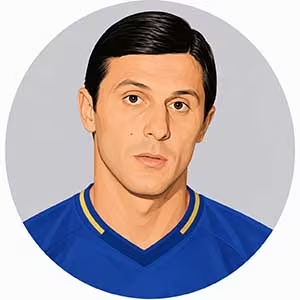
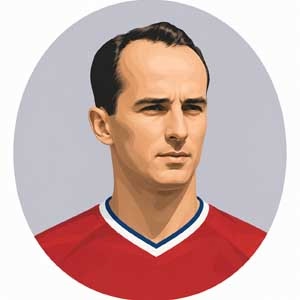
Serbia - Right BackDurković, Vladimir
Impeccable positional discipline, tireless physical endurance, and an unshakeable sense of defensive duty turned a native of Đakovica into the most decorated and dependable right-back of Red Star Belgrade’s post-war era and a dominant force in French football. Vladimir Durković was the quintessential, no-nonsense defensive full-back: an impenetrable wall on the right flank who specialized in neutralizing the continent's most flamboyant wingers through relentless close-contact marking and flawless tackling mechanics.
Stationed on the right flank, Durković was a master of defensive containment: utilizing sharp short-burst acceleration to close down crossing angles, body-checking opponents off the ball with clean physical power, and clearing danger with low-risk, composed distribution into midfield. Across 220 official appearances for Red Star Belgrade between 1955 and 1966, he lifted five Yugoslav First League championships and three Yugoslav Cups, before moving abroad to become the foundational right-back of AS Saint-Étienne's historic French dynasty under Albert Batteux. In France, he made over 150 appearances for Les Verts, winning three consecutive Ligue 1 titles (1967–68, 1968–69, 1969–70) and two Coupes de France. For Yugoslavia, across 50 caps, his international record was glittering: capturing the Gold Medal at the 1960 Rome Olympics, starting the 1960 European Nations' Cup final in Paris, and playing every minute of their run to fourth place at the 1962 World Cup in Chile.
His traditional, defensive-first approach, however, was deliberately stripped of offensive flair. Durković was not a dynamic, overlapping wing-back who ventured deep into the opposition penalty box to deliver high crosses or score from distance; his primary mission was strictly containment and protection of his central defenders. When his team was chasing games against deep, compact low blocks that required attacking width and creative penetration from full-backs, his contribution in the final third was minimal. Tragically, his life and career were cut short in June 1972 at just 34 years of age when he was fatally shot outside a nightclub in Sion by an intoxicated police officer who mistook him for someone else.
Stoic, modest, and governed by an ironclad team-first work ethic, Durković approached professional football with quiet, monastic seriousness. He had zero interest in media fanfare or personal vanity, taking immense professional pride in completely removing opposing stars from the match without committing cynical fouls. On the pitch, his presence was steady, vigilant, and unshakeable: tracking wingers with laser focus across ninety minutes, getting up instantly from bruising collisions, and maintaining defensive shape with total concentration. Inside the Red Star, Saint-Étienne, and Yugoslav dressing rooms, he was an adored, reliable professional whose discipline, humility, and extraordinary consistency made him one of the most respected full-backs of his generation.