We use Google Analytics to understand how visitors use this site. Analytics cookies are only activated with your consent. For details, read our Privacy Policy.
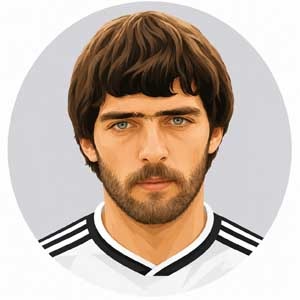
Profile lensThe same player, read from a different angle.
Athletic83
Acceleration
87
Pace
85
Agility
86
Strength
75
Balance
74
Jumping
84
Stamina
85
Fitness
90
Technical82
Dribbling
82
Short Passing
82
Long Passing
79
Finishing
87
Shot Accuracy
87
Shot Power
83
Shooting Technique
85
Heading
76
Tackling
45
Crossing
81
Free Kick
78
Penalties
79
First Touch
83
Mental84
Composure
86
Aggression
78
Consistency
85
Creativity
78
Leadership
82
Work Rate
82
Tactical82
Vision
81
Off the Ball
88
Defensive Positioning
40
Teamwork
82
Anticipation
88
Marking
41
Attacking84
Crossing
81
Finishing
87
Heading Accuracy
76
Shot Accuracy
87
Off the Ball
88
Technique82
Dribbling
82
Free Kick
78
Short Passing
82
Long Passing
79
First Touch
83
Shot Technique
85
Movement83
Acceleration
87
Pace
85
Agility
86
Balance
74
Physicality83
Shot Power
83
Jumping
84
Stamina
85
Strength
75
Fitness
90
Defending42
Marking
41
Tackling
45
Def. Positioning
40
Mentality & Game Reading82
Aggression
78
Composure
86
Penalties
79
Vision
81
Leadership
82
Work Rate
82
Teamwork
82
Anticipation
88
Consistency
85
Creativity
78
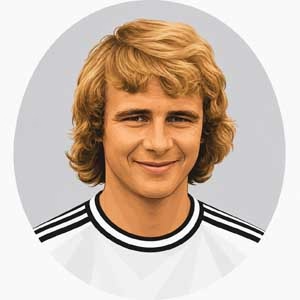
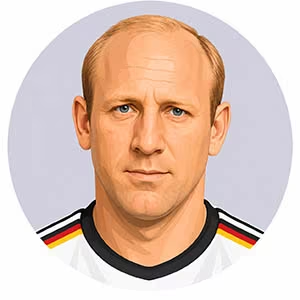
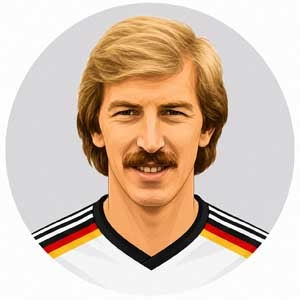
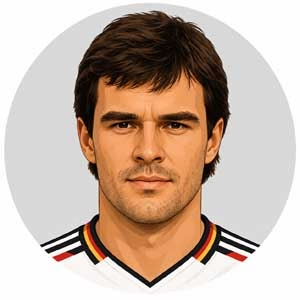
Germany - Left WingerHölzenbein, Bernd
The instinctive, desperate tumble in the Munich penalty box under Wim Jansen’s challenge on July 7, 1974, earned West Germany the equalizing penalty that changed the course of a World Cup final, forever sealing the name of a forward from Dehrn in international football history. Bernd Hölzenbein was a dynamic, razor-sharp inside-forward and outside-left who combined blistering acceleration over the first ten yards with exquisite low-center-of-gravity dribbling, clinical finishing, and an extraordinary knack for decisive penalty-box improvisation.
Operating primarily from the left wing or as a roaming second striker, Hölzenbein was an absolute menace in one-on-one isolations: dropping his shoulder to skip past lunging full-backs, driving into the penalty box at acute angles, and either unleashing venomous, low-backlift strikes or clipping precise cutbacks into the six-yard box. A legendary one-club icon for Eintracht Frankfurt across 420 Bundesliga appearances and 160 goals between 1967 and 1981—holding the club's all-time Bundesliga scoring record—he captained the side through its greatest domestic and continental era, lifting three DFB-Pokals (1973–74, 1974–75, 1980–81) and the historic 1979–80 UEFA Cup over Borussia Mönchengladbach. For West Germany, across 40 caps and five goals, his international legacy was glittering: starting the 1974 World Cup final triumph, scoring in the Euro 1976 final against Czechoslovakia in Belgrade, and featuring prominently at the 1978 World Cup in Argentina.
His specialized, line-breaking style, however, was fundamentally geared toward dynamic transitions and open space. Hölzenbein was not an imposing target-man built to contest static aerial duels against towering center-halves under constant direct clearances; he required the ball played into his stride or in tight pockets where his rapid change of direction could punish off-balance defenders. When confronted by ultra-compact, deep-lying defenses on heavy pitches that denied him sprinting lanes and doubled him along the touchline, his open-play impact could be contained if his midfield failed to switch play rapidly.
Pragmatic, resilient, and possessed of a dry, self-deprecating humor, Hölzenbein carried the persistent stigma of the 1974 penalty controversy with quiet, unshakeable composure, always insisting on the legitimacy of the contact while letting his immense club achievements speak for themselves. He was devoid of prima-donna tendencies, approaching training and matches with total dedication and sacrificing personal goal tallies to create space for partners like Jürgen Grabowski and Bernd Nickel. On the pitch, his presence was all kinetic alertness and tactical cunning: hovering on the shoulder of the last defender, snapping into sudden diagonal runs, and celebrating clutch goals with understated, earnest joy. Inside the Frankfurt and German national team dressing rooms, he was an indispensable, beloved unifying figure whose technical sharpness, big-game temperament, and profound loyalty cemented an eternal legacy as one of the finest wingers in German football history.