We use Google Analytics to understand how visitors use this site. Analytics cookies are only activated with your consent. For details, read our Privacy Policy.
Profile lensThe same player, read from a different angle.
Athletic85
Acceleration
84
Pace
84
Agility
78
Strength
87
Balance
85
Jumping
88
Stamina
86
Fitness
89
Technical78
Dribbling
78
Short Passing
75
Long Passing
73
Finishing
54
Shot Accuracy
66
Shot Power
85
Shooting Technique
69
Heading
87
Tackling
92
Crossing
65
Free Kick
65
Penalties
68
First Touch
78
Mental85
Composure
85
Aggression
86
Consistency
86
Creativity
73
Leadership
86
Work Rate
86
Tactical83
Vision
77
Off the Ball
65
Defensive Positioning
90
Teamwork
85
Anticipation
90
Marking
88
Player Traits
Attacking67
Crossing
65
Finishing
54
Heading Accuracy
87
Shot Accuracy
66
Off the Ball
65
Technique73
Dribbling
78
Free Kick
65
Short Passing
75
Long Passing
73
First Touch
78
Shot Technique
69
Movement83
Acceleration
84
Pace
84
Agility
78
Balance
85
Physicality87
Shot Power
85
Jumping
88
Stamina
86
Strength
87
Fitness
89
Defending90
Marking
88
Tackling
92
Def. Positioning
90
Mentality & Game Reading82
Aggression
86
Composure
85
Penalties
68
Vision
77
Leadership
86
Work Rate
86
Teamwork
85
Anticipation
90
Consistency
86
Creativity
73
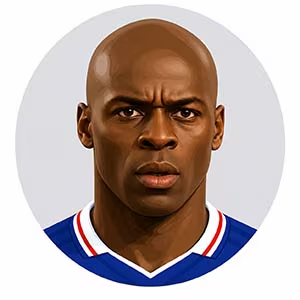
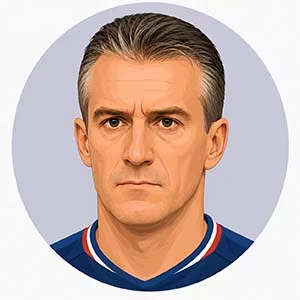
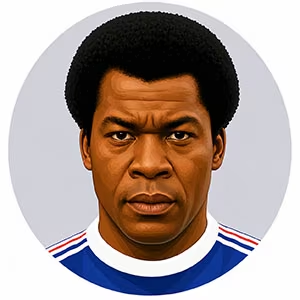
France - SweeperTrésor, Marius
Guadeloupean athletic power merged with an innate sense of timing in the defensive craft of Marius Trésor, the sweeper who provided the backline foundation for the resurgence of French football throughout the 1970s and early 1980s. Converted from a center-forward during his formative years at Ajaccio, Trésor became the defensive centerpiece of Olympique de Marseille and later Girondins de Bordeaux under Aimé Jacquet. His game rested on exceptional vertical elevation, clean slide-tackling technique, and rapid recovery pace over short distances, allowing his teams to step out without fearing direct balls behind them. In possession, his early forward education showed: he stepped into midfield with upright, confident strides, picking out line-breaking passes or driving into open space to unbalance defensive blocks. His international pinnacle was achieved across 65 caps for France, captaining Les Bleus as their first Black skipper and anchoring the back four during the 1978 and 1982 World Cups. In the traumatic 1982 semi-final against West Germany in Seville, he authored one of French football's iconic images, unleashing an extraordinary airborne right-foot volley into the roof of the net in extra time, cementing a legacy that earned him a spot in Pelé's FIFA 100 list.
Psychologically, Trésor was an island of tranquility and warmth whose relaxed, smiling demeanor hid a fiercely competitive inner motor. He carried the historical weight of breaking racial barriers in French national sport with effortless dignity, never allowing external prejudice or media pressure to rattle his concentration. On the pitch, his leadership was calm, reassuring, and completely devoid of frantic panic; he organized his central defensive partners with gentle, clear instructions, using his physical presence to absorb opposing pressure rather than berating his colleagues. Inside the dressing room, he was a universally beloved figure—a musical, joyful presence who diffused tension before high-stakes fixtures with his deep, resonant singing voice and infectious good humor. When matches descended into bruising physical duels, his composure remained spotless; he avoided retaliatory fouls, never feigned injury, and met cynical physical forwards with immaculate, hard-but-fair defensive execution. Toward match officials, Trésor carried himself with aristocratic courtesy, leaving an enduring reputation as one of the most graceful, honorable, and physically dominant sweepers in European football history.


 All Time FranceNT