We use Google Analytics to understand how visitors use this site. Analytics cookies are only activated with your consent. For details, read our Privacy Policy.
Profile lensThe same player, read from a different angle.
Athletic81
Acceleration
92
Pace
86
Agility
85
Strength
72
Balance
74
Jumping
77
Stamina
78
Fitness
80
Technical80
Dribbling
82
Short Passing
75
Long Passing
74
Finishing
83
Shot Accuracy
82
Shot Power
87
Shooting Technique
80
Heading
66
Tackling
42
Crossing
76
Free Kick
77
Penalties
73
First Touch
83
Mental74
Composure
78
Aggression
77
Consistency
74
Creativity
81
Leadership
71
Work Rate
70
Tactical76
Vision
76
Off the Ball
83
Defensive Positioning
38
Teamwork
72
Anticipation
84
Marking
35
Player Traits
Attacking78
Crossing
76
Finishing
83
Heading Accuracy
66
Shot Accuracy
82
Off the Ball
83
Technique79
Dribbling
82
Free Kick
77
Short Passing
75
Long Passing
74
First Touch
83
Shot Technique
80
Movement84
Acceleration
92
Pace
86
Agility
85
Balance
74
Physicality79
Shot Power
87
Jumping
77
Stamina
78
Strength
72
Fitness
80
Defending38
Marking
35
Tackling
42
Def. Positioning
38
Mentality & Game Reading76
Aggression
77
Composure
78
Penalties
73
Vision
76
Leadership
71
Work Rate
70
Teamwork
72
Anticipation
84
Consistency
74
Creativity
81
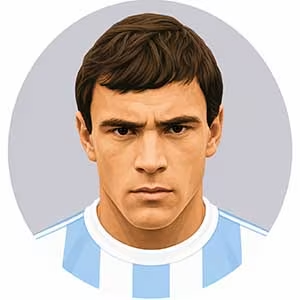
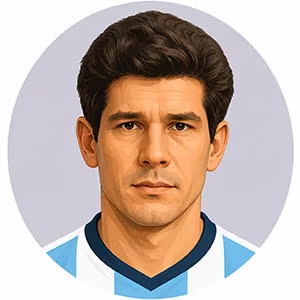
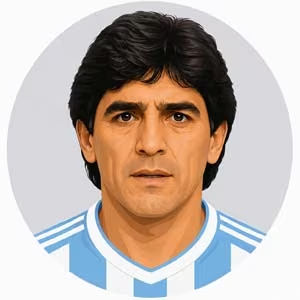
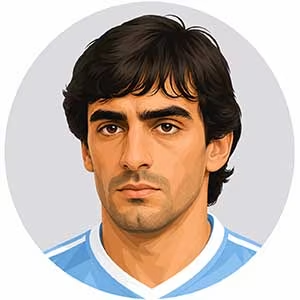
Argentina - Left WingerMás, Oscar
Oscar Más seemed most dangerous at the instant the pitch opened in front of him. Starting from the left, he could receive outside the defensive block and accelerate immediately towards goal, carrying with a forward bias that gave defenders little time to reorganise their body position. The nickname “Pinino” accompanied a player whose small frame did not prevent him from attacking space with unusual force. At River Plate during the 1960s, those movements gradually produced something more than conventional wing play. Más did not simply reach the outside and cross: he moved diagonally into scoring positions, attacked the penalty area and finished often enough to become one of the most prolific players in the club’s history. The winger and the goalscorer were not separate versions. His scoring emerged because the same instinct that drove him beyond a full-back also kept directing him towards the goal once the first defensive line had been beaten.
Más was a left-sided forward with exceptional pace, direct dribbling and a powerful left foot. He could attack outside his marker but was particularly dangerous when turning that speed diagonally towards the penalty area, where his shooting transformed progression into immediate goal threat. His game required relatively few preparatory touches: control, acceleration and conclusion could belong to the same continuous action. Despite his size, he also possessed enough spring and timing to contribute in the air. River increasingly used him as a forward rather than restricting him to traditional touchline duties, and his scoring numbers expanded accordingly. He finished as Argentina’s league top scorer twice and ultimately accumulated more than 200 goals for River across his two spells, placing him among the club’s leading scorers. With Argentina he played at the 1966 World Cup, starting in the attack during a tournament in which the national side reached the quarter-finals. His brief move to Real Madrid in 1973 demonstrated the limits of exporting that influence late in his peak, and he returned to River after one season.
The limitations were closely connected to his directness. Más was not an attacking organiser who wanted prolonged possession in order to manipulate several phases of the move. His passing and combination play could support attacks, but his comparative advantage emerged when the action could advance. Opponents who denied him space to accelerate and forced repeated static receptions reduced the mechanism through which he created separation. His strong preference for the left foot could further narrow options when defenders successfully controlled his orientation. Nor was he naturally suited to heavy defensive responsibility or sustained midfield construction. As athletic sharpness declined, these dependencies became more important because anticipation and finishing could preserve some value but could not fully replace the speed that had originally destabilised defenders. His short Real Madrid period should not automatically be interpreted psychologically: different tactical circumstances, age, competition and adaptation all provide more defensible explanations than an assumed inability to tolerate European pressure.
Psychologically, Más is best defined cautiously by **directness preservation under rising responsibility**. River’s prolonged title drought during much of his first spell created a useful distinction between individual production and collective reinforcement. Más continued accumulating goals while the club repeatedly finished close to major success without converting those campaigns into championships. The observable response was not a retreat towards safer or less exposed attacking behaviour: as his importance increased, he continued accepting the actions most likely to end possession—dribbles, shots and direct attacks on goal. That does not prove immunity to frustration, and surviving evidence is insufficient to score his response to criticism, teammate errors or hostile crowds with confidence. The 1966 World Cup similarly provides evidence of major-event participation but too little behavioural material to construct a special pressure profile. His later return to River is more informative: after the unsuccessful Real Madrid experience, he re-entered the club without requiring preservation of the international status associated with the move abroad and resumed scoring heavily. Evidence for persistent referee confrontation, retaliatory aggression, coach conflict or teammate-directed blame remains insufficient and should stay unknown. The defensible pattern is therefore deliberately narrow: **greater scoring responsibility did not make Más protect possession or reduce attacking exposure; his response remained to move towards the action that could decide the attack, even though those actions carried the highest probability of losing the ball as well as scoring**.