We use Google Analytics to understand how visitors use this site. Analytics cookies are only activated with your consent. For details, read our Privacy Policy.
Profile lensThe same player, read from a different angle.
Athletic80
Acceleration
91
Pace
86
Agility
89
Strength
70
Balance
79
Jumping
77
Stamina
78
Fitness
73
Technical81
Dribbling
86
Short Passing
75
Long Passing
77
Finishing
82
Shot Accuracy
82
Shot Power
83
Shooting Technique
80
Heading
72
Tackling
40
Crossing
79
Free Kick
75
Penalties
73
First Touch
84
Mental78
Composure
82
Aggression
76
Consistency
74
Creativity
80
Leadership
75
Work Rate
83
Tactical76
Vision
80
Off the Ball
84
Defensive Positioning
41
Teamwork
75
Anticipation
76
Marking
38
Player Traits
Attacking80
Crossing
79
Finishing
82
Heading Accuracy
72
Shot Accuracy
82
Off the Ball
84
Technique80
Dribbling
86
Free Kick
75
Short Passing
75
Long Passing
77
First Touch
84
Shot Technique
80
Movement86
Acceleration
91
Pace
86
Agility
89
Balance
79
Physicality76
Shot Power
83
Jumping
77
Stamina
78
Strength
70
Fitness
73
Defending40
Marking
38
Tackling
40
Def. Positioning
41
Mentality & Game Reading77
Aggression
76
Composure
82
Penalties
73
Vision
80
Leadership
75
Work Rate
83
Teamwork
75
Anticipation
76
Consistency
74
Creativity
80
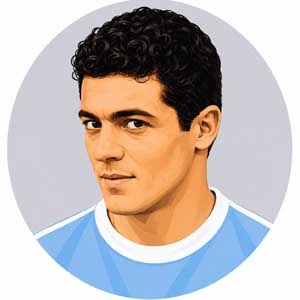
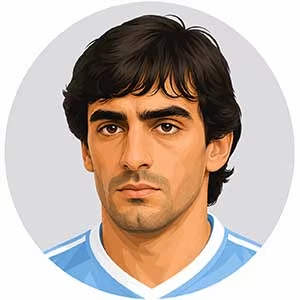
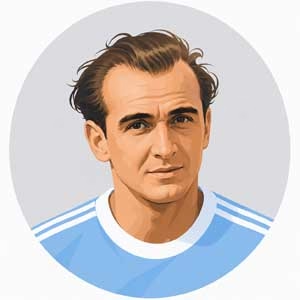
Uruguay - Left WingerBorges, Carlos
When the inaugural Copa Libertadores kicked off on April 19, 1960, at the Estadio Centenario, it took just thirteen minutes for an explosive outside-left from Montevideo to etch his name into eternity by slotting the first goal in the tournament’s history, sparking a 7–1 rout of Jorge Wilstermann. Carlos Ariel Borges—immortalized in South American folklore as Lucho—was the quintessential high-tempo touchline sprinter of the 1950s: a dynamic winger whose blistering straight-line acceleration, direct dribbling momentum, and clinical finishing instincts made him a foundational pillar of CA Peñarol's continental rise and a vital protagonist of Uruguay’s 1954 World Cup campaign.
Operating along the left flank as an orthodox outside-left, Borges was a nightmare in transitional space. He possessed an electric initial burst over twenty yards, using sharp shoulder drops and low-center-of-gravity changes of pace to burn past full-backs before whipping accurate, driven deliveries into the six-yard box or cutting inside to finish across the goalkeeper. Coming through the youth ranks of Peñarol in 1950, he established himself as an untouchable starter throughout the decade, lifting seven Uruguayan Primera División championships (including four in a row from 1958 to 1961), alongside starting in the historic 1960 Copa Libertadores final triumph over Olimpia. He later featured for Racing Club in Argentina and Huracán Buceo back home. For Uruguay, across 35 official caps and 10 goals between 1954 and 1959, his international pinnacle arrived at the 1954 World Cup in Switzerland, where he scored a sensational hat-trick against Scotland in the group stage, struck the opener in the 4–2 quarter-final victory over England, and started the legendary, heartbreaking 4–2 semi-final epic against Hungary’s Magical Magyars, before capturing the 1956 South American Championship (Copa América) on home soil.
That explosive, vertical style, however, lived within distinct structural and stylistic boundaries. Borges was a pure touchline specialist who thrived on green grass and direct vertical passes behind the defensive line; when opponents deployed compact, deep-sitting low blocks that crowded the wide channels and denied him space to build full sprint speed, his ability to break down defenses via intricate short-passing combinations in central pockets was limited. He relied almost exclusively on his favored left foot for final-third crossing, making him susceptible to defenders who anticipated his linear bursts to the byline. Furthermore, against rugged, cynical stoppers who used aggressive physical contact to knock him off balance early in matches, his effectiveness could be disrupted if he lost his initial sprinting rhythm.
Emotionally, Borges was an unpretentious, intensely driven professional who carried the weight of the Manyas and Celeste jerseys with quiet, fierce pride. Devoid of personal vanity or theatrical antics, he viewed his role through the lens of collective duty, working tirelessly to stretch opposing backlines and create space for inside-forwards like Juan Alberto Schiaffino and Javier Ambrois. On the pitch, his body language was all coiled, kinetic readiness: hugging the touchline with watchful eyes, exploding into space with sharp, decisive strides, and dispatching chances with cold, opportunistic efficiency. Inside the Peñarol and Uruguayan national team dressing rooms, his dependability, quiet humility, and historic pioneering goals cemented an eternal legacy as one of the most decisive wide forwards in the nation's golden era.