We use Google Analytics to understand how visitors use this site. Analytics cookies are only activated with your consent. For details, read our Privacy Policy.
Profile lensThe same player, read from a different angle.
Athletic85
Acceleration
85
Pace
87
Agility
83
Strength
86
Balance
85
Jumping
88
Stamina
82
Fitness
82
Technical85
Dribbling
87
Short Passing
77
Long Passing
77
Finishing
89
Shot Accuracy
93
Shot Power
85
Shooting Technique
87
Heading
83
Tackling
33
Crossing
76
Free Kick
78
Penalties
85
First Touch
87
Mental82
Composure
86
Aggression
78
Consistency
82
Creativity
83
Leadership
81
Work Rate
76
Tactical84
Vision
80
Off the Ball
89
Defensive Positioning
45
Teamwork
85
Anticipation
89
Marking
33
Player Traits
Attacking86
Crossing
76
Finishing
89
Heading Accuracy
83
Shot Accuracy
93
Off the Ball
89
Technique82
Dribbling
87
Free Kick
78
Short Passing
77
Long Passing
77
First Touch
87
Shot Technique
87
Movement85
Acceleration
85
Pace
87
Agility
83
Balance
85
Physicality85
Shot Power
85
Jumping
88
Stamina
82
Strength
86
Fitness
82
Defending37
Marking
33
Tackling
33
Def. Positioning
45
Mentality & Game Reading83
Aggression
78
Composure
86
Penalties
85
Vision
80
Leadership
81
Work Rate
76
Teamwork
85
Anticipation
89
Consistency
82
Creativity
83
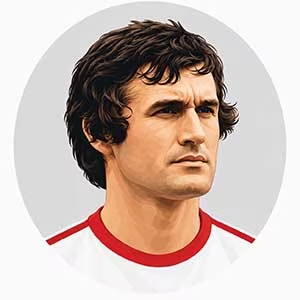
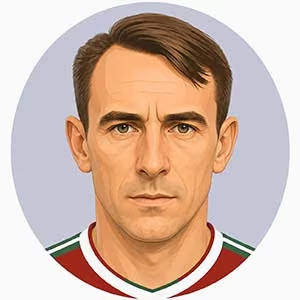
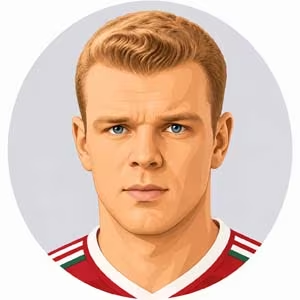
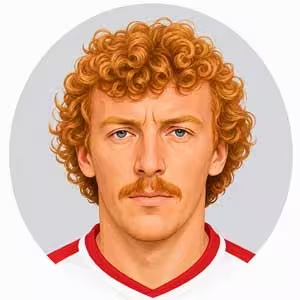
Poland - ForwardLubański, Włodzimierz
Widely regarded by his contemporaries as the most complete and technically gifted pure striker in Eastern European football before a tragic injury altered the course of his prime, Włodzimierz Leonard Lubański was a prodigy of staggering precocity and athletic elegance. Making his senior international debut for Poland at just 16 years and 188 days—scoring immediately to set a record that still stands—Lubański became the undisputed focal point and five-time consecutive league top scorer for Górnik Zabrze during their golden era, steering them to seven Polish league titles and the 1970 European Cup Winners' Cup final. Possessing a balanced, muscular frame, sharp explosive acceleration, and exceptional two-footed shooting technique, he combined the spatial awareness of a classic playmaker with the ruthless finishing instincts of an elite number nine. His crowning tactical mastery was his fluid movement between the lines: dropping deep to combine in tight half-spaces before making sharp, diagonal runs into the penalty area to finish with precision or powerful headers. After spearheading Poland to Olympic Gold at Munich in 1972, tragedy struck in June 1973: during a vital World Cup qualifier against England in Chorzów, moments after scoring Poland's second goal, a devastating cruciate ligament tear sidelined him for nearly two years, forcing him to miss Poland's historic 1974 World Cup run. Remarkably, he rebuilt his career through sheer determination, earning 75 caps, scoring 48 international goals, and later scoring prolifically in Belgium with K.S.C. Lokeren alongside Grzegorz Lato. Mentally and emotionally, Lubański was a figure of quiet nobility, deep tactical intelligence, and immense psychological fortitude. Unlike many star strikers who thrived on theatrical self-indulgence, he carried himself with an understated dignity and a selfless team-first ethic that made him the natural, undisputed captain of Kazimierz Górski’s emerging Polish powerhouse in the early 1970s. The true measure of his character was forged in the agonizing aftermath of his 1973 knee trauma; having to watch his teammates conquer global acclaim in 1974 from the sidelines could have broken lesser athletes, yet Lubański processed the heartbreak with remarkable grace, zero bitterness, and an unwavering commitment to grueling physical rehabilitation. In the locker room, he was universally revered—articulate, cultured, and soft-spoken, serving as a trusted mentor to younger talents like Kazimierz Deyna and Grzegorz Lato. Under match pressure, his focus was cool, analytical, and uncluttered; he never panicked when tightly marked, using his footballing brain to manipulate defenders out of position. Toward match officials and bruising opposing stoppers who routinely targeted his technical wizardry with heavy physical challenges, Lubański maintained an immaculate standard of gentlemanly conduct: playing a clean, honorable game devoid of simulation or dissent, leaving an enduring legacy as one of the purest, most respected striking talents in European football history.