We use Google Analytics to understand how visitors use this site. Analytics cookies are only activated with your consent. For details, read our Privacy Policy.
Profile lensThe same player, read from a different angle.
Athletic78
Acceleration
77
Pace
75
Agility
76
Strength
74
Balance
88
Jumping
72
Stamina
78
Fitness
83
Technical88
Dribbling
88
Short Passing
97
Long Passing
88
Finishing
76
Shot Accuracy
74
Shot Power
77
Shooting Technique
89
Heading
66
Tackling
38
Crossing
87
Free Kick
82
Penalties
82
First Touch
92
Mental85
Composure
90
Aggression
70
Consistency
76
Creativity
90
Leadership
87
Work Rate
87
Tactical86
Vision
92
Off the Ball
83
Defensive Positioning
42
Teamwork
92
Anticipation
77
Marking
41
Player Traits
Attacking77
Crossing
87
Finishing
76
Heading Accuracy
66
Shot Accuracy
74
Off the Ball
83
Technique89
Dribbling
88
Free Kick
82
Short Passing
97
Long Passing
88
First Touch
92
Shot Technique
89
Movement79
Acceleration
77
Pace
75
Agility
76
Balance
88
Physicality77
Shot Power
77
Jumping
72
Stamina
78
Strength
74
Fitness
83
Defending40
Marking
41
Tackling
38
Def. Positioning
42
Mentality & Game Reading84
Aggression
70
Composure
90
Penalties
82
Vision
92
Leadership
87
Work Rate
87
Teamwork
92
Anticipation
77
Consistency
76
Creativity
90
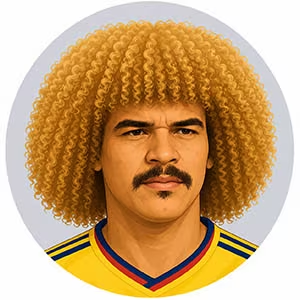
Colombia - Attacking MidfielderValderrama, Carlos
A glorious explosion of golden afro curls and a pair of neon pink boots strolled around the center circle as if the frenetic, chaotic pace of 1990s international football simply did not exist. Carlos Alberto Valderrama Palacio—universally idolized as El Pibe—was the undisputed spiritual guide, tempo-dictator, and cultural symbol of Colombia’s golden generation. Stationed strictly in the central corridor with minimal physical running, Valderrama transformed one-touch and two-touch passing into an absolute art form: holding off markers using subtle hip shields, executing blind, no-look through-balls with the outside of his boot, and slicing open entire defensive structures through microscopic gaps that nobody else in the stadium could see. Over a career highlighted by triumphs with Deportivo Cali, Montpellier (winning the 1990 Coupe de France), Real Valladolid, Junior de Barranquilla (two Colombian championships), and becoming the iconic face of early Major League Soccer with Tampa Bay Mutiny, he was named South American Footballer of the Year twice (1987, 1993). Across 111 caps and 11 goals for Colombia, he captained Los Cafeteros through three consecutive World Cups (1990, 1994, 1998), orchestrating the historic 5–0 humiliation of Argentina in Buenos Aires in 1993.
However, Valderrama’s hyper-static, artistic profile presented extreme structural headaches for modern tactical balance. He offered absolute zero in terms of defensive pressing, aerial duels, or recovery sprinting; his physical output was confined to a small radius in the middle third, forcing his managers to deploy two or three relentless ball-winning enforcers (like Leonel Álvarez) solely to protect his back and do his running. When subjected to suffocating, physical man-markers who denied him even one second to turn and survey passing angles, Colombia's entire attacking fluid machine could grind to a sudden, frustrating halt.
Flamboyant in appearance but zen-like and totally immune to panic on the ball, Valderrama played football with the relaxed detachment of a park veteran playing chess on a Sunday afternoon. Hostile away atmospheres, whistling crowds, and aggressive double-teams failed to rush his decision-making by a single millisecond; the more chaotic the match became, the slower and more deliberate his touches were. On the pitch, his body language was clean, languid, and expressive, directing his teammates' forward runs with sharp pointing fingers and vocal prompts. Inside the Colombian dressing room, he was the indisputable, revered chieftain—the ultimate unifying voice who protected his teammates from outside media madness and political turmoil with immense calm. Referees respected his non-violent, purely technical approach, leaving an immortal legacy as the purest, most unhurried, and visually iconic classical number ten in the history of the game.