We use Google Analytics to understand how visitors use this site. Analytics cookies are only activated with your consent. For details, read our Privacy Policy.
Profile lensThe same player, read from a different angle.
Athletic86
Acceleration
81
Pace
86
Agility
80
Strength
90
Balance
83
Jumping
83
Stamina
91
Fitness
93
Technical87
Dribbling
88
Short Passing
87
Long Passing
85
Finishing
88
Shot Accuracy
79
Shot Power
87
Shooting Technique
85
Heading
91
Tackling
68
Crossing
85
Free Kick
88
Penalties
88
First Touch
88
Mental89
Composure
87
Aggression
89
Consistency
91
Creativity
87
Leadership
88
Work Rate
93
Tactical87
Vision
87
Off the Ball
83
Defensive Positioning
62
Teamwork
92
Anticipation
85
Marking
57
Player Traits
Attacking85
Crossing
85
Finishing
88
Heading Accuracy
91
Shot Accuracy
79
Off the Ball
83
Technique87
Dribbling
88
Free Kick
88
Short Passing
87
Long Passing
85
First Touch
88
Shot Technique
85
Movement83
Acceleration
81
Pace
86
Agility
80
Balance
83
Physicality89
Shot Power
87
Jumping
83
Stamina
91
Strength
90
Fitness
93
Defending62
Marking
57
Tackling
68
Def. Positioning
62
Mentality & Game Reading89
Aggression
89
Composure
87
Penalties
88
Vision
87
Leadership
88
Work Rate
93
Teamwork
92
Anticipation
85
Consistency
91
Creativity
87
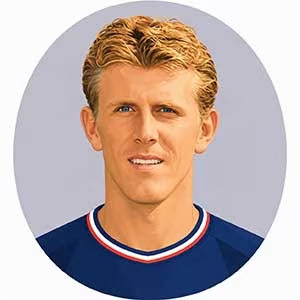
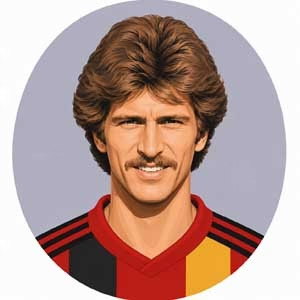
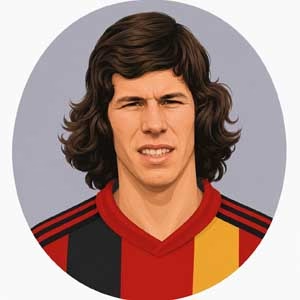
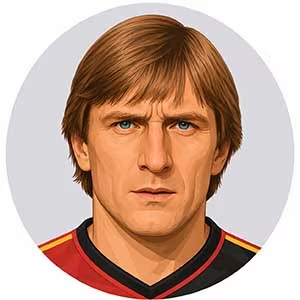
Belgium - Attacking MidfielderCeulemans, Jan
An imposing six-foot-three frame, a stride like an unyielding freight train, and relentless cardiovascular endurance made Jan Anna Gumaar Ceulemans the undisputed talisman of Belgian football’s golden 1980s. Emerging from Lierse before dedicating thirteen seasons to Club Brugge, Caje was a tactical hybrid: capable of operating as an attacking midfielder, an auxiliary central striker, or a dynamic box-to-box engine. He was not a silky, lightweight playmaker who dazzled with delicate stepovers; his technical strength lay in upper-body shielding, aggressive late runs into the eighteen-yard box, and a direct, vertical driving ability that dismantled defensive structures through sheer momentum. Across more than 500 appearances for Club Brugge, he secured three Belgian First Division titles, two Belgian Cups, and captained the side to the 1978 European Cup final against Liverpool. For Belgium, he amassed 96 caps and 23 goals, serving as Guy Thys’s irreplaceable on-pitch leader through the final of Euro 1980 and the historic semi-final run at the 1986 World Cup in Mexico. Nevertheless, his game had evident structural limits: his turning circle in congested central areas was relatively wide, his technical repertoire lacked finesse when forced onto his weaker left foot, and his stubborn refusal to move abroad to AC Milan left his ultimate ceiling unvalidated against the weekly defensive rigor of Serie A.
Unassuming, intensely loyal, and deeply anchored to his Flemish roots, Ceulemans had zero appetite for the glamorous trappings of international stardom, famously turning down lucrative Italian contracts simply because he preferred the quiet life around Bruges. On the pitch, his competitive motor was ferocious and contagious; he was the type of captain who dragged an entire tactical unit forward through pure physical sacrifice, throwing his tall frame into brutal 50-50 duels without a second thought. Yet this blue-collar ethos occasionally manifested in periods of tactical stubbornness, where he would attempt to bulldoze through three markers instead of releasing the ball to open teammates in wide channels. Inside the national team dressing room, he was the essential bridge between the Dutch-speaking Flemish and French-speaking Walloon factions, commanding total respect across cultural divides through his spotless work ethic and utter lack of ego. When markers kicked him relentlessly—a common strategy deployed to disrupt his powerful forward runs—Ceulemans never feigned injury or complained to officials; he simply hoisted up his socks, leaned his broad shoulders into the next challenge, and continued his charge, leaving an immortal legacy as the most durable and physically dominant midfield powerhouse in Belgian history.


 All Time BelgiumNT