We use Google Analytics to understand how visitors use this site. Analytics cookies are only activated with your consent. For details, read our Privacy Policy.
Profile lensThe same player, read from a different angle.
Athletic82
Acceleration
79
Pace
85
Agility
76
Strength
84
Balance
81
Jumping
82
Stamina
85
Fitness
84
Technical81
Dribbling
81
Short Passing
80
Long Passing
81
Finishing
75
Shot Accuracy
71
Shot Power
83
Shooting Technique
74
Heading
82
Tackling
87
Crossing
77
Free Kick
70
Penalties
69
First Touch
81
Mental83
Composure
83
Aggression
86
Consistency
85
Creativity
74
Leadership
85
Work Rate
81
Tactical83
Vision
80
Off the Ball
77
Defensive Positioning
86
Teamwork
85
Anticipation
87
Marking
84
Player Traits
Attacking76
Crossing
77
Finishing
75
Heading Accuracy
82
Shot Accuracy
71
Off the Ball
77
Technique78
Dribbling
81
Free Kick
70
Short Passing
80
Long Passing
81
First Touch
81
Shot Technique
74
Movement80
Acceleration
79
Pace
85
Agility
76
Balance
81
Physicality84
Shot Power
83
Jumping
82
Stamina
85
Strength
84
Fitness
84
Defending86
Marking
84
Tackling
87
Def. Positioning
86
Mentality & Game Reading82
Aggression
86
Composure
83
Penalties
69
Vision
80
Leadership
85
Work Rate
81
Teamwork
85
Anticipation
87
Consistency
85
Creativity
74
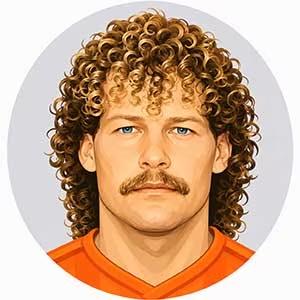
Belgium - SweeperMeeuws, Walter
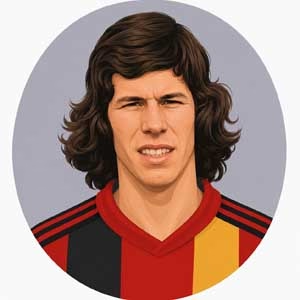
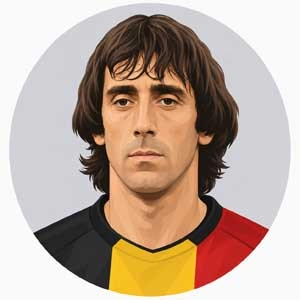
Walter Meeuws is a name that survives in Belgian football conversation largely attached to one image: a taller, physically uncompromising centre-back standing over a diminutive Diego Maradona at the 1982 World Cup, having just helped mark him out of Argentina's opening match. Belgium won that game 1-0, the reigning European champions upset by a country nobody expected much from, and Meeuws was one of the reasons the biggest individual talent in the tournament barely got a kick.
Born in Antwerp in 1954, Meeuws was a physically dominant, no-nonsense central defender built around aerial strength, aggressive marking and a willingness to engage in duels most forwards preferred to avoid. He was not technically refined in possession and made no attempt to disguise it, preferring to clear danger directly rather than build attacks from the back, a style suited perfectly to the pragmatic, well-organized Belgian sides of the late 1970s and early 1980s. He spent the majority of his career at Beerschot and later Standard Liège, winning Belgian league titles and cups, and became a fixture of the national team through its most successful modern period. For Belgium he won 63 caps and was a starting centre-back at both the 1980 European Championship, where the country reached the final, and the 1982 World Cup, where his marking of Maradona in the opening match became the single moment his international career is remembered for outside Belgium.
His limitations were the predictable cost of his style. Meeuws offered essentially nothing in build-up play, and against sides that pressed high and demanded composure from defenders in possession, his lack of technical comfort on the ball became a genuine liability rather than a neutral trait. His physical, high-contact approach to defending produced a correspondingly high number of fouls across his career, and against faster, more mobile forwards who could draw him out of position before attacking the space he left behind, his aggression could be turned against his own team. He was, in essence, a specialist built for a specific kind of physical confrontation, and less effective in matches that avoided giving him one.
Temperamentally he was blunt, combative and entirely unapologetic about the kind of defender he was. Meeuws approached marking as a personal contest to be won through intimidation as much as through skill, and his approach to Maradona in 1982 — persistent, physical, uninterested in the reputation of the man he was marking — reflected a broader pattern of treating even the most gifted opponents as problems to be solved with contact rather than finesse. He argued with referees more than the average defender of his era and accumulated a disciplinary record consistent with a player who accepted cards as a reasonable cost of doing his job properly, rather than as failures to be avoided. Within Belgian football he was respected as a tough, reliable professional rather than as a technically admired one, and teammates described him as straightforward and consistent in temperament — the same combative approach in a routine domestic fixture as in a World Cup opener against the tournament's most talked-about player. He showed little vulnerability to reputation or occasion, treating a famous opponent with exactly the same physical directness he applied to an unknown one. Away from the pitch he remained closely tied to Belgian football after retiring, moving into coaching within the domestic game, and his public profile stayed modest relative to the recognition his Maradona duel earned him internationally. Uncompromising, unrefined and entirely comfortable with both, Meeuws built a career on the conviction that even the greatest talent in the world could be neutralized with enough physical commitment.


 All Time BelgiumNT