We use Google Analytics to understand how visitors use this site. Analytics cookies are only activated with your consent. For details, read our Privacy Policy.
Profile lensThe same player, read from a different angle.
Athletic80
Acceleration
90
Pace
82
Agility
91
Strength
70
Balance
81
Jumping
70
Stamina
82
Fitness
77
Technical88
Dribbling
95
Short Passing
87
Long Passing
85
Finishing
85
Shot Accuracy
84
Shot Power
82
Shooting Technique
88
Heading
66
Tackling
48
Crossing
84
Free Kick
77
Penalties
77
First Touch
92
Mental76
Composure
79
Aggression
76
Consistency
72
Creativity
92
Leadership
73
Work Rate
77
Tactical84
Vision
86
Off the Ball
87
Defensive Positioning
44
Teamwork
85
Anticipation
79
Marking
46
Player Traits
Attacking81
Crossing
84
Finishing
85
Heading Accuracy
66
Shot Accuracy
84
Off the Ball
87
Technique87
Dribbling
95
Free Kick
77
Short Passing
87
Long Passing
85
First Touch
92
Shot Technique
88
Movement86
Acceleration
90
Pace
82
Agility
91
Balance
81
Physicality76
Shot Power
82
Jumping
70
Stamina
82
Strength
70
Fitness
77
Defending46
Marking
46
Tackling
48
Def. Positioning
44
Mentality & Game Reading80
Aggression
76
Composure
79
Penalties
77
Vision
86
Leadership
73
Work Rate
77
Teamwork
85
Anticipation
79
Consistency
72
Creativity
92
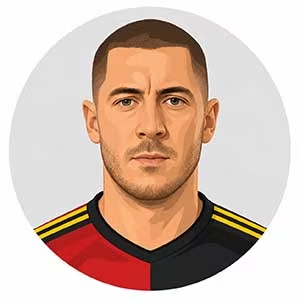
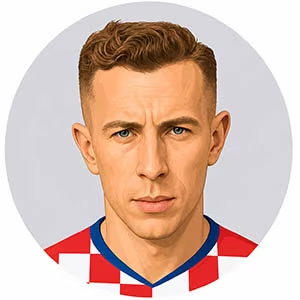
Belgium - Attacking MidfielderHazard, Eden
He said it himself, more than once, and nobody quite believed he meant it: he did not want to be the best player in the world. Eden Hazard explained across his entire career that he enjoyed football, enjoyed his family, enjoyed being at home, and had no interest in the monastic self-optimisation that the era's two dominant players had normalised. Everyone treated it as false modesty until the evidence accumulated. It was simply true, and it is the single most important fact about a career that contained a great deal of brilliance and one enormous unopened room.
Born in La Louvière in 1991 into a family of footballers — both parents played, and two brothers turned professional — Hazard emerged at Lille, where he won Ligue 1 and the Coupe de France in 2011 and became the youngest player to be named French Player of the Year. Chelsea signed him in 2012. At 1.75m he was low-slung, thick through the legs, and possessed the most reliable one-against-one dribbling in European football for most of the decade: not fast in a straight line but explosive over two metres, with a centre of gravity that made him almost impossible to knock over and the specific ability to receive a pass under pressure and immediately eliminate the man closest to him. He drew fouls constantly, finished well with his right foot, and created at a high rate without ever being a classical playmaker. Across seven seasons at Chelsea he made 352 appearances, won two Premier League titles, two Europa Leagues, the FA Cup and the League Cup, and was twice named the club's player of the year. His transfer to Real Madrid in 2019 for a fee approaching €115m became one of the most complete failures in the club's history: injuries, weight and fitness questions, and four seasons that produced 76 appearances and seven goals. For Belgium he won 126 caps, captained the golden generation, and was outstanding at the 2018 World Cup where they finished third and he was named in the team of the tournament.
The physical decline was not accidental. Hazard's approach to conditioning was famously relaxed — he spoke openly about his diet and his dislike of extended pre-season work — and a serious ankle injury sustained shortly after arriving in Madrid met a body that had not been prepared to absorb it. He also offered little defensively at Chelsea until Antonio Conte compelled it, disappeared in matches where opponents doubled him and denied space to run into, and his goal output was modest relative to his chance quality throughout his career.
His temperament was warm, light and entirely without edge. Hazard was cheerful and unpretentious, popular in every dressing room he entered, and famous for laughing off both fouls and his own failures — he was among the most fouled players in Europe for years and almost never retaliated, protested or simulated. He got up, smiled, and asked for the ball again. Pressure did not appear to reach him because he did not appear to assign it much weight: his performances were largely unaffected by the size of the occasion, in either direction. That equanimity was also the problem. Without the internal engine that drives elite athletes through the unglamorous parts of the job, he required external structure to reach his ceiling, and when Madrid provided a different environment and a broken ankle, there was no personal fury available to fight back with — he faded quietly rather than raging. Away from football he was devoted to his wife and four sons, uninterested in celebrity, and retired at thirty-two with an ease that unsettled people more than the decline had. Gifted, contented and fundamentally unbothered, Hazard is the rare great footballer whose career was limited not by his body or his luck but by the simple absence of the desire to be greater.