We use Google Analytics to understand how visitors use this site. Analytics cookies are only activated with your consent. For details, read our Privacy Policy.
Profile lensThe same player, read from a different angle.
Athletic80
Acceleration
85
Pace
79
Agility
88
Strength
72
Balance
77
Jumping
76
Stamina
82
Fitness
78
Technical89
Dribbling
89
Short Passing
88
Long Passing
91
Finishing
82
Shot Accuracy
81
Shot Power
85
Shooting Technique
90
Heading
82
Tackling
58
Crossing
90
Free Kick
87
Penalties
87
First Touch
94
Mental79
Composure
88
Aggression
74
Consistency
72
Creativity
92
Leadership
79
Work Rate
74
Tactical85
Vision
88
Off the Ball
82
Defensive Positioning
57
Teamwork
92
Anticipation
77
Marking
48
Player Traits
Attacking83
Crossing
90
Finishing
82
Heading Accuracy
82
Shot Accuracy
81
Off the Ball
82
Technique90
Dribbling
89
Free Kick
87
Short Passing
88
Long Passing
91
First Touch
94
Shot Technique
90
Movement82
Acceleration
85
Pace
79
Agility
88
Balance
77
Physicality79
Shot Power
85
Jumping
76
Stamina
82
Strength
72
Fitness
78
Defending54
Marking
48
Tackling
58
Def. Positioning
57
Mentality & Game Reading82
Aggression
74
Composure
88
Penalties
87
Vision
88
Leadership
79
Work Rate
74
Teamwork
92
Anticipation
77
Consistency
72
Creativity
92
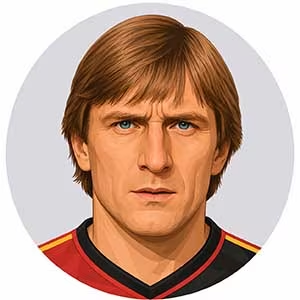
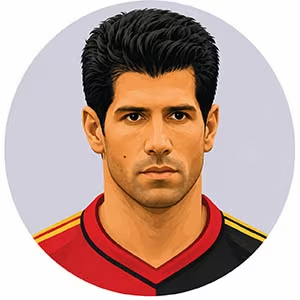
Belgium - Attacking MidfielderScifo, Enzo
In Bologna on 17 June 1990, Belgium were drawing 1–1 with Uruguay when Enzo Scifo received possession roughly thirty metres from goal. He advanced into the space in front of the defence and struck before the defenders could close him, sending a low shot beyond Fernando Álvez. Belgium won 3–1. Four years earlier, at twenty, Scifo had already been one of the central players in Belgium’s run to the World Cup semi-finals; four years later he would again direct their midfield in the United States. Yet between those tournaments his club career had nearly lost its direction. A celebrated move from Anderlecht to Internazionale in 1987 became an unhappy season, followed by Bordeaux and Auxerre before he rebuilt himself in France. The contrast is essential to understanding him. International tournaments repeatedly showed a player capable of accepting the ball when attention and responsibility were maximal. Everyday environments in which his role, confidence or relationship with the coach deteriorated could affect him far more profoundly than the abstract size of the occasion.
Scifo was an attacking midfielder and playmaker whose greatest strength was control of attacking geometry. He received between midfield and defence, turned elegantly, carried through central space and possessed the passing range to alter the direction of an attack before opponents had reorganised. His technique was accompanied by genuine scoring threat: he could strike powerfully from distance, arrive around the box and execute set pieces rather than functioning merely as a provider. Anderlecht recognised that ability extraordinarily early, placing him in the senior team as a teenager; he won multiple Belgian titles and was named Belgian Golden Shoe in 1984. At the 1986 World Cup he scored twice as Belgium reached the semi-finals and was named the tournament’s best young player. Later, Guy Roux rebuilt his club career at Auxerre, where Scifo recovered enough continuity to earn another move to Italy with Torino and reach the 1992 UEFA Cup final. His four World Cups ultimately produced 16 appearances. Tactically, Scifo was most effective when given central access to possession and enough surrounding movement to turn his first touch into progression rather than merely ball retention.
His weaknesses were inseparable from that creative responsibility. Scifo was not physically dominant, exceptionally fast or naturally suited to a game built around continuous defensive pressing. If opponents denied him the turn and forced repeated contact before he could face forward, his influence could become intermittent. His defensive work could be tactically adequate without becoming a defining strength, and teams expecting him to compensate for creative restriction through high-volume ball-winning were asking for a different player. More unusually, environmental confidence could affect his football significantly. His Inter season became the clearest example: he struggled to establish himself under Giovanni Trapattoni, scored relatively little and left after one year. Bordeaux did not immediately restore him. The recovery at Auxerre under Guy Roux therefore matters because it argues against treating the Italian failure as inability to survive elite competition. Scifo later returned to Serie A with Torino and performed at a much higher level. The variable was not simply league difficulty. Role clarity, confidence and the relationship between creative responsibility and coaching trust materially affected how consistently his technique became influence.
Psychologically, Scifo is best understood through **high performance sensitivity to relational confidence without corresponding fear of competitive responsibility**. His career repeatedly separates those variables. At major tournaments he accepted central creative responsibility while still very young and continued asking for the ball in matches whose consequences were immediate. Club instability was different. Scifo later described the Inter period as one in which communication with Trapattoni was difficult and in which he progressively lost confidence; the experience affected his football rather than merely his satisfaction. Guy Roux subsequently approached him differently at Auxerre, giving him responsibility and rebuilding his sense of importance inside the team. Scifo responded with one of the strongest periods of his club career. This should not be flattened into “needs praise”. Creative responsibility itself did not frighten him; indeed, being entrusted with it could increase engagement. The vulnerability appeared when uncertainty about his standing became prolonged enough to alter his willingness or ability to impose himself. Nor was Scifo emotionally inert. Accounts from teammates and his own later reflections describe a player capable of strong reactions and pride, while his career contained disagreements with coaches; however, the evidence is insufficient to convert those episodes into systematic authority rebellion or emotional aggression. Likewise, there is not enough consistent material to score referee conflict, provocation, teammate-error response or hostile-crowd degradation. The stronger contradiction survives without speculation: **Scifo could tolerate the pressure of being responsible for the ball better than the pressure of wondering whether the structure still trusted him with it**.


 All Time BelgiumNT