We use Google Analytics to understand how visitors use this site. Analytics cookies are only activated with your consent. For details, read our Privacy Policy.
Profile lensThe same player, read from a different angle.
Athletic74
Acceleration
72
Pace
74
Agility
73
Strength
76
Balance
80
Jumping
68
Stamina
77
Fitness
75
Technical91
Dribbling
90
Short Passing
94
Long Passing
95
Finishing
81
Shot Accuracy
81
Shot Power
85
Shooting Technique
88
Heading
66
Tackling
48
Crossing
90
Free Kick
88
Penalties
85
First Touch
93
Mental80
Composure
91
Aggression
78
Consistency
74
Creativity
91
Leadership
75
Work Rate
74
Tactical84
Vision
94
Off the Ball
83
Defensive Positioning
45
Teamwork
81
Anticipation
74
Marking
47
Player Traits
Attacking80
Crossing
90
Finishing
81
Heading Accuracy
66
Shot Accuracy
81
Off the Ball
83
Technique91
Dribbling
90
Free Kick
88
Short Passing
94
Long Passing
95
First Touch
93
Shot Technique
88
Movement75
Acceleration
72
Pace
74
Agility
73
Balance
80
Physicality76
Shot Power
85
Jumping
68
Stamina
77
Strength
76
Fitness
75
Defending47
Marking
47
Tackling
48
Def. Positioning
45
Mentality & Game Reading82
Aggression
78
Composure
91
Penalties
85
Vision
94
Leadership
75
Work Rate
74
Teamwork
81
Anticipation
74
Consistency
74
Creativity
91
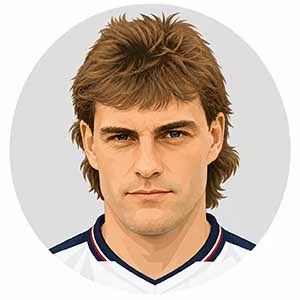
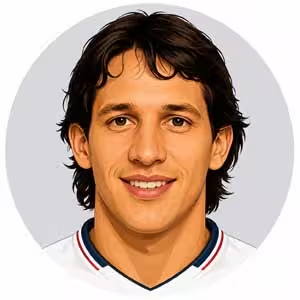
England - Attacking MidfielderHoddle, Glenn
White Hart Lane in the late 1970s and 1980s was the sanctuary of a midfield aristocrat who treated a leather football like a delicate instrument of high art. Glenn Hoddle possessed a technical range and panoramic vision so advanced that foreign observers often mistook him for a continental playmaker raised in Madrid or Milan rather than Essex. Operating as a deep-lying orchestrator or classic number ten, Hoddle manipulated space with effortless bilateral mastery: curling 50-yard diagonal passes onto a teammate’s toe, scoring chips with zero backlift, and executing delicate body swerves that sent aggressive markers flying the wrong way. Over 490 matches and 110 goals for Tottenham Hotspur, he won back-to-back FA Cups (1981, 1982) and the 1983–84 UEFA Cup, before taking his craft to AS Monaco under Arsène Wenger, where he claimed the 1987–88 Division 1 title and was voted Ligue 1 Foreign Player of the Year. For England, across 53 caps and eight goals, he starred across two World Cups (1982, 1986), though his visionary talent was often criminally underutilized by managers trapped in rigid, physical 4-4-2 systems.
Yet Hoddle’s pure artistic profile clashed violently with the brutal physical demands of British football in his era. He was entirely allergic to muddy dogfights, offered minimal defensive tracking or mid-block tackling, and relied heavily on midfield enforcers like Graham Roberts or Steve Perryman to supply the physical protection behind him. When confronted by aggressive, physical man-markers who pressed him relentlessly and turned the game into a war of attrition, his influence could be pushed to the peripheral margins of the pitch.
Aristocratic, unhurried, and deeply spiritual, Hoddle carried himself with the serene detachment of a maestro who operated on a completely different cognitive plane from everyone else on the pitch. He did not engage in shouting matches or cynical physical retaliation; he punished opponents by exposing their positional flaws with a single flick of his boot. On the pitch, his body language was upright and elegant, demanding the ball in tight spaces and directing teammates' attacking runs with subtle hand signals. Inside the Spurs and Monaco dressing rooms, he was an admired figure whose supreme standard in training sessions left teammates in awe, even if more traditional British coaches struggled to grasp his tactical autonomy. Referees appreciated his spotless, non-violent conduct, leaving behind an immortal legacy as the most gifted, visionary, and aesthetic playmaker England ever produced.