We use Google Analytics to understand how visitors use this site. Analytics cookies are only activated with your consent. For details, read our Privacy Policy.
Profile lensThe same player, read from a different angle.
Athletic76
Acceleration
76
Pace
75
Agility
77
Strength
82
Balance
76
Jumping
68
Stamina
77
Fitness
74
Technical87
Dribbling
91
Short Passing
93
Long Passing
86
Finishing
79
Shot Accuracy
72
Shot Power
75
Shooting Technique
88
Heading
66
Tackling
44
Crossing
85
Free Kick
71
Penalties
76
First Touch
92
Mental76
Composure
87
Aggression
72
Consistency
71
Creativity
91
Leadership
70
Work Rate
68
Tactical82
Vision
90
Off the Ball
82
Defensive Positioning
48
Teamwork
80
Anticipation
74
Marking
40
Player Traits
Attacking77
Crossing
85
Finishing
79
Heading Accuracy
66
Shot Accuracy
72
Off the Ball
82
Technique87
Dribbling
91
Free Kick
71
Short Passing
93
Long Passing
86
First Touch
92
Shot Technique
88
Movement76
Acceleration
76
Pace
75
Agility
77
Balance
76
Physicality75
Shot Power
75
Jumping
68
Stamina
77
Strength
82
Fitness
74
Defending44
Marking
40
Tackling
44
Def. Positioning
48
Mentality & Game Reading78
Aggression
72
Composure
87
Penalties
76
Vision
90
Leadership
70
Work Rate
68
Teamwork
80
Anticipation
74
Consistency
71
Creativity
91
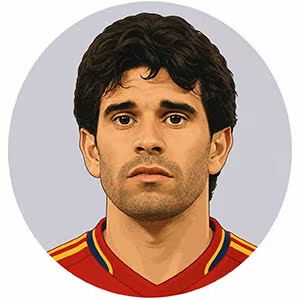
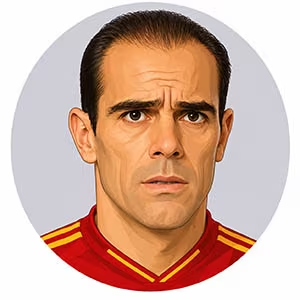
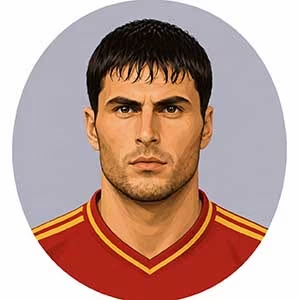
Spain - Attacking MidfielderValerón, Juan Carlos
Born in Arguineguín, Gran Canaria — the same small town that later produced David Silva — in 1975, Valerón was an attacking midfielder built almost entirely around close control, spatial awareness and passing precision rather than pace or physical presence. He was not quick and never had been, compensating instead with a first touch that gave him time other players didn't have and a vision for the pass that would break a defensive line before it had fully organized. He emerged at Las Palmas before a brief, largely unsuccessful spell at Mallorca, and then found his defining context at Deportivo de La Coruña from 1998, where he spent twelve seasons as the technical and creative core of the finest Deportivo side in the club's history. He won the 2000 La Liga title, still the only one in the club's history, and reached a Champions League semi-final in 2004 as part of a squad considered one of the great overachieving sides of the era, built substantially around his passing and vision. He was named Spanish Footballer of the Year in 2000. For Spain he won 46 caps across a long international career interrupted repeatedly by injuries, and though he was part of the golden generation that eventually won the 2008 European Championship and 2010 World Cup, persistent physical problems meant he missed selection for the major tournaments at the moments the team was actually winning them, one of Spanish football's more specific individual disappointments of that period.
His limitations were physical and largely constant across his career rather than developing gradually with age. Valerón was never quick and became increasingly vulnerable to aggressive, high-tempo pressing as the game's physical demands intensified around him, a mismatch that grew more pronounced in his thirties. He suffered a serious knee injury early in his Deportivo career that required lengthy rehabilitation and appears to have permanently affected his explosiveness, and he battled recurring physical problems for the rest of his playing days, missing considerable time across nearly every season and denying Spain his services at several major tournaments when he was otherwise in good form.
Temperamentally he was calm, modest and notably attached to a comparatively small footballing context relative to his individual quality — a technician of a level that could plausibly have played for any major European club choosing instead to build his entire prime around a provincial Spanish side. Valerón rarely sought a move to a bigger club despite considerable interest across his Deportivo years, and teammates and journalists consistently described him as unassuming and almost reluctant with individual praise, uncomfortable with the attention his ability generated. He was not a vocal leader, organizing play through positioning and passing rather than instruction, and his disciplinary record across two decades remained clean, consistent with a player whose game depended on technical composure rather than physical assertion. He handled his repeated absences from major Spain tournaments with public equanimity rather than visible frustration, rarely commenting extensively on what those missed opportunities cost him personally, even as the golden generation around him collected the trophies Spanish football had waited decades for. Away from the pitch he remained closely associated with Gran Canaria and with Deportivo throughout his life, and his loyalty to a comparatively modest club across the peak of his career reflected the same low-key temperament that characterized his relationship with individual recognition generally. Elegant, unhurried and seemingly indifferent to the more conventional markers of a great career, Valerón built one of Spanish football's most admired individual bodies of work almost entirely away from the sport's largest stages.