We use Google Analytics to understand how visitors use this site. Analytics cookies are only activated with your consent. For details, read our Privacy Policy.
Profile lensThe same player, read from a different angle.
Athletic76
Acceleration
76
Pace
77
Agility
82
Strength
73
Balance
77
Jumping
71
Stamina
79
Fitness
73
Technical87
Dribbling
87
Short Passing
94
Long Passing
85
Finishing
82
Shot Accuracy
77
Shot Power
76
Shooting Technique
87
Heading
66
Tackling
44
Crossing
83
Free Kick
77
Penalties
78
First Touch
90
Mental77
Composure
90
Aggression
65
Consistency
68
Creativity
91
Leadership
72
Work Rate
71
Tactical84
Vision
87
Off the Ball
84
Defensive Positioning
48
Teamwork
85
Anticipation
80
Marking
38
Player Traits
Attacking78
Crossing
83
Finishing
82
Heading Accuracy
66
Shot Accuracy
77
Off the Ball
84
Technique87
Dribbling
87
Free Kick
77
Short Passing
94
Long Passing
85
First Touch
90
Shot Technique
87
Movement78
Acceleration
76
Pace
77
Agility
82
Balance
77
Physicality74
Shot Power
76
Jumping
71
Stamina
79
Strength
73
Fitness
73
Defending43
Marking
38
Tackling
44
Def. Positioning
48
Mentality & Game Reading79
Aggression
65
Composure
90
Penalties
78
Vision
87
Leadership
72
Work Rate
71
Teamwork
85
Anticipation
80
Consistency
68
Creativity
91
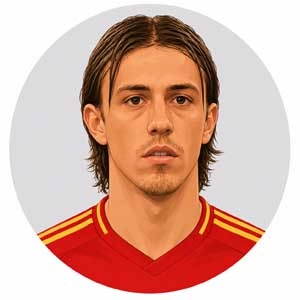
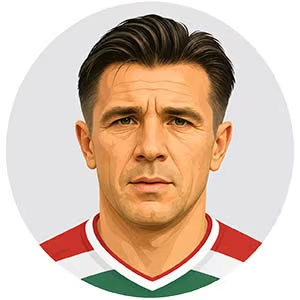
Spain - Attacking MidfielderGuti
Riazor, January 2010. Ronaldo drove a low ball across the six-yard box, slightly behind the run, and Guti — arriving at pace, facing the wrong way, with a defender on his shoulder — flicked it backwards with the outside of his heel into Karim Benzema's path without ever looking at him. The pass had no obvious precedent and served no tactical necessity; a simple sidefoot would have done the same job. He was thirty-three years old, playing in a Real Madrid side that had long since stopped selecting him regularly, and he had just produced the most replayed assist of the decade. That was the entire argument about Guti, settled in one touch and immediately reopened the following week.
Born in Torrejón de Ardoz in 1976 and known as El Rubio, José María Gutiérrez Hernández spent fifteen seasons in the Real Madrid first team after arriving in the cantera as a child. He began as a striker and was converted into an attacking midfielder in his early twenties, a move that revealed a passer of genuinely rare imagination. At 1.80m he was slim, elegant and comfortable in tight areas, but his gift was spatial rather than physical: he saw passing lines two seconds before anyone else and executed them with an insistence on the difficult version — backheels, disguised outside-of-the-boot balls, chipped through-passes into space behind defensive lines that had not yet formed. He made 542 appearances for the club and won five La Liga titles, three Champions Leagues (1998, 2000, 2002) and two Intercontinental Cups, functioning for most of the Galáctico era as the squad's most technically inventive Spaniard and its least predictable selection. Internationally the reward never came: 13 caps for Spain across six years, no World Cup, no tournament of consequence, in a generation that offered Guardiola, Valerón and then Xavi for the same shirt. He closed his career with two seasons at Beşiktaş.
The reasons for that international neglect were not mysterious. Guti's defensive contribution was minimal — he did not press consistently, lost most physical duels, and left his midfield partner covering ground for two. His decision-making was governed by ambition rather than percentage, so he attempted the spectacular pass in situations that required the safe one and conceded possession in dangerous areas as a result. His discipline record was poor, with red cards for retaliation and dissent, and his output swung violently from one match to the next in a way that made him impossible for a cautious coach to build around. Fabio Capello, who valued control above all, spent an entire title-winning season using him from the bench.
He knew exactly how good he was, and never developed a way of coping with not being trusted. Guti was outspoken, sarcastic and unusually willing to criticize coaches and teammates in public, and he carried a visible sense of grievance about a career he believed had been mismanaged around him. On the pitch his emotional state was legible from the stands: expansive and dominant when the game was going well, sulking and disengaged when it was not, gesturing at teammates who failed to read his passes and at referees who failed to protect him. The Bernabéu, which had watched him grow up, turned on him repeatedly, and unlike players who feed on hostility he shrank under it — his touch tightened, his passing became either safe or reckless, and whole matches slipped past him after an early whistle from his own supporters. Off the pitch he lived the Madrid celebrity life fully: fashionable, permanently photographed, married to a television presenter and followed by a tabloid press that treated his private affairs as public property, an exposure he neither courted nor especially resisted. Loyal to one club for a decade and a half, gifted beyond almost anyone around him, and never quite reliable enough to be indispensable, Guti remains Spanish football's most beautiful unresolved question.