We use Google Analytics to understand how visitors use this site. Analytics cookies are only activated with your consent. For details, read our Privacy Policy.
Profile lensThe same player, read from a different angle.
Athletic77
Acceleration
81
Pace
82
Agility
84
Strength
73
Balance
76
Jumping
68
Stamina
77
Fitness
75
Technical87
Dribbling
90
Short Passing
91
Long Passing
85
Finishing
83
Shot Accuracy
73
Shot Power
77
Shooting Technique
86
Heading
70
Tackling
44
Crossing
86
Free Kick
78
Penalties
77
First Touch
89
Mental76
Composure
85
Aggression
66
Consistency
71
Creativity
87
Leadership
72
Work Rate
70
Tactical82
Vision
88
Off the Ball
81
Defensive Positioning
40
Teamwork
82
Anticipation
74
Marking
33
Player Traits
Attacking79
Crossing
86
Finishing
83
Heading Accuracy
70
Shot Accuracy
73
Off the Ball
81
Technique87
Dribbling
90
Free Kick
78
Short Passing
91
Long Passing
85
First Touch
89
Shot Technique
86
Movement81
Acceleration
81
Pace
82
Agility
84
Balance
76
Physicality74
Shot Power
77
Jumping
68
Stamina
77
Strength
73
Fitness
75
Defending39
Marking
33
Tackling
44
Def. Positioning
40
Mentality & Game Reading77
Aggression
66
Composure
85
Penalties
77
Vision
88
Leadership
72
Work Rate
70
Teamwork
82
Anticipation
74
Consistency
71
Creativity
87
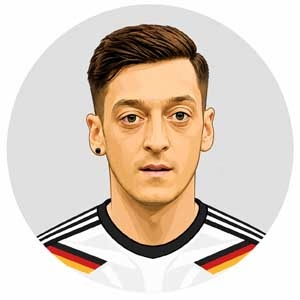
Germany - Attacking MidfielderÖzil, Mesut
Belo Horizonte, July 2014. Germany had just scored their fifth goal against Brazil in the first half of a World Cup semi-final and the players were jogging back with the strained expressions of men who had realised something terrible was happening. Mesut Özil's face was doing what it always did: nothing at all. For a decade that face was used as evidence — that he did not care, that he was not trying, that he lacked the aggression the game demanded — by people watching a player who had just recorded the highest chance-creation numbers in European football. He never learned to perform effort, and it cost him more than any technical limitation ever did.
Born in Gelsenkirchen in 1988 to a Turkish family from Zonguldak, Özil came through the Schalke academy and became the defining creative midfielder of Germany's post-2006 reinvention. At 1.80m he was slight and unathletic-looking, and his game was built on two things: the ability to receive the ball in tight areas facing forward, and spatial vision of an order few players in the modern game have possessed. He specialised in the pass that arrives a beat before the defence has reorganised — through-balls into channels that did not yet exist, cutbacks weighted to a stride length rather than a zone — and he did it left-footed with almost no backlift. He was not quick, did not beat men regularly, and finished modestly. Werder Bremen made his name, Real Madrid bought him in 2010, and under José Mourinho he assisted at an extraordinary rate, contributing to the record-breaking 100-point La Liga title of 2012 and the 2011 Copa del Rey. Arsenal signed him in 2013 for a club-record fee, where across seven seasons he won four FA Cups and, in 2015–16, equalled the Premier League record of 19 assists in a season. For Germany he collected 92 caps, was named the country's player of the year five times, and won the 2014 World Cup, providing the assist for Mario Götze's winner in the final.
His limitations were real and formed a pattern. Özil offered almost nothing defensively — he pressed reluctantly and inconsistently, and in systems that demanded collective pressure he was a structural liability that managers had to compensate for elsewhere. He was physically avoidable, disappeared in matches that became attritional or hostile, and his output depended heavily on being surrounded by movement: in an Arsenal side that stopped making runs beyond him, the assists stopped too, and he could pass entire matches without meaningful influence. His form fluctuated badly with team quality, which made him look world-class in one context and peripheral in another.
The temperament beneath the blank face was quiet rather than absent. Özil was reserved, soft-spoken and conflict-averse, disliked confrontation to a degree unusual in elite sport, and never developed the theatrical body language that would have protected him from the accusation of indifference. He rarely argued with referees, almost never retaliated, and was fouled repeatedly without visible complaint. Criticism, however, reached him deeply and stayed: he was demonstrably sensitive to media hostility and to the sense of not being wanted, and his performances declined markedly in environments where he felt distrusted — the final years at Arsenal, frozen out under successive managers, produced a player visibly diminished rather than defiant. The rupture with German football in 2018, when he retired from international duty citing racism and the treatment he received after a photograph with the Turkish president, revealed how much had been accumulating behind the impassivity for years. Away from the pitch he was private, generous with charitable donations he rarely publicised, and family-oriented. Serene in appearance and thin-skinned in fact, Özil was a player whose greatest asset — the calm that let him see the pitch slowly — was permanently mistaken for not caring.


 All Time ArsenalClub