We use Google Analytics to understand how visitors use this site. Analytics cookies are only activated with your consent. For details, read our Privacy Policy.
Profile lensThe same player, read from a different angle.
Athletic80
Acceleration
88
Pace
80
Agility
86
Strength
74
Balance
79
Jumping
72
Stamina
80
Fitness
78
Technical87
Dribbling
90
Short Passing
87
Long Passing
85
Finishing
84
Shot Accuracy
80
Shot Power
83
Shooting Technique
85
Heading
66
Tackling
44
Crossing
80
Free Kick
87
Penalties
79
First Touch
91
Mental78
Composure
82
Aggression
76
Consistency
73
Creativity
92
Leadership
77
Work Rate
74
Tactical82
Vision
84
Off the Ball
84
Defensive Positioning
44
Teamwork
84
Anticipation
77
Marking
39
Attacking79
Crossing
80
Finishing
84
Heading Accuracy
66
Shot Accuracy
80
Off the Ball
84
Technique88
Dribbling
90
Free Kick
87
Short Passing
87
Long Passing
85
First Touch
91
Shot Technique
85
Movement83
Acceleration
88
Pace
80
Agility
86
Balance
79
Physicality77
Shot Power
83
Jumping
72
Stamina
80
Strength
74
Fitness
78
Defending42
Marking
39
Tackling
44
Def. Positioning
44
Mentality & Game Reading80
Aggression
76
Composure
82
Penalties
79
Vision
84
Leadership
77
Work Rate
74
Teamwork
84
Anticipation
77
Consistency
73
Creativity
92
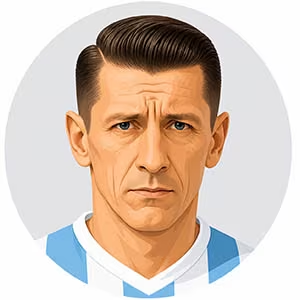
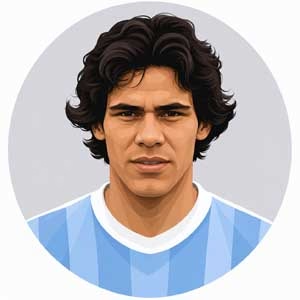
Uruguay - Attacking MidfielderPaz, Rubén
Paz was a left-footed attacking midfielder who combined the instincts of a traditional number ten with a much broader understanding of space. Around 1.74 metres tall, he was balanced, technically refined and capable of changing rhythm without requiring explosive pace. He received between lines, protected the ball with subtle body positioning and could either slow possession or suddenly accelerate the attack through a vertical pass, dribble or shot from distance. His left foot gave him range from set pieces and open play, but he was not simply a static creator waiting for the ball. Paz later spoke explicitly about learning to work better without possession: making runs, dragging markers away and opening space before receiving. That evolution was important because his early career had been built heavily around natural technique. After emerging in Artigas, he joined Peñarol in 1977 and won three Uruguayan championships before moving to Internacional in 1982, where he added three Campeonato Gaúcho titles and was recognised among Brazil’s outstanding midfielders. A move to Racing Paris in 1986 proved far less successful. Paz played very little, disliked the emotional detachment of the environment and returned to South America with Racing Club in 1987. There he reached his peak, becoming the creative reference of the side that won the 1988 Supercopa and earning both Argentina’s footballer-of-the-year honour and the continental Rey de América award. Later spells included Genoa and a return to Racing. For Uruguay he won 45 caps and scored eight goals, played at the 1986 and 1990 World Cups and was part of the team that won the 1980 Mundialito.
His game depended heavily on freedom, rhythm and emotional engagement with the contest. Paz was not a midfielder built to dominate through constant physical pressing, repeated recovery runs or rigid positional discipline. When teams denied him access to the ball between the lines, his influence could fall sharply. He was technically secure enough to survive contact, but aggressive marking that prevented him turning reduced the time available for his imagination. His Paris period exposed another limitation: he could adapt culturally, but he did not perform equally well in emotionally flat environments where matches lacked the intensity and public involvement he associated with football. Paz himself described training without playing in front of sparse crowds as profoundly frustrating. His confidence was therefore not independent of context. He needed to feel that the match mattered, that the crowd cared and that his role had consequence. When those conditions disappeared, his level and motivation could decline together.
Psychologically, Paz’s strongest signal is the way meaning altered his performance. In Paris he was earning money and training regularly but later said he felt like a failure because he was not playing and because the surrounding environment seemed indifferent to winning or losing. He chose to move in the opposite direction of most South American players of the era, leaving Europe for a troubled Racing side because he wanted competition, pressure and public emotion again. The decision was not financially or symbolically obvious, but it immediately restored his level. Paz said Racing had trusted him when others believed he was finished, and he responded by becoming deeply attached to the club and prioritising staying there even when other possibilities appeared. That attachment was social as well as competitive. He described wanting familiar environments, building relationships with teammates and learning from older players such as Ubaldo Fillol rather than protecting his own status as the team’s star. He also spoke repeatedly about observing others and learning from them, explaining that humility meant recognising that football continued evolving. Pressure itself did not appear to destabilise him. Before the 1988 Supercopa final, Paz and Fillol famously relaxed the squad by joking and dancing the night before facing Cruzeiro; Paz later recalled the episode as a natural attempt to reduce tension inside the group, not as indifference to the occasion. He explicitly said that he liked preparing to be the best, while recognising that preparation did not require permanent solemnity. His response to failure was more complicated. Missing the 1982 World Cup squad was, in his own words, a major blow, and the Paris period wounded his self-belief significantly. Yet neither episode produced a long public feud with selectors or clubs. He tended to interpret frustration through usefulness: if he was not playing or no longer felt central to the contest, he sought another environment rather than remaining merely for status or salary. There is little strong evidence of habitual retaliation toward referees or opponents; his competitive aggression was expressed primarily through demanding the ball, assuming creative responsibility and refusing passive roles. Paz was sociable and capable of easing tension inside a group, but his leadership was more technical and emotional than hierarchical. He influenced teammates by giving them solutions and by making the game feel worth playing. The crucial contradiction is that he was adaptable across countries yet not emotionally neutral toward context. He could live almost anywhere; he could not play his best football anywhere.


 All Time UruguayNT