We use Google Analytics to understand how visitors use this site. Analytics cookies are only activated with your consent. For details, read our Privacy Policy.
Profile lensThe same player, read from a different angle.
Athletic80
Acceleration
77
Pace
76
Agility
75
Strength
83
Balance
82
Jumping
87
Stamina
82
Fitness
80
Technical77
Dribbling
73
Short Passing
74
Long Passing
74
Finishing
62
Shot Accuracy
64
Shot Power
77
Shooting Technique
65
Heading
83
Tackling
87
Crossing
66
Free Kick
64
Penalties
60
First Touch
75
Mental82
Composure
82
Aggression
90
Consistency
80
Creativity
63
Leadership
88
Work Rate
84
Tactical83
Vision
72
Off the Ball
63
Defensive Positioning
89
Teamwork
82
Anticipation
87
Marking
90
Player Traits
Attacking 68
Crossing
66
Finishing
62
Heading Accuracy
83
Shot Accuracy
64
Off the Ball
63
Technique 71
Dribbling
73
Free Kick
64
Short Passing
74
Long Passing
74
First Touch
75
Shot Technique
65
Movement 78
Acceleration
77
Pace
76
Agility
75
Balance
82
Physicality 82
Shot Power
77
Jumping
87
Stamina
82
Strength
83
Fitness
80
Defending 89
Marking
90
Tackling
87
Def. Positioning
89
Mentality & Game Reading 79
Aggression
90
Composure
82
Penalties
60
Vision
72
Leadership
88
Work Rate
84
Teamwork
82
Anticipation
87
Consistency
80
Creativity
63
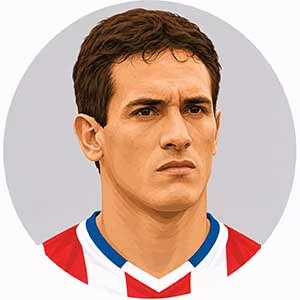
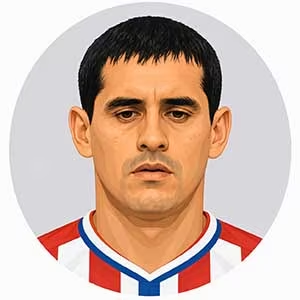
Paraguay - Centre-backGamarra, Carlos
In Saint-Étienne on 28 June 1998, Paraguay spent 120 minutes defending against the host nation in a World Cup round of sixteen match that gradually became an exercise in controlled emergency. France attacked repeatedly, Paraguay retreated, and Carlos Gamarra remained at the centre of a defence that survived until Laurent Blanc scored the tournament’s first golden goal seven minutes from the end of extra time. What made Gamarra’s tournament extraordinary was not simply that Paraguay conceded only two goals in four matches. FIFA’s technical report recorded that he completed all 390 minutes without committing a single foul. In a role defined by contact, emergency intervention and repeated exposure to attackers running towards goal, Gamarra managed to remain physically assertive without conceding even one free kick. ([eltiempo.com](https://www.eltiempo.com/archivo/documento/MAM-788779?utm_source=chatgpt.com)) That statistic should not be romanticised into passivity. He challenged, intercepted, headed and blocked constantly. The significance lies in how selectively he intervened: aggression was present, but the threshold for unnecessary contact was unusually high.
Gamarra was a centre-back built around anticipation, timing and clean physical engagement. At approximately 1.80 metres he was not exceptionally tall for the position, yet he competed strongly in the air and used body position intelligently enough to reduce the importance of pure size. His tackling was decisive without depending on reckless momentum; the 1998 World Cup became the clearest expression of a style in which reading the attacker early allowed him to arrive before desperation was necessary. He could defend deep, operate beside another physical centre-back and remain effective through long phases without possession, an essential quality for Paraguay’s tournament structures. His career nevertheless extended far beyond one defensive system. He won titles in Paraguay and Brazil, played in Argentina, Portugal, Greece and Italy, and spent three seasons with Internazionale before returning to South America. Internationally he reached 110 senior appearances and became the first Paraguayan to pass 100 caps. ([uol.com.br](https://www.uol.com.br/esporte/futebol/ultimas/2006/10/07/ult59u105194.jhtm?utm_source=chatgpt.com)) By the 2006 World Cup he was captain, completing a progression from defensive reference to formal leader. FIFA’s current historical account records him wearing the armband throughout Paraguay’s three group matches in Germany. ([fifa.com](https://www.fifa.com/es/tournaments/mens/worldcup/canadamexicousa2026/articles/historial-capitanes-paraguay-copa-mundial-de-la-fifa?utm_source=chatgpt.com))
The limitations emerge when anticipation could no longer eliminate physical disadvantage. Gamarra’s lack of exceptional height meant that repeated aerial isolation against larger centre-forwards could reduce the advantage created by timing, while ageing inevitably diminished the recovery margin available after an incorrect step. His game was also far more valuable as defensive resolution than as creative initiation. He could circulate possession competently but was not a centre-back whose passing transformed the attacking structure by itself. By 2002 and especially 2006, Paraguay increasingly relied on experience to compensate for declining collective athleticism. Gamarra’s own 2006 World Cup began with an accidental own goal after three minutes against England, when David Beckham’s free kick was redirected off him into the net. Paraguay lost 1–0. That episode is useful because it separates technical misfortune from psychological collapse: Gamarra remained captain and completed the tournament. ([europapress.es](https://www.europapress.es/deportes/noticia-futbol-mundial-gamarra-reconoce-dolor-dejar-seleccion-tan-tristes-circunstancias-20060619200250.html?utm_source=chatgpt.com)) The degradation condition was therefore mainly structural and physical—late recovery, aerial exposure, ageing—not evidence that mistakes or major-event pressure caused disintegration.
Psychologically, Gamarra is best defined by **selective confrontation**. The same defender who could play an entire World Cup without committing a foul was not generally conflict-avoidant when he believed a collective boundary had been crossed. Before the 2002 World Cup, José Luis Chilavert publicly questioned teammate Julio César Enciso’s loyalty. Gamarra, who described Enciso as almost a brother, responded sharply: if Chilavert was going to speak, then someone had to answer, and he challenged the justification being given for Enciso’s exclusion. ([as.com](https://as.com/futbol/2002/04/27/mas_futbol/1019858401_850215.html?utm_source=chatgpt.com)) Yet after Chilavert later criticised the national team from outside it, Gamarra’s response as captain was different: he said that outside comments did not matter, that the group solved internal problems internally and that results were the proper answer. ([as.com](https://as.com/futbol/2003/11/17/mas_futbol/1069023614_850215.html?utm_source=chatgpt.com)) The contradiction is informative rather than inconsistent. Gamarra did not appear to seek confrontation as stimulation; he entered it when he judged loyalty, group cohesion or fairness to require intervention, and otherwise preferred containment. His own later description of leadership emphasised that matches sometimes required leaders on the field to resolve problems rather than waiting passively for instructions. ([elcomercio.pe](https://elcomercio.pe/deporte-total/seleccion/peru-vs-paraguay-carlos-gamarra-excapitan-de-la-albirroja-peru-tuvo-suerte-de-encontrar-a-gianluca-lapadula-encajo-perfectamente-en-el-equipo-eliminatorias-qatar-2022-rmmd-dtcc-noticia/?utm_source=chatgpt.com)) Evidence for referee obsession, retaliatory fouling or provocation-driven loss of control is weak. The stronger signal is that **Gamarra used force and confrontation only when he considered them functionally necessary; restraint was not softness, but selection**.