We use Google Analytics to understand how visitors use this site. Analytics cookies are only activated with your consent. For details, read our Privacy Policy.
Profile lensThe same player, read from a different angle.
Athletic79
Acceleration
83
Pace
76
Agility
85
Strength
73
Balance
77
Jumping
68
Stamina
87
Fitness
80
Technical83
Dribbling
86
Short Passing
86
Long Passing
85
Finishing
74
Shot Accuracy
72
Shot Power
85
Shooting Technique
81
Heading
71
Tackling
72
Crossing
82
Free Kick
78
Penalties
74
First Touch
85
Mental81
Composure
85
Aggression
76
Consistency
78
Creativity
83
Leadership
78
Work Rate
82
Tactical82
Vision
85
Off the Ball
76
Defensive Positioning
73
Teamwork
88
Anticipation
83
Marking
68
Attacking75
Crossing
82
Finishing
74
Heading Accuracy
71
Shot Accuracy
72
Off the Ball
76
Technique84
Dribbling
86
Free Kick
78
Short Passing
86
Long Passing
85
First Touch
85
Shot Technique
81
Movement80
Acceleration
83
Pace
76
Agility
85
Balance
77
Physicality79
Shot Power
85
Jumping
68
Stamina
87
Strength
73
Fitness
80
Defending71
Marking
68
Tackling
72
Def. Positioning
73
Mentality & Game Reading81
Aggression
76
Composure
85
Penalties
74
Vision
85
Leadership
78
Work Rate
82
Teamwork
88
Anticipation
83
Consistency
78
Creativity
83
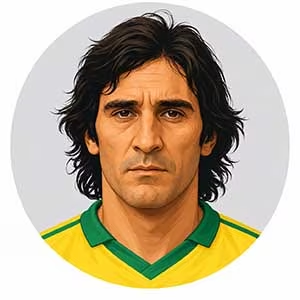
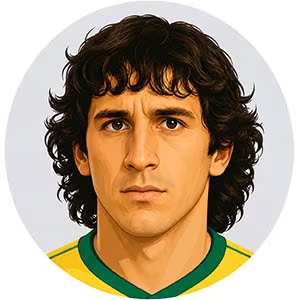
Brazil - Centre MidfielderCarpegiani, Paulo César
Asked once to define himself in a single word, Paulo César Carpegiani didn't hesitate: simplicity. He said it allowed him to play for two of the great clubs of world football and to compete in two different World Cups, once as a player and once as a coach — a career summary offered without embellishment, by a man whose own surname wasn't originally his football identity at all. At Internacional he had simply been Paulo César; when the national team called him up alongside another player of the same first name, nicknamed Caju, the federation started using his surname to avoid confusion, and Carpegiani stuck for the rest of his life.
Born in Erechim, in Rio Grande do Sul, in 1949, Carpegiani came through Internacional's youth system and spent seven seasons in the first team, winning seven consecutive state championships and back-to-back Brazilian titles alongside Falcão. He began as an attacking midfielder and was converted into a holding role at Mário Zagallo's specific request ahead of the 1974 World Cup, where Brazil were eliminated by the Netherlands' celebrated Clockwork Orange side. He moved to Flamengo in 1977, joining a squad where Zico, Adílio and Tita were just emerging, and quickly became one of the group's senior leaders, embraced by supporters for playing, in the club's own description, with considerable grit and vigor. He wore the captain's armband, formed the club's central midfield alongside Adílio and Zico, and was voted the best player of Flamengo's title-winning 1978 Carioca campaign — a form so strong that national coach Cláudio Coutinho's decision to leave him out of that year's World Cup squad was one he reportedly admitted regretting the following year. Carpegiani returned to the national team for the 1979 Copa América as starter and captain, and closed his Flamengo career with a symbolic farewell match against Boca Juniors in September 1981, featuring a number-10 duel between Zico and a young Diego Maradona. Worsening knee injuries forced his retirement at thirty-two, having won three Carioca titles and the 1980 Brazilian championship. For Brazil he won 17 caps.
His limitations were tied almost entirely to the physical toll that eventually ended his career prematurely. Carpegiani's knee problems recurred across his final Flamengo seasons, costing him months of playing time even during his best individual form, and the same injuries that denied him a longer career also denied him the chance to test himself at a second World Cup as a player, a gap he seemed to accept with quiet, if not entirely painless, resignation rather than public frustration.
Temperamentally he was described consistently, by teammates, journalists and by his own account, as cerebral, technically accomplished and fundamentally unassuming — a player whose considerable achievements never translated into a demand for individual recognition. His self-chosen word, simplicity, matches the pattern of a career built on integration into strong collectives — Internacional's championship-winning generation alongside Falcão, Flamengo's emerging golden era alongside Zico — rather than on singular self-promotion. He accepted the disappointment of missing the 1978 World Cup without public complaint despite what appears to have been genuine merit for inclusion, and he responded to his own coach's belated public regret with the same evenness he applied to the rest of his career. The immediate transition that followed his enforced retirement said as much about his standing as anything from his playing days: Flamengo handed him the head coaching job in 1981, his very first, and he won the Copa Libertadores and the Intercontinental Cup, beating Liverpool, in his debut season on the bench, followed by the Brazilian championship the year after — an almost unprecedented start to a coaching career that would go on to span decades, dozens of clubs, and a genuinely respected run with the Paraguay national team at the 1998 World Cup. Grounded, technically gifted, and consistently trusted with responsibility by teammates and institutions alike despite never actively seeking it, Carpegiani built a playing career on quiet competence that made his subsequent decades in football feel, in retrospect, entirely inevitable.