We use Google Analytics to understand how visitors use this site. Analytics cookies are only activated with your consent. For details, read our Privacy Policy.
Profile lensThe same player, read from a different angle.
Athletic80
Acceleration
75
Pace
77
Agility
76
Strength
82
Balance
80
Jumping
80
Stamina
88
Fitness
85
Technical83
Dribbling
82
Short Passing
84
Long Passing
83
Finishing
81
Shot Accuracy
78
Shot Power
87
Shooting Technique
74
Heading
78
Tackling
84
Crossing
76
Free Kick
75
Penalties
72
First Touch
82
Mental88
Composure
86
Aggression
85
Consistency
86
Creativity
74
Leadership
90
Work Rate
95
Tactical85
Vision
85
Off the Ball
78
Defensive Positioning
85
Teamwork
93
Anticipation
87
Marking
78
Attacking78
Crossing
76
Finishing
81
Heading Accuracy
78
Shot Accuracy
78
Off the Ball
78
Technique80
Dribbling
82
Free Kick
75
Short Passing
84
Long Passing
83
First Touch
82
Shot Technique
74
Movement77
Acceleration
75
Pace
77
Agility
76
Balance
80
Physicality84
Shot Power
87
Jumping
80
Stamina
88
Strength
82
Fitness
85
Defending82
Marking
78
Tackling
84
Def. Positioning
85
Mentality & Game Reading85
Aggression
85
Composure
86
Penalties
72
Vision
85
Leadership
90
Work Rate
95
Teamwork
93
Anticipation
87
Consistency
86
Creativity
74
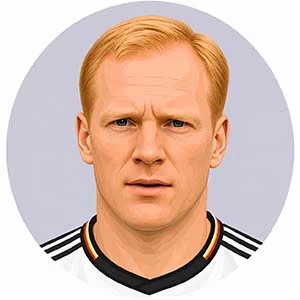
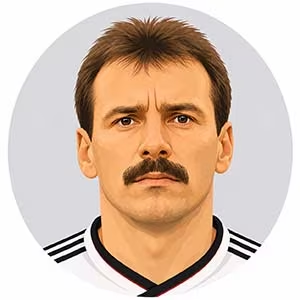
Germany - SweeperSammer, Matthias
England, June 1996, the closing stages of a European Championship that Germany were winning without ever quite convincing. A sweeper broke out of his own half with the ball at his feet, carried it forty yards through a disintegrating midfield, played a pass, kept running, and was still sprinting back into his defensive position twelve seconds later. Matthias Sammer played that entire tournament as though he had been personally insulted by the idea of standing still, and by the end of it he had become the first defender in thirty years to win the Ballon d'Or.
Born in Dresden in 1967, the son of Dynamo Dresden player and coach Klaus Sammer, he grew up inside East German football and became the last great product of it. He began as a midfielder — quick, technically excellent, a genuine passer with a hard right-foot shot — and was converted into a libero at Borussia Dortmund, where the role transformed him. As a sweeper he was not physically imposing at 1.80m, and he compensated with reading, acceleration and an aggression in the step-out that was almost provocative: he intercepted rather than tackled, then advanced with the ball into midfield to create numerical superiority, a function nobody in Europe performed better in the mid-nineties. He won the final East German championship with Dynamo Dresden in 1990, moved to Stuttgart, spent an unhappy half-season at Inter, and returned to Dortmund in 1993 for the defining chapter: two Bundesliga titles (1995, 1996) and the 1997 Champions League, won against Juventus. Internationally he was capped 23 times by East Germany and 51 by unified Germany, scored the winner in the Euro 96 semi-final against Croatia and drove the team to the title at Wembley, collecting both the Ballon d'Or and German Footballer of the Year that season. His career ended abruptly at thirty-one, in 1998, after a knee injury that never healed properly.
His flaws followed directly from his strengths. Sammer's instinct to step out of the defensive line left space behind him that intelligent forwards could attack, and against sides playing quick direct balls into that channel he could be a genuine liability. He committed a high volume of fouls in advanced positions, collected cards for dissent and persistent infringement, and his refusal to manage his own workload — playing through pain, refusing rest, treating substitution as failure — contributed directly to the knee damage that removed him from football years early.
The intensity behind all of it was relentless and largely humourless. Sammer talked constantly on the pitch, reorganizing the line, demanding higher pressing, and berating teammates for lapses with a sharpness that made him respected and, by several accounts, exhausting to play alongside. He argued with referees over marginal decisions and with coaches over tactical detail, and he applied to others a standard he enforced on himself first, which made the criticism difficult to reject. Losing genuinely wounded him; he was visibly furious at half-time in matches his team was winning comfortably but playing poorly, since a sloppy lead offended him more than a hard defeat. Provocation had little effect on him because he was already operating at maximum agitation. Away from the pitch he was serious, disciplined and private, uninterested in nightlife or public visibility, and he carried the same perfectionism into a career as sporting director at Dortmund and Bayern Munich and DFB technical director, where his demanding, confrontational style produced both remarkable results and repeated institutional friction. Driven, abrasive and physically self-destructive, Sammer burned out precisely because he never learned to play at anything less than full intensity.