We use Google Analytics to understand how visitors use this site. Analytics cookies are only activated with your consent. For details, read our Privacy Policy.
Profile lensThe same player, read from a different angle.
Athletic76
Acceleration
68
Pace
69
Agility
74
Strength
82
Balance
81
Jumping
85
Stamina
63
Fitness
85
Technical44
Dribbling
52
Short Passing
54
Long Passing
60
Shot Accuracy
44
Shot Power
82
Shooting Technique
44
Heading
49
Free Kick
44
Penalties
44
First Touch
53
Mental76
Composure
76
Consistency
75
Leadership
83
Goalkeeping88
Reflexes
92
Positioning
89
Handling
85
Kicking
84
Goalkeeping88
Reflexes
92
Positioning
89
Handling
85
Kicking
84
Attacking47
Heading Accuracy
49
Shot Accuracy
44
Technique51
Dribbling
52
Free Kick
44
Short Passing
54
Long Passing
60
First Touch
53
Shot Technique
44
Physicality79
Shot Power
82
Jumping
85
Stamina
63
Strength
82
Fitness
85
Movement73
Acceleration
68
Pace
69
Agility
74
Balance
81
Mentality & Game Reading70
Composure
76
Penalties
44
Leadership
83
Consistency
75
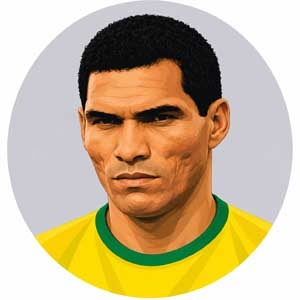
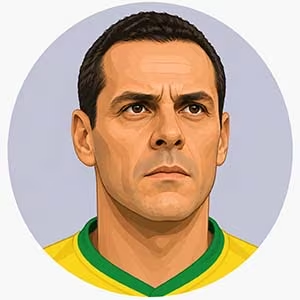
Brazil - GoalkeeperManga
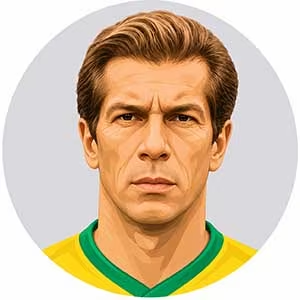
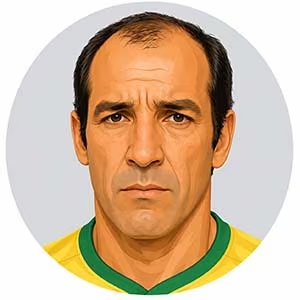
Dislocated, gnarled fingers twisted into unnatural angles after decades of bare-handed collisions stood as the raw badge of honor for a six-foot-two leviathan from Recife who guarded the goalmouth with terrifying fearlessness and acrobatic elasticity. Haílton Corrêa de Arruda—canonized across South America simply as Manga—was one of the most imposing, reflex-driven, and durable goalkeeping titans in the history of the sport: an athletic phenomenon whose feline shot-stopping, thunderous counter-attacking throws, and sheer physical presence established dynasties in both Brazil and Uruguay.
Manga was a force of nature beneath the crossbar, combining an immense wingspan with explosive, low-center-of-gravity lateral spring. He dominated the entire penalty area, snatching crosses out of the sky with enormous, ungloved hands and demonstrating instantaneous recovery speed on double and triple saves. Rising through Sport Recife (where he won three Campeonato Pernambucano titles), his first legendary epoch unfolded at Botafogo between 1959 and 1968 across 442 appearances. Guarding the net behind Garrincha, Nilton Santos, and Didi, he backstopped O Glorioso to four Campeonato Carioca crowns and three Torneios Rio-São Paulo. In 1969, he crossed the border to Club Nacional de Football, becoming an immortal idol of the Tricolor faithful across five seasons: he anchored the backline to four straight Uruguayan Primera División titles (1969–1972), the 1971 Copa Libertadores over Estudiantes, the 1971 Intercontinental Cup against Panathinaikos, and the 1972 Copa Interamericana. Returning to Brazil in his late thirties, his longevity produced yet another domestic peak at Internacional, where he claimed back-to-back Campeonato Brasileiro titles in 1975 and 1976 (awarded the Bola de Prata in both campaigns), before adding further silverware with Operário, Coritiba, and Grêmio, playing at the top flight well into his forties. For Brazil, across 12 caps between 1965 and 1967, his international story carried bitter frustration: starting against Portugal at the 1966 World Cup in England, he bore the brunt of intense media criticism after an error in the team's group-stage elimination, which prematurely truncated his Seleção journey despite his towering domestic stature.
That instinctive, physical shot-stopping mastery, however, came with specific technical and tactical eccentricities. Manga belonged to the instinct-first generation; his distribution with his feet under backpass pressure was rudimentary and strictly aimed at clearing danger into touch rather than orchestrating controlled buildup. Furthermore, his unyielding refusal to wear goalkeeping gloves—even in torrential rain or on freezing pitches—meant that on slick leather balls, he occasionally opted for dramatic double-fist parries rather than clean catches. His aggressive, front-foot sweeping instincts on corner kicks could also leave his goal-line exposed if an opponent blocked his path through a crowded six-yard box.
Psychologically, Manga was a charismatic, unshakeable eccentric forged in iron resilience, wicked humor, and total emotional invulnerability. He possessed a legendary psychological swagger, famously mocking rival strikers in pre-match press conferences—most notably promising that Flamengo's attacking bonus was already in his pocket—and backing up his banter with miraculous saves that crushed the morale of opposing forwards. The painful scapegoating following the 1966 World Cup failed to break his spirit; instead, it fueled a fierce competitive pride that drove him to reinvent himself in Montevideo and Porto Alegre as an untouchable continental champion. On the pitch, his body language was that of an undisputed territorial monarch: towering over his six-yard box, bellowing commands in a deep, booming voice, staring down penalty-takers with cold amusement, and launching forty-yard trajectory throws with the torque of a baseball pitcher. Inside the Botafogo, Nacional, and Internacional dressing rooms, his folklore, relentless work ethic, and astonishing four-decade career cemented an eternal legacy as one of the most formidable goalkeepers ever to grace the footballing world.