We use Google Analytics to understand how visitors use this site. Analytics cookies are only activated with your consent. For details, read our Privacy Policy.
Profile lensThe same player, read from a different angle.
Athletic76
Acceleration
73
Pace
72
Agility
82
Strength
76
Balance
75
Jumping
83
Stamina
61
Fitness
84
Technical47
Dribbling
50
Short Passing
72
Long Passing
79
Shot Accuracy
44
Shot Power
77
Shooting Technique
42
Heading
45
Free Kick
44
Penalties
45
First Touch
57
Mental81
Composure
83
Consistency
76
Leadership
82
Goalkeeping91
Reflexes
95
Positioning
91
Handling
87
Kicking
90
Goalkeeping91
Reflexes
95
Positioning
91
Handling
87
Kicking
90
Attacking45
Heading Accuracy
45
Shot Accuracy
44
Technique57
Dribbling
50
Free Kick
44
Short Passing
72
Long Passing
79
First Touch
57
Shot Technique
42
Physicality76
Shot Power
77
Jumping
83
Stamina
61
Strength
76
Fitness
84
Movement76
Acceleration
73
Pace
72
Agility
82
Balance
75
Mentality & Game Reading72
Composure
83
Penalties
45
Leadership
82
Consistency
76
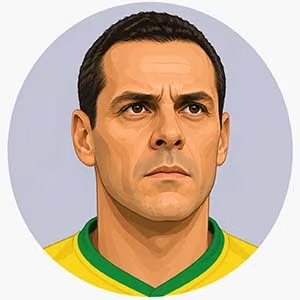
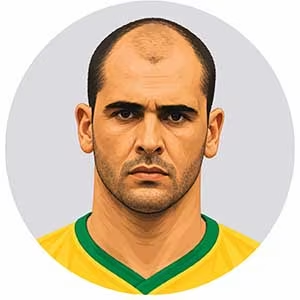
Brazil - GoalkeeperLeão, Émerson
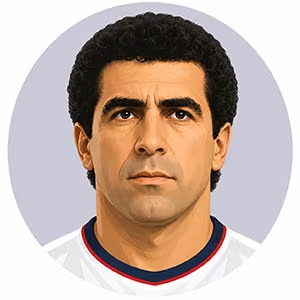
Athletic agility, aggressive aerial departures, and an uncompromising martial discipline made Émerson Leão the premier Brazilian shot-stopper of the 1970s, fundamentally transforming a role often neglected in Brazilian football culture. Rising to national prominence with Palmeiras under Osvaldo Brandão, Leão became the defensive cornerstone of the famous Segunda Academia, collecting three Paulista championships and two Brazilian national titles (1972, 1973) before later capturing another national league with Vasco da Gama and starring for Grêmio and Corinthians. Standing just under six feet tall, he compensated for his relatively modest height with explosive vertical spring, rapid footwork across his line, and an extraordinary command of the entire penalty box: charging off his line to intercept crosses at their apex with clean, southpaw punch-mechanics and smothering low breakaways at the feet of oncoming strikers. Across 80 caps for the Seleção spanning four consecutive World Cups (1970 as a third keeper, 1974 and 1978 as the starting number one, and 1986 as a seasoned veteran), his international peak was the 1978 tournament in Argentina, where he captained Brazil to an unbeaten third-place finish, conceding just three goals across seven matches and keeping four clean sheets.
Mentally and emotionally, Leão was an authoritarian, combative drill sergeant who governed his penalty area and locker room with an iron fist. He had zero tolerance for defensive laziness, tactical drift, or the casual bohemian lifestyle common among Brazilian superstars of the period, enforcing strict physical conditioning regimes and barking furious, uninterrupted commands across ninety minutes. On the pitch, his leadership was confrontational, fearless, and intimidating; he relished physical clashes with opposing forwards on aerial balls, using his knees and elbows to carve out space and establish psychological dominance inside the six-yard box. Inside the dressing room, he was a polarizing, unyielding alpha who frequently clashed with club directors and coaches who attempted to compromise his training standards or tactical authority. Under intense pressure, his concentration remained rock-solid; in hostile Argentine cauldrons at the 1978 World Cup, he absorbed deafening noise and aggressive physical obstruction without blinking, delivering clean, error-free performances. Toward referees and opposing strikers, Leão was fierce, proud, and unapologetic, carrying himself with an imposing swagger that commanded absolute respect and leaving an indelible legacy as the most disciplined, demanding, and athletic goalkeeper in Brazilian history.