We use Google Analytics to understand how visitors use this site. Analytics cookies are only activated with your consent. For details, read our Privacy Policy.
Profile lensThe same player, read from a different angle.
Athletic75
Acceleration
68
Pace
71
Agility
72
Strength
91
Balance
87
Jumping
75
Stamina
60
Fitness
73
Technical42
Dribbling
40
Short Passing
47
Long Passing
56
Shot Accuracy
42
Shot Power
86
Shooting Technique
40
Heading
49
Free Kick
40
Penalties
48
First Touch
49
Mental82
Composure
84
Consistency
77
Leadership
84
Goalkeeping88
Reflexes
90
Positioning
90
Handling
88
Kicking
84
Goalkeeping88
Reflexes
90
Positioning
90
Handling
88
Kicking
84
Attacking46
Heading Accuracy
49
Shot Accuracy
42
Technique45
Dribbling
40
Free Kick
40
Short Passing
47
Long Passing
56
First Touch
49
Shot Technique
40
Physicality77
Shot Power
86
Jumping
75
Stamina
60
Strength
91
Fitness
73
Movement75
Acceleration
68
Pace
71
Agility
72
Balance
87
Mentality & Game Reading73
Composure
84
Penalties
48
Leadership
84
Consistency
77
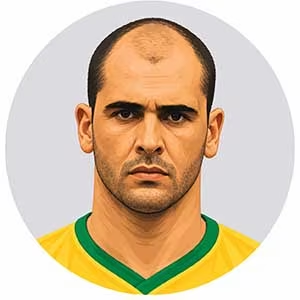
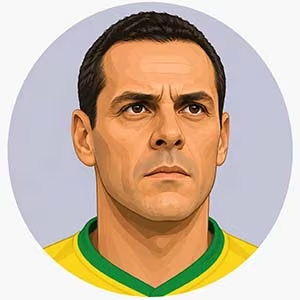
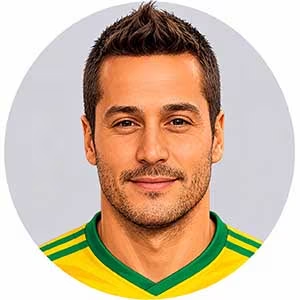
Brazil - GoalkeeperMarcos
The blinding spotlights of Yokohama on June 30, 2002, saw a six-foot-four native of Oriente step between the posts for the biggest match of his life, pulling off a series of miraculous reflex saves against Oliver Neuville and Miroslav Klose to deliver Brazil's fifth World Cup crown. Marcos Roberto Silveira Reis—canonized across South America simply as São Marcos (Saint Marcos)—was the spiritual guardian and clutch shot-stopping pillar of Palmeiras and Luiz Felipe Scolari's Seleção. Combining an imposing physical frame with startling acrobatic elasticity, Marcos was a specialist in the impossible: dominating one-on-one standoffs through immense spread technique, snatching high crosses out of the sky with iron-clad wrists, and becoming a near-mythic penalty-killer. A loyal one-club icon, he spent two uninterrupted decades at Palmeiras across 533 matches, capturing two Brazilian Série A championships, the 1998 Copa do Brasil, and the 1999 Copa Libertadores (winning MVP of the tournament after a legendary quarter-final shootout display against arch-rivals Corinthians). For Brazil, across 29 caps, he was Scolari’s trusted starter for every single minute of the triumphant 2002 World Cup campaign.
Yet his high-flying, explosive style carried clear physical costs. A relentless cycle of broken fingers, shattered wrist bones, and chronic knee surgeries plagued his career, periodically eroding his agility and forcing him into extended recovery layoffs. Tactically, his sweeping range outside the box was conservative, and his distribution with his feet under intense forward pressing could be heavy and erratic when forced into ground-level recycling.
Fiery, deeply devout, and utterly devoid of commercial vanity, Marcos played with raw emotional honesty. He never hid his feelings: celebrating crucial penalty stops with explosive fist pumps, openly weeping after crushing defeats, and famously rejecting a lucrative transfer to Arsenal in 2003 to stay and fight in Brazil's second division with his beloved Palmeiras. On the pitch, his presence was explosive and authoritarian, screaming defensive instructions with passion and throwing his frame into dangerous collisions without a second thought. Inside the Palmeiras and Brazilian locker rooms, he was an indispensable emotional glue—humble, self-deprecating, and fiercely protective of his teammates. Opposing penalty-takers found his wingspan and psychological presence intensely unnerving, cementing his legacy as one of the most beloved, clutch, and iconic goalkeepers in Brazilian football history.