We use Google Analytics to understand how visitors use this site. Analytics cookies are only activated with your consent. For details, read our Privacy Policy.
Profile lensThe same player, read from a different angle.
Athletic82
Acceleration
76
Pace
78
Agility
77
Strength
78
Balance
77
Jumping
82
Stamina
93
Fitness
91
Technical80
Dribbling
81
Short Passing
83
Long Passing
82
Finishing
82
Shot Accuracy
83
Shot Power
82
Shooting Technique
73
Heading
73
Tackling
68
Crossing
78
Free Kick
70
Penalties
77
First Touch
78
Mental80
Composure
85
Aggression
86
Consistency
76
Creativity
73
Leadership
82
Work Rate
76
Tactical80
Vision
82
Off the Ball
83
Defensive Positioning
66
Teamwork
86
Anticipation
76
Marking
57
Player Traits
Attacking80
Crossing
78
Finishing
82
Heading Accuracy
73
Shot Accuracy
83
Off the Ball
83
Technique78
Dribbling
81
Free Kick
70
Short Passing
83
Long Passing
82
First Touch
78
Shot Technique
73
Movement77
Acceleration
76
Pace
78
Agility
77
Balance
77
Physicality85
Shot Power
82
Jumping
82
Stamina
93
Strength
78
Fitness
91
Defending64
Marking
57
Tackling
68
Def. Positioning
66
Mentality & Game Reading80
Aggression
86
Composure
85
Penalties
77
Vision
82
Leadership
82
Work Rate
76
Teamwork
86
Anticipation
76
Consistency
76
Creativity
73
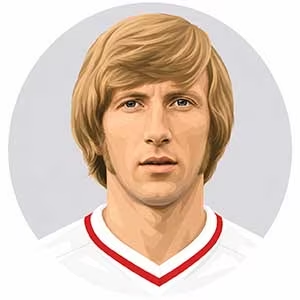
England - Centre MidfielderBell, Colin
The Kippax terrace at Maine Road bestowed upon him the regal moniker The King of the Kippax, but across the mud-soaked First Division battlegrounds of the late 1960s and 1970s, he was just as often hailed as Nijinsky—named after the legendary racehorse for his seemingly bottomless cardiovascular stamina. Colin Bell MBE stood as the complete, dynamic box-to-box midfielder and undisputed beating heart of Malcolm Allison and Joe Mercer’s historic Manchester City vintage. Operating with tireless running power, Bell possessed an extraordinary engine paired with explosive late arrivals into the eighteen-yard box, sublime aerial timing, and crisp distribution off both feet. Over 501 appearances and 153 goals in sky blue between 1966 and 1979, he powered City to their most decorated era of the 20th century: capturing the 1967–68 First Division championship, the 1969 FA Cup, the 1970 European Cup Winners' Cup in Vienna, and two League Cups (1970, 1976). For England, across 48 caps and nine goals, he was a pivotal figure at the 1970 World Cup in Mexico, replacing Bobby Charlton in the infamous quarter-final against West Germany.
The trajectory of his genius, however, was brutally cut down in its absolute prime by single catastrophic trauma. On November 12, 1975, a savage tackle from Manchester United’s Martin Buchan in a League Cup derby resulted in a devastating, multi-ligament knee collapse that sidelined Bell for two entire years and required multiple surgical reconstructions. While he staged an emotional return in 1977, the injury permanently stripped him of his fluid, long-striding agility and explosive vertical leap, forcing his retirement from elite football before the age of 34.
Modest to a fault, monastic, and completely uninterested in celebrity status, Bell was the ultimate gentleman-warrior of English football. He never engaged in cheap gamesmanship, theatrical diving, or verbal retaliation against opponents, letting his superhuman work rate and clean goalscoring output do the talking. On the pitch, his body language was earnest, upright, and tireless: tracking back sixty yards to make a crucial block before immediately leading the counter-attack on the other end. Inside the Manchester City dressing room, he was an untouchable, quiet leader who commanded universal reverence from teammates like Francis Lee and Mike Summerbee, leaving behind an immortal legacy as the greatest and most beloved player in the history of Manchester City.