We use Google Analytics to understand how visitors use this site. Analytics cookies are only activated with your consent. For details, read our Privacy Policy.
Profile lensThe same player, read from a different angle.
Athletic82
Acceleration
79
Pace
81
Agility
81
Strength
74
Balance
83
Jumping
76
Stamina
92
Fitness
92
Technical81
Dribbling
83
Short Passing
84
Long Passing
80
Finishing
70
Shot Accuracy
76
Shot Power
82
Shooting Technique
80
Heading
73
Tackling
74
Crossing
78
Free Kick
70
Penalties
70
First Touch
85
Mental85
Composure
85
Aggression
88
Consistency
86
Creativity
78
Leadership
82
Work Rate
89
Tactical85
Vision
85
Off the Ball
82
Defensive Positioning
72
Teamwork
91
Anticipation
85
Marking
74
Player Traits
Attacking76
Crossing
78
Finishing
70
Heading Accuracy
73
Shot Accuracy
76
Off the Ball
82
Technique80
Dribbling
83
Free Kick
70
Short Passing
84
Long Passing
80
First Touch
85
Shot Technique
80
Movement81
Acceleration
79
Pace
81
Agility
81
Balance
83
Physicality83
Shot Power
82
Jumping
76
Stamina
92
Strength
74
Fitness
92
Defending73
Marking
74
Tackling
74
Def. Positioning
72
Mentality & Game Reading84
Aggression
88
Composure
85
Penalties
70
Vision
85
Leadership
82
Work Rate
89
Teamwork
91
Anticipation
85
Consistency
86
Creativity
78
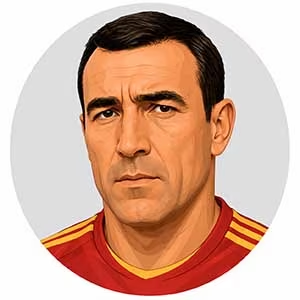
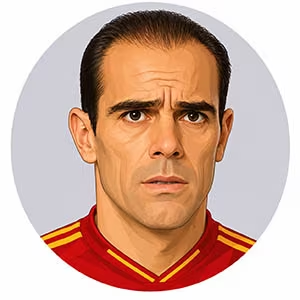
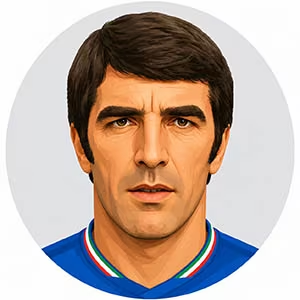
Spain - Centre MidfielderDel Sol, Luis
Luis del Sol
The Estadio Benito Villamarín laid the foundations for a relentless footballing motor before a high-profile move to the capital in 1960 integrated Luis del Sol Cascajares into Real Madrid’s legendary five-time European Cup-winning machine. Affectionately christened Settepulmoni (Seven Lungs) upon his subsequent transfer to Italy, the Andalusian powerhouse became one of the most dynamic, tactically indispensable box-to-box midfielders of the 1960s. After helping Real Madrid lift the 1959–60 European Cup and the inaugural 1960 Intercontinental Cup, Del Sol made a historic switch to Juventus in 1962, inheriting Giampiero Boniperti’s mythic number ten jersey. He redefined the role entirely: instead of acting as a static playmaker, he combined ceaseless horizontal coverage, abrasive ball recovery, and crisp, rapid transitional distribution that linked defense directly with the forward line. Over nearly three hundred matches in Turin, he drove Juventus to the 1964–65 Coppa Italia and the 1966–67 Scudetto, before repeating his midfield mastery at AS Roma, where he captained the Giallorossi to the 1972 Anglo-Italian Cup. For Spain, across 16 caps and three goals, he played an integral role in capturing the 1964 European Nations' Cup and featured at two World Cups (1962, 1966).
Tactically and technically, however, Del Sol's maximalist game carried clear structural limitations. He was an engine of sheer kinetic pressure rather than a pure geometric visionary; his passing range lacked the delicate, splitting verticality of orthodox playmakers, and his direct shooting from distance was inconsistent. Furthermore, because his game relied heavily on continuous cardiovascular output and high-friction duels, his impact suffered noticeably whenever matches slowed down into low-tempo, heavily defensive tactical stalemates that required slow positional patience.
Fierce, unyielding, and driven by an intense pride in his physical labor, Del Sol treated every square yard of the pitch as contested territory. He had zero tolerance for passivity or showmanship; his authority came from outpacing and outfighting entire opposing midfield lines over ninety minutes. On the pitch, his body language radiated relentless urgency: he demanded the ball constantly, chased down lost causes with furious slide tackles, and instantly reset defensive shapes through energetic positional calls. Inside the Juventus and Roma dressing rooms, he was an untouchable leader and tactical pillar, holding younger players to a monastic standard of stamina and physical commitment while commanding deep respect from Italian tactical masters like Heriberto Herrera. When subjected to violent man-marking in the physical cauldron of 1960s Serie A, Del Sol absorbed the punishment without breaking stride, using his low center of gravity to ride challenges and keep driving forward. Referees admired his honest, full-blooded commitment, cementing an immortal legacy as one of the greatest, most tireless, and influential box-to-box midfielders in Spanish and Italian football history.