We use Google Analytics to understand how visitors use this site. Analytics cookies are only activated with your consent. For details, read our Privacy Policy.
Profile lensThe same player, read from a different angle.
Athletic83
Acceleration
80
Pace
79
Agility
78
Strength
82
Balance
87
Jumping
81
Stamina
93
Fitness
87
Technical82
Dribbling
77
Short Passing
82
Long Passing
85
Finishing
85
Shot Accuracy
77
Shot Power
91
Shooting Technique
76
Heading
82
Tackling
82
Crossing
82
Free Kick
78
Penalties
78
First Touch
82
Mental86
Composure
77
Aggression
90
Consistency
92
Creativity
75
Leadership
88
Work Rate
93
Tactical84
Vision
85
Off the Ball
79
Defensive Positioning
76
Teamwork
87
Anticipation
85
Marking
74
Player Traits
Attacking81
Crossing
82
Finishing
85
Heading Accuracy
82
Shot Accuracy
77
Off the Ball
79
Technique80
Dribbling
77
Free Kick
78
Short Passing
82
Long Passing
85
First Touch
82
Shot Technique
76
Movement81
Acceleration
80
Pace
79
Agility
78
Balance
87
Physicality87
Shot Power
91
Jumping
81
Stamina
93
Strength
82
Fitness
87
Defending77
Marking
74
Tackling
82
Def. Positioning
76
Mentality & Game Reading85
Aggression
90
Composure
77
Penalties
78
Vision
85
Leadership
88
Work Rate
93
Teamwork
87
Anticipation
85
Consistency
92
Creativity
75
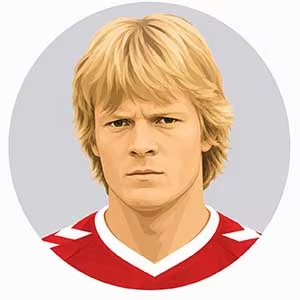
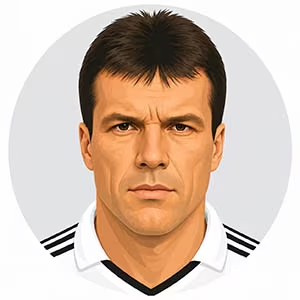
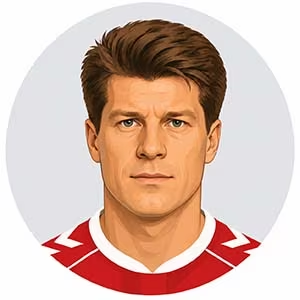
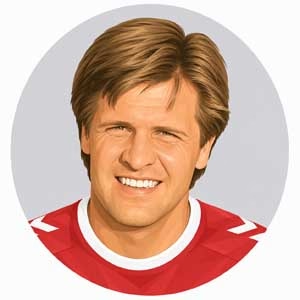
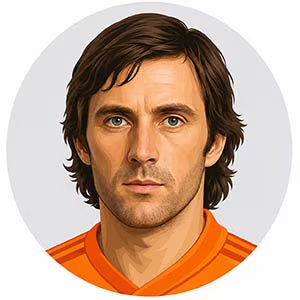
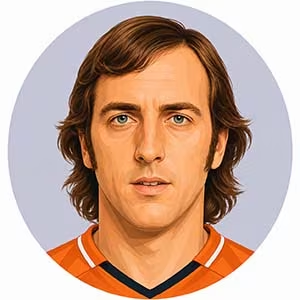
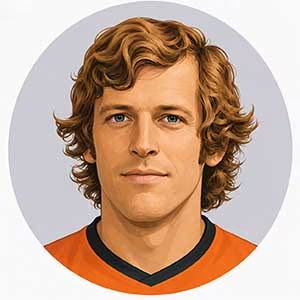
Denmark - Centre MidfielderLerby, Søren
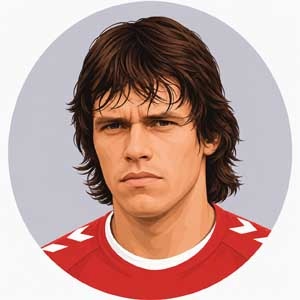
Playing a World Cup qualifier for Denmark against Ireland in Dublin on the afternoon of November 13, 1985, before boarding a private jet to Germany to come on as a second-half substitute for Bayern Munich in a DFB-Pokal match in Bochum that very same evening captured the maniacal, indestructible motor of an absolute Nordic gladiator. Søren Lerby was the snarling, high-octane box-to-box midfielder who provided the physical steel, tactical fury, and leadership spine behind Ajax’s transition, Bayern Munich’s dominance, and Guus Hiddink’s legendary PSV Eindhoven treble winners.
Operating with his socks rolled down to his ankles without shin guards, Lerby played with a frantic, all-consuming intensity. He combined limitless cardiovascular endurance with bone-jarring sliding tackles, aggressive aerial duels, and an exceptionally cultured left foot that allowed him to switch play with forty-yard cross-field passes or arrive late to smash volleys into the roof of the net. After breaking through at Ajax—where he made 269 appearances, scored 92 goals, and won five Eredivisie titles and two KNVB Cups as club captain—he moved to Bayern Munich in 1983, lifting two Bundesliga titles and two DFB-Pokals. His crowning club triumph arrived at PSV Eindhoven in 1988, where his midfield generalship carried the club to an Eredivisie, KNVB Cup, and European Cup treble. For Denmark, across 67 caps and ten goals, he was the combative enforcer and heartbeat of the iconic Danish Dynamite side across Euro 1984, the 1986 World Cup in Mexico, and Euro 1988.
That ferocious, high-friction approach, however, lived on the absolute edge of physical and tactical control. Lerby’s aggressive tackling style and fiery temper regularly brought him into direct confrontation with referees, collecting a heavy tally of bookings that occasionally left his sides shorthanded in critical continental ties. Furthermore, his game required an all-out, maximum-tempo physical battle to be effective; in slow, sterile possession matches where opponents refused to engage in physical duels, his chaotic vertical drive could occasionally disrupt his own team's passing rhythm.
Emotionally, Lerby was a volcanic, hyper-demanding serial winner who despised complacency with every fiber of his being. He possessed an ironclad, tyrannical standard of accountability, famously berating veteran teammates on the pitch if their defensive tracking dropped by a fraction of a second. Defeat felt to him like an existential insult, fueling a manic, relentless drive that dragged tired squads over the finish line through sheer willpower. On the pitch, his presence was all kinetic aggression and wild blond hair: lunging into muddy challenges with total disregard for his own body, barking tactical commands with veins bulging in his neck, and driving forward like an unstoppable force of nature. Inside the dressing rooms of Amsterdam, Munich, and Eindhoven, he was an untouchable, magnetic leader whose relentless fighting spirit and big-game bravery made him one of the most fearsome and decorated midfielders in European history.