We use Google Analytics to understand how visitors use this site. Analytics cookies are only activated with your consent. For details, read our Privacy Policy.
Profile lensThe same player, read from a different angle.
Athletic81
Acceleration
81
Pace
82
Agility
76
Strength
82
Balance
85
Jumping
76
Stamina
87
Fitness
79
Technical87
Dribbling
86
Short Passing
88
Long Passing
87
Finishing
86
Shot Accuracy
87
Shot Power
89
Shooting Technique
82
Heading
76
Tackling
60
Crossing
88
Free Kick
85
Penalties
77
First Touch
86
Mental80
Composure
87
Aggression
76
Consistency
78
Creativity
85
Leadership
70
Work Rate
85
Tactical85
Vision
87
Off the Ball
87
Defensive Positioning
52
Teamwork
92
Anticipation
75
Marking
48
Attacking85
Crossing
88
Finishing
86
Heading Accuracy
76
Shot Accuracy
87
Off the Ball
87
Technique86
Dribbling
86
Free Kick
85
Short Passing
88
Long Passing
87
First Touch
86
Shot Technique
82
Movement81
Acceleration
81
Pace
82
Agility
76
Balance
85
Physicality83
Shot Power
89
Jumping
76
Stamina
87
Strength
82
Fitness
79
Defending53
Marking
48
Tackling
60
Def. Positioning
52
Mentality & Game Reading81
Aggression
76
Composure
87
Penalties
77
Vision
87
Leadership
70
Work Rate
85
Teamwork
92
Anticipation
75
Consistency
78
Creativity
85
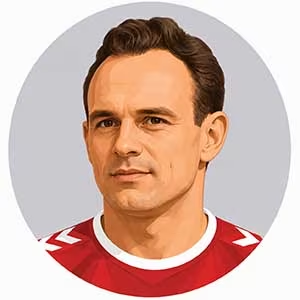
Denmark - Attacking MidfielderHansen, Karl Aage
Twenty-five years after leaving Turin, Karl Aage Hansen still remembered the referee's name. Pieri, from Trieste, had a personal grudge against him, Hansen told an Italian journalist he ran into by chance at Copenhagen airport in 1975 — the man had a habit of disallowing his goals, including one so blatant that the ball tore clean through a worn net and the referee still refused to count it. Recalling it decades later, Hansen said the injustice had made him turn purple with rage. It is one of the only flashes of real anger anyone ever recorded from him, and it says something that it survived a quarter century in his memory undimmed.
Born in Mesinge, Denmark, in 1921, Hansen broke through as an amateur at Akademisk Boldklub, where he won four Danish championships and four Danish Cups playing what began as a defensive-minded centre-half role and evolved, across his career, into a box-to-box inside forward capable of attacking, retreating to organize play, and never being consumed entirely by either function. He captained Denmark 17 times and was central to the country's bronze-medal run at the 1948 London Olympics, a tournament that also ended his amateur international career — turning professional, as teammates John Hansen and Karl Aage Præst also did that year, meant permanent exclusion from Denmark's amateur-only national team. He moved briefly to Huddersfield Town, then to Atalanta in 1949, scoring 18 goals in his debut Serie A season, before Juventus signed him for a then-record fee in 1950 to join Præst and John Hansen in the club's celebrated "Danish trio." He top-scored for Juventus with 23 goals in his first season there and won the Scudetto in his second, before later spells at Sampdoria and Catania closed out a career that, in three separate years, saw him fly between an English Saturday fixture and a Danish Sunday one on the same weekend. For Denmark he scored 17 goals in 22 caps.
His limitations were mostly physical, in the sense that recurring injuries interrupted an otherwise remarkably durable career — 86 appearances and 37 goals across three seasons at Juventus alone were described by contemporaries as limited specifically by intermittent physical setbacks rather than by any decline in ability. He was not, by his own team's account, an individual improviser; his game depended on reading the collective structure around him rather than solving problems alone, which meant his influence, while constant, rarely produced the kind of singular, name-making moment that individual stars are remembered for outside their own era.
Temperamentally the available record — thinner than for better-documented contemporaries, but genuine where it exists — describes a warm, well-liked, almost stoically hardworking man. Teammates and club officials nicknamed him a workhorse capable, in Giampiero Boniperti's words, of playing three matches in a single day, and journalists who covered Juventus in that period consistently praised his professional seriousness as the honest counterpart to the substantial wages Italian football offered Scandinavian imports still adjusting from strict amateur backgrounds. His football was explicitly described by observers as selfless rather than individualistic — an "innate altruism," in the words of one contemporary account, that made him a team man before he was ever a star, always organizing space for others, notably setting up strike partner John Hansen repeatedly rather than seeking personal credit. He held no recorded conflicts with coaches or teammates, maintained warm personal relationships that outlasted his career by decades — greeting old friends by name, asking after Boniperti's health, sending regards to former teammates from an airport lounge a quarter century after they had shared a dressing room — and stayed emotionally attached to Juventus for the rest of his life, reading Italian newspapers two or three times a week from Denmark just to follow the club's results. He was mildly, good-humoredly critical of what he saw as football becoming more cautious and tactical by the mid-1970s, nostalgic for an era of higher-scoring, more attacking football that he felt his own generation had embodied. Away from the pitch he also competed at a high level in team handball, winning a Danish national championship. Durable, quietly generous on the pitch, and capable of real but contained anger only when he judged an injustice had been done to him personally, Hansen belonged to the first generation of Scandinavian professionals who taught Italian football that seriousness and skill were not mutually exclusive.


 All Time DenmarkNT