We use Google Analytics to understand how visitors use this site. Analytics cookies are only activated with your consent. For details, read our Privacy Policy.
Profile lensThe same player, read from a different angle.
Athletic77
Acceleration
70
Pace
76
Agility
71
Strength
82
Balance
88
Jumping
73
Stamina
79
Fitness
75
Technical86
Dribbling
86
Short Passing
93
Long Passing
90
Finishing
81
Shot Accuracy
80
Shot Power
86
Shooting Technique
81
Heading
72
Tackling
68
Crossing
88
Free Kick
79
Penalties
86
First Touch
86
Mental79
Composure
87
Aggression
76
Consistency
73
Creativity
82
Leadership
78
Work Rate
73
Tactical84
Vision
88
Off the Ball
81
Defensive Positioning
65
Teamwork
92
Anticipation
81
Marking
52
Player Traits
Attacking80
Crossing
88
Finishing
81
Heading Accuracy
72
Shot Accuracy
80
Off the Ball
81
Technique86
Dribbling
86
Free Kick
79
Short Passing
93
Long Passing
90
First Touch
86
Shot Technique
81
Movement76
Acceleration
70
Pace
76
Agility
71
Balance
88
Physicality79
Shot Power
86
Jumping
73
Stamina
79
Strength
82
Fitness
75
Defending62
Marking
52
Tackling
68
Def. Positioning
65
Mentality & Game Reading82
Aggression
76
Composure
87
Penalties
86
Vision
88
Leadership
78
Work Rate
73
Teamwork
92
Anticipation
81
Consistency
73
Creativity
82
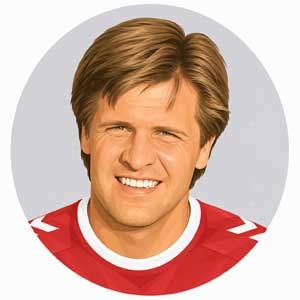
Denmark - Centre MidfielderMølby, Jan
On 10 May 1986, Liverpool faced Everton at Wembley with the league title already secured and the FA Cup required to complete the Double. Everton scored first. Jan Mølby did not respond by increasing the speed of his game; he continued to control it. From central midfield he repeatedly changed the point of attack, supplied runners early and participated in the construction of all three Liverpool goals as the match turned into a 3–1 victory. He was named man of the match. It was an appropriate expression of his football: pressure did not require visible urgency. Mølby’s authority came from making the ball travel faster than he did.
At 1.88 metres and heavily built, Mølby was an unusual central midfielder whose lack of mobility was offset by extraordinary technical range and spatial awareness. He could receive under pressure, protect the ball, then switch play forty metres with either foot or split a defensive line without needing to advance himself. His first touch gave him time that his body could not create through acceleration. Liverpool also used him deeper, even as an auxiliary central defender, before allowing him to move forward as matches developed. He possessed a powerful shot and became one of the outstanding penalty takers of his era, converting 42 of 45 penalties for Liverpool. Rather than choosing a corner in advance, Mølby watched the goalkeeper: if the keeper committed early, he went the other way; if not, he had a preferred low finish. That ability to delay the final decision made his technique unusually resistant to pressure. After beginning with Kolding and helping the club reach Denmark’s top division, he joined Ajax in 1982, winning the Dutch league and cup before Liverpool signed him in 1984. His first English season was difficult, but Kenny Dalglish’s appointment transformed his role. In 1985–86 he produced the defining season of his career, scoring 21 times in all competitions as Liverpool won the league and FA Cup. He ultimately made 292 official appearances and scored 61 goals for the club, winning three league titles and three FA Cups. Injuries increasingly disrupted his later seasons, and he eventually left in 1996 after loans to Barnsley and Norwich, becoming player-manager of Swansea. For Denmark he won 33 caps and scored twice between 1982 and 1990, appearing at the 1986 World Cup.
Mølby’s technical control could conceal substantial physical limitations. He was never quick, and opponents capable of forcing him to defend large spaces could expose his turning speed and recovery capacity. Liverpool’s structure often protected those weaknesses by allowing him to control play from central areas rather than chase opponents across the pitch. When matches became stretched, his passing remained valuable but his defensive influence could diminish. Fitness became a more serious problem after the foot and Achilles injuries that disrupted the second half of his career. Mølby later said that after the major injury he never again felt physically as strong or powerful as before. Periods out of the side made regaining condition more difficult, and his naturally heavy build reduced his margin further. He was therefore considerably more effective when the game could be organised around his reading and distribution than when it demanded repeated high-speed transitions.
Psychologically, Mølby’s strongest evidence comes from the contrast between his calm decision-making and the less orderly parts of his career. Penalties reveal the first channel clearly. He remembered all three Liverpool misses years later, but insisted they had been good saves rather than poor kicks; there is no sign that failure altered his method. He continued waiting for goalkeepers to commit and finished his Liverpool career with an exceptional conversion rate. Pressure therefore did not push him toward premature decisions. His transition to England required another form of control. The first Liverpool season began badly for both player and club, yet he later discussed those difficulties through injuries, tactical circumstances and team transition rather than blaming individuals. When Dalglish changed his role the following year, Mølby accepted being used unusually deep and then advancing later in matches, producing his best season rather than defending a fixed idea of what a creative midfielder should be. Authority worked particularly well when trust was present; Mølby repeatedly credited Dalglish with rescuing his Liverpool career. His response to personal failure was more complicated. After an off-field legal episode interrupted the 1987–88 season, Mølby later called the period the most difficult of his life, said he was not proud of what had happened and acknowledged that he had done wrong. He also admitted feeling watched after returning. That shame did not become public defiance: with Dalglish backing him, he returned to the team and eventually won further trophies. Injury produced a different frustration. Mølby said that throughout rehabilitation he continued believing he could recover fully, even when his body repeatedly failed to return to its previous level. The optimism helped persistence but may also have delayed acceptance of a changed physical reality. Socially, he integrated unusually deeply into Liverpool, remaining long enough to become the first foreign player to spend a decade with the club and eventually being recognised by the city itself. His leadership was therefore more technical and cultural than confrontational. He controlled games through passing, absorbed pressure without needing emotional display and earned trust through football intelligence. Mølby was not psychologically low-risk in every area, but once the ball was at his feet and a decision had to be made, emotional noise became remarkably small.