We use Google Analytics to understand how visitors use this site. Analytics cookies are only activated with your consent. For details, read our Privacy Policy.
Profile lensThe same player, read from a different angle.
Athletic80
Acceleration
82
Pace
80
Agility
86
Strength
74
Balance
80
Jumping
75
Stamina
84
Fitness
78
Technical86
Dribbling
87
Short Passing
93
Long Passing
87
Finishing
78
Shot Accuracy
78
Shot Power
82
Shooting Technique
80
Heading
75
Tackling
72
Crossing
85
Free Kick
78
Penalties
76
First Touch
88
Mental83
Composure
86
Aggression
75
Consistency
78
Creativity
85
Leadership
85
Work Rate
83
Tactical86
Vision
90
Off the Ball
78
Defensive Positioning
72
Teamwork
94
Anticipation
85
Marking
66
Player Traits
Attacking79
Crossing
85
Finishing
78
Heading Accuracy
75
Shot Accuracy
78
Off the Ball
78
Technique86
Dribbling
87
Free Kick
78
Short Passing
93
Long Passing
87
First Touch
88
Shot Technique
80
Movement82
Acceleration
82
Pace
80
Agility
86
Balance
80
Physicality79
Shot Power
82
Jumping
75
Stamina
84
Strength
74
Fitness
78
Defending70
Marking
66
Tackling
72
Def. Positioning
72
Mentality & Game Reading84
Aggression
75
Composure
86
Penalties
76
Vision
90
Leadership
85
Work Rate
83
Teamwork
94
Anticipation
85
Consistency
78
Creativity
85
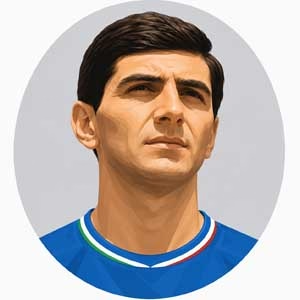
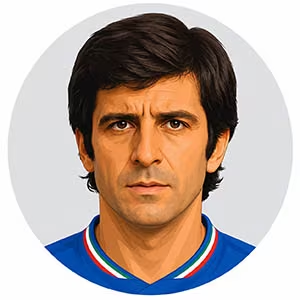
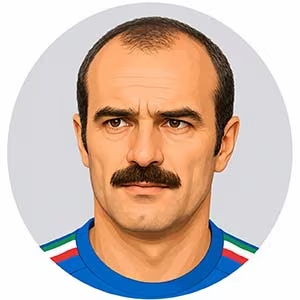
Italy - Centre MidfielderBulgarelli, Giacomo
The sight of an Italian captain being carried off the muddy pitch of Middlesbrough in agonizing pain while North Korea completed the most shocking upset in World Cup history remained a heartbreaking scar, yet it could never diminish the aristocratic generalship of the man who orchestrated Bologna’s greatest modern masterpiece. Giacomo Bulgarelli was the definitive prototype of the complete, cultured mezzala and central orchestrator: a player whose pristine spatial geometry, tactical intelligence, and commanding presence made him the intellectual compass of Italian midfield play throughout the 1960s.
Operating as a right-sided interior or deep-lying conductor, Bulgarelli blended panoramic passing vision with exceptional tactical discipline and dynamic box-to-box running. He possessed clean close control, an uncanny ability to shield the ball under pressure on the half-turn, and a laser-accurate distribution range that allowed him to unlock defenses with defense-splitting diagonal passes or arrive late on the edge of the area to unleash powerful strikes. A proud, lifelong one-club icon, he made 486 appearances and scored 58 goals for Bologna between 1959 and 1975, serving as the undisputed captain and heartbeat of Fulvio Bernardini's immortal side that defeated Helenio Herrera's Inter in the historic 1964 playoff to claim the Scudetto, alongside lifting two Coppe Italia (1969–70, 1973–74) and the 1961 Mitropa Cup. For Italy, across 29 caps and seven goals, he was a key figure across two World Cups (1962, 1966—where he captained the side) and was an integral part of the squad that won the 1968 European Championship on home soil.
That refined, cerebral elegance, however, existed within distinct physical boundaries. Bulgarelli was not a lightning-fast sprinter over long distances, relying instead on reading passing lanes, body positioning, and early release rather than outpacing markers in open-field footraces. When matches descended into chaotic, muddy wrestling contests where aggressive physical destroyers targeted him with continuous hacking and denied him the breathing room to orchestrate, his rhythmic passing influence could be disrupted. Furthermore, a career plagued by knee and ligament vulnerabilities severely curtailed his international peak following the trauma of 1966.
Noble, dignified, and radiating an effortless, natural authority, Bulgarelli led not through screaming intimidation, but through moral gravitas and flawless technical leadership. He was a deeply cultured, articulate sportsman who viewed football as an intellectual craft of space and timing, earning the unconditional respect of opponents, managers, and referees through his spotless sporting conduct. On the pitch, his posture was upright, elegant, and commanding: surveying the pitch with cold, calculating lucidity, dictating attacking transitions with subtle hand signals, and demanding total tactical synchronization from his teammates. Inside the Stadio Renato Dall'Ara and Azzurri dressing rooms, he was an untouchable patriarch and civic monument—the eternal symbol of Bolognese footballing identity whose tactical vision, leadership elegance, and technical completeness defined an entire golden era of Italian football.