We use Google Analytics to understand how visitors use this site. Analytics cookies are only activated with your consent. For details, read our Privacy Policy.
Profile lensThe same player, read from a different angle.
Athletic80
Acceleration
85
Pace
79
Agility
91
Strength
71
Balance
78
Jumping
73
Stamina
82
Fitness
80
Technical88
Dribbling
93
Short Passing
89
Long Passing
87
Finishing
81
Shot Accuracy
77
Shot Power
81
Shooting Technique
88
Heading
66
Tackling
42
Crossing
88
Free Kick
70
Penalties
74
First Touch
92
Mental81
Composure
86
Aggression
71
Consistency
76
Creativity
90
Leadership
78
Work Rate
80
Tactical85
Vision
87
Off the Ball
82
Defensive Positioning
48
Teamwork
90
Anticipation
81
Marking
41
Player Traits
Attacking79
Crossing
88
Finishing
81
Heading Accuracy
66
Shot Accuracy
77
Off the Ball
82
Technique87
Dribbling
93
Free Kick
70
Short Passing
89
Long Passing
87
First Touch
92
Shot Technique
88
Movement83
Acceleration
85
Pace
79
Agility
91
Balance
78
Physicality77
Shot Power
81
Jumping
73
Stamina
82
Strength
71
Fitness
80
Defending44
Marking
41
Tackling
42
Def. Positioning
48
Mentality & Game Reading81
Aggression
71
Composure
86
Penalties
74
Vision
87
Leadership
78
Work Rate
80
Teamwork
90
Anticipation
81
Consistency
76
Creativity
90
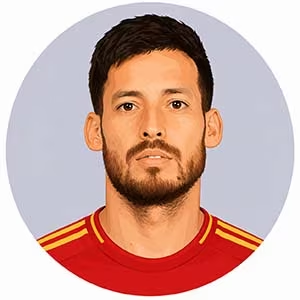
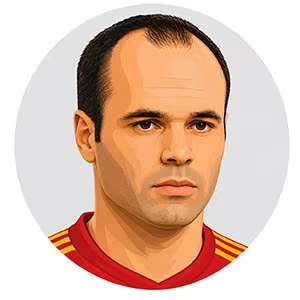
Spain - Attacking MidfielderSilva, David
He was the smallest player on the pitch in almost every match he ever played, and for a decade in the most physical league in Europe nobody could take the ball off him. David Silva survived at 1.70m in the Premier League by making contact irrelevant: receiving with his body already turned, moving the ball a beat before the challenge arrived, and finding passes in half-spaces that opponents had not registered as spaces at all. Manchester City supporters called him El Mago — the Magician — and the nickname was less about tricks than about the recurring sensation of not having seen how something happened.
Born in Arguineguín, Gran Canaria, in 1986 to a Spanish father and a Japanese mother, Silva came through Valencia and spent four seasons there before joining Manchester City in 2010, arriving just as the club began its transformation. He played as a left-sided attacking midfielder and later, as he aged, as a deeper interior in a midfield three, a conversion he made without any visible loss of influence. His qualities were touch, spatial awareness and the disguised short pass: he rarely struck the spectacular ball, preferring the ten-yard delivery that dismantled a defensive line by geometry rather than force. He finished neatly rather than powerfully and pressed with a persistence that his frame did not suggest. Across ten seasons at City he made 436 appearances, won four Premier League titles, two FA Cups and five League Cups, and was central to both the 2011–12 title decided on the final day and the 100-point side of 2017–18 under Pep Guardiola, who described him as the best player he had coached in the position. He closed his career at Real Sociedad. For Spain he collected 125 caps and 35 goals, and won the 2010 World Cup and both the 2008 and 2012 European Championships, scoring the opening goal in the 4–0 final in Kyiv.
His limitations were physical and never fully solved. Silva could be overwhelmed in matches that became purely attritional, and against sides that pressed him with aggressive, physical man-marking in tight areas he was more disruptible than his reputation suggested. He scored infrequently for a player operating so close to goal, offered limited aerial or defensive duel value, and suffered recurring muscular injuries that cost him significant portions of several seasons. His influence also depended on runners: without movement ahead of him, his short passing became sideways possession rather than penetration.
Temperamentally he was almost invisible, and deliberately so. Silva was reserved to the point of shyness, gave few interviews, spoke quietly when he did, and led exclusively through consistency and preparation — a professional whose standards were understood by everyone in the dressing room without ever being stated. He did not protest to referees, did not simulate, rarely retaliated against defenders who fouled him repeatedly, and was cautioned less than almost any player of his usage rate. Criticism did not visibly affect him, and neither did acclaim: his performance level was among the most stable of his generation, largely unchanged between routine league fixtures and finals. He carried, privately, the most difficult period of his life during the 2017–18 season, when his son was born prematurely and spent months in hospital in Valencia — Silva flew back and forth, missed matches without public explanation, and said almost nothing about it until it had resolved, a silence entirely consistent with everything else about him. Away from football he was private, family-centred, and produced no controversy across sixteen years at the top. Quiet, durable and technically flawless, Silva was the rare creative player who behaved like a defender.