We use Google Analytics to understand how visitors use this site. Analytics cookies are only activated with your consent. For details, read our Privacy Policy.
Profile lensThe same player, read from a different angle.
Athletic76
Acceleration
66
Pace
68
Agility
74
Strength
89
Balance
86
Jumping
74
Stamina
65
Fitness
85
Technical48
Dribbling
54
Short Passing
60
Long Passing
63
Shot Accuracy
51
Shot Power
86
Shooting Technique
51
Heading
58
Free Kick
52
Penalties
49
First Touch
54
Mental85
Composure
86
Consistency
82
Leadership
85
Goalkeeping88
Reflexes
90
Positioning
90
Handling
87
Kicking
84
Goalkeeping88
Reflexes
90
Positioning
90
Handling
87
Kicking
84
Attacking55
Heading Accuracy
58
Shot Accuracy
51
Technique56
Dribbling
54
Free Kick
52
Short Passing
60
Long Passing
63
First Touch
54
Shot Technique
51
Physicality80
Shot Power
86
Jumping
74
Stamina
65
Strength
89
Fitness
85
Movement74
Acceleration
66
Pace
68
Agility
74
Balance
86
Mentality & Game Reading76
Composure
86
Penalties
49
Leadership
85
Consistency
82
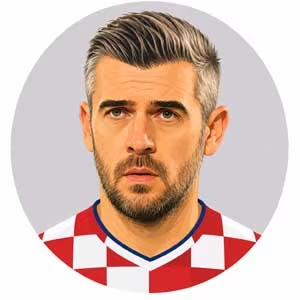
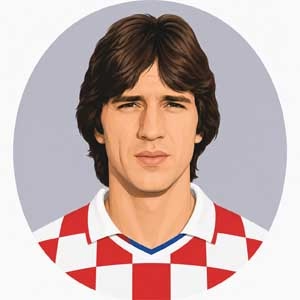
Croatia - GoalkeeperPletikosa, Stipe
In Vienna on 20 June 2008, Croatia and Turkey had played almost 120 scoreless minutes when Ivan Klasnić finally headed Croatia in front. Seconds later Semih Şentürk equalised with virtually the final kick of extra time. Croatia then missed three of their four penalties and were eliminated. Stipe Pletikosa saved none. Four years later, approaching another European Championship as Croatia’s established goalkeeper, he described himself differently from the player who had entered his first World Cup in 2002. The nervousness he had felt ten years earlier, he said, was largely gone. Experience had given him a repeatable way to prepare: follow the same routine, discuss likely situations with defenders and arrive at the match mentally clear enough that his own behaviour transmitted confidence to the line in front of him. The important evolution was not that disappointment or pressure ceased to exist. It was that uncertainty increasingly became converted into preparation before the match began.
Pletikosa was a tall, reactive goalkeeper whose strengths were shot-stopping, positioning and rapid adjustment around the goal line. At approximately 1.93 metres he possessed useful reach without being dependent on spectacular athleticism alone. He could set himself early, react strongly to medium-range shots and use his frame effectively in one-on-one situations. His distribution was functional rather than transformative, while his game remained fundamentally built around conventional goalkeeper responsibilities: organise, position, save and restart. Hajduk Split developed him into Croatia’s first choice before moves to Shakhtar Donetsk and Spartak Moscow exposed him to different defensive structures. He later spent a season at Tottenham without breaking into the Premier League side, then rebuilt regular club football at Rostov. Despite those unstable club periods, Croatia continued to use him across three World Cups and two European Championships. His international career reached 114 appearances, and by Euro 2012 his experience had become part of his technical function: preparation and communication were mechanisms for stabilising defenders as much as himself.
His limitations were most visible when technical security had to compensate for changing athletic margins or extended inactivity. Pletikosa was not an expansive goalkeeper whose feet could dominate build-up, and prolonged spells without first-team football inevitably made match rhythm harder to preserve. Tottenham provides the extreme example: with Heurelho Gomes and Carlo Cudicini ahead of him, he made only one senior competitive appearance. His career nevertheless suggests that selection instability itself was more damaging than one isolated mistake. At Spartak he had played regularly and been recognised as one of the league’s stronger goalkeepers before suddenly being told that, despite being considered the best goalkeeper at the club, he would not play. Pletikosa later described that benching as harder than similar experiences at Shakhtar or Tottenham. By 2014, age had also reduced the margin supplied by reactions, and his World Cup performances were below his own standard. Importantly, he said so himself rather than searching for a tactical alibi.
Psychologically, Pletikosa is best defined by **preparation-mediated self-trust combined with strong self-accountability**. Before Euro 2012 he explicitly contrasted the nervous goalkeeper of 2002 with the experienced player who could now rely on routine preparation, conversation with defenders and familiarity with the demands of international football. Trust from coaches still mattered: shortly after joining Spartak, he said that feeling the staff’s confidence was essential for any goalkeeper. But his response to failure was not primarily to externalise blame. After Croatia’s disappointing 2014 World Cup he described himself as his own harshest critic, said he had not been good enough and explicitly rejected the idea of isolating one culprit for the team’s elimination. Euro 2012 supplies an earlier contradiction. After elimination by Spain he sat in the dressing room considering whether continuing with the national team still made sense; the reception the team received back in Croatia helped reverse that impulse. Emotional disappointment therefore could be substantial, but it did not automatically become permanent withdrawal. Even his later international retirement retained ambivalence: months after stopping, Pletikosa said he still considered the timing logical yet regretted no longer sharing the group and wished he could play once more for Croatia. Evidence for systematic referee confrontation, retaliatory aggression or teammate blame is weak. The stronger pattern is that **Pletikosa increasingly stabilised performance by making preparation predictable, while unexpected withdrawal of trust or major collective failure could disturb him much more than the acute pressure of the save itself**.