We use Google Analytics to understand how visitors use this site. Analytics cookies are only activated with your consent. For details, read our Privacy Policy.
Profile lensThe same player, read from a different angle.
Athletic82
Acceleration
83
Pace
82
Agility
79
Strength
84
Balance
78
Jumping
85
Stamina
84
Fitness
80
Technical78
Dribbling
75
Short Passing
77
Long Passing
77
Finishing
68
Shot Accuracy
64
Shot Power
82
Shooting Technique
68
Heading
83
Tackling
86
Crossing
72
Free Kick
60
Penalties
60
First Touch
75
Mental86
Composure
86
Aggression
85
Consistency
87
Creativity
64
Leadership
88
Work Rate
89
Tactical84
Vision
71
Off the Ball
63
Defensive Positioning
92
Teamwork
81
Anticipation
88
Marking
90
Attacking70
Crossing
72
Finishing
68
Heading Accuracy
83
Shot Accuracy
64
Off the Ball
63
Technique72
Dribbling
75
Free Kick
60
Short Passing
77
Long Passing
77
First Touch
75
Shot Technique
68
Movement81
Acceleration
83
Pace
82
Agility
79
Balance
78
Physicality83
Shot Power
82
Jumping
85
Stamina
84
Strength
84
Fitness
80
Defending89
Marking
90
Tackling
86
Def. Positioning
92
Mentality & Game Reading80
Aggression
85
Composure
86
Penalties
60
Vision
71
Leadership
88
Work Rate
89
Teamwork
81
Anticipation
88
Consistency
87
Creativity
64
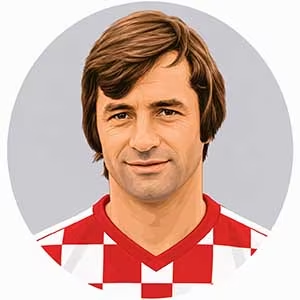
Croatia - Centre-backHolcer, Dragan
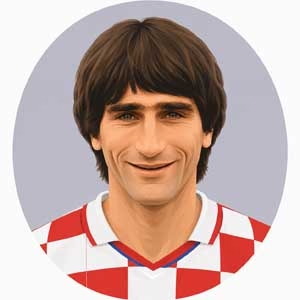
Born inside a Nazi concentration camp in Zwiesel to an Italian-Austrian mother and a fallen Slovenian partisan father, a boy raised in Niš channeled an unimaginable legacy of survival into becoming the most elegant, commanding, and respected defensive sweeper in Balkan football. Dragan Holcer was the refined tactical brain and defensive marshal of Yugoslavia’s brilliant late-1960s generation and the spiritual pillar of Hajduk Split’s golden decade.
Operating as a classic, cultured libero, Holcer elevated defending into pure anticipatory geometry. Rather than relying on brute force or crude body checks, he dominated games through pristine spatial reading: cutting out dangerous through-balls two steps before they materialized, executing clean standing tackles, and stepping out from the backline with his head held high to start attacking phases with laser-accurate distribution off either foot. After establishing his reputation at Radnički Niš across over 170 matches, he moved to Hajduk Split in 1967, becoming an iconic captain across 419 appearances, capturing three Yugoslav First League championships (1970–71, 1973–74, 1974–75) and three consecutive Yugoslav Cups. He later enjoyed a distinguished six-year chapter in West Germany with VfB Stuttgart, anchoring their backline across 106 Bundesliga matches. For Yugoslavia, across 52 caps between 1965 and 1974, his international apex was Euro 1968 in Italy, where his majestic performances earned him a place in the UEFA Team of the Tournament, alongside starring appearances at the 1974 World Cup.
Holcer’s refined, intellectual style, however, operated within clear physical boundaries. Standing five-foot-ten with a slender frame, he lacked towering aerial height; when confronted by massive, six-foot-three European target men who pinned him inside the six-yard box under direct, physical cross bombardments, he had to rely strictly on body leverage, aerial timing, and positional anticipation. If caught in isolated footraces against explosive, dynamic sprinters in open forty-yard channels without cover, his linear recovery pace could be tested.
Emotionally, Holcer was a noble, deeply reflective leader who commanded absolute reverence without ever raising his voice in anger. He possessed a serene, aristocratic calm on the pitch that disarmed chaotic atmospheres, leading purely through moral authority, tactical clarity, and spotless sporting conduct. On the field, his posture was upright, poised, and unhurried: effortlessly sweeping up danger behind his markers and signaling movements with gentle, authoritative hand gestures. Inside the Hajduk Split, Stuttgart, and Yugoslav locker rooms, he was an untouchable patriarch and cultural bridge—a universally beloved figure whose quiet dignity, immense courage, and immaculate technical mastery cemented his standing as one of the greatest sweepers Europe has ever known.