We use Google Analytics to understand how visitors use this site. Analytics cookies are only activated with your consent. For details, read our Privacy Policy.
Profile lensThe same player, read from a different angle.
Athletic81
Acceleration
74
Pace
77
Agility
74
Strength
87
Balance
84
Jumping
86
Stamina
85
Fitness
80
Technical79
Dribbling
76
Short Passing
75
Long Passing
75
Finishing
63
Shot Accuracy
64
Shot Power
84
Shooting Technique
69
Heading
86
Tackling
88
Crossing
71
Free Kick
62
Penalties
64
First Touch
77
Mental83
Composure
80
Aggression
89
Consistency
87
Creativity
66
Leadership
84
Work Rate
83
Tactical82
Vision
75
Off the Ball
64
Defensive Positioning
87
Teamwork
84
Anticipation
83
Marking
87
Player Traits
Attacking70
Crossing
71
Finishing
63
Heading Accuracy
86
Shot Accuracy
64
Off the Ball
64
Technique72
Dribbling
76
Free Kick
62
Short Passing
75
Long Passing
75
First Touch
77
Shot Technique
69
Movement77
Acceleration
74
Pace
77
Agility
74
Balance
84
Physicality84
Shot Power
84
Jumping
86
Stamina
85
Strength
87
Fitness
80
Defending87
Marking
87
Tackling
88
Def. Positioning
87
Mentality & Game Reading80
Aggression
89
Composure
80
Penalties
64
Vision
75
Leadership
84
Work Rate
83
Teamwork
84
Anticipation
83
Consistency
87
Creativity
66
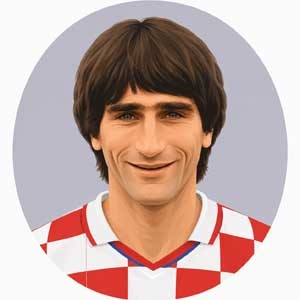
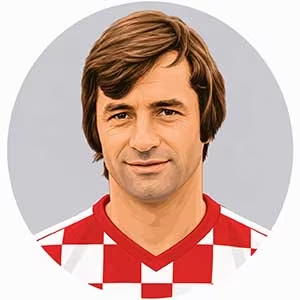
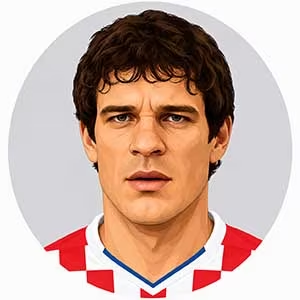
Croatia - Centre-backBilić, Slaven
Slaven Bilić built a defensive career on physical solidity and positional intelligence, and then became rather more famous, at least outside Croatia, for one specific piece of theater at a World Cup than for almost anything he actually did as a footballer — a reputation he spent years trying to outrun without ever fully managing it, and one that sits oddly alongside a genuinely accomplished defensive record.
Born in Split in 1968, Bilić was a physically robust, aggressive central defender, strong in the air and committed in the tackle, with reasonable comfort in possession for a player of his generation and generally reliable positioning against direct, physical forwards. He began at Hajduk Split before moving through West Ham United, Everton and Karlsruher SC across a well-traveled European career, later returning to Hajduk to close his playing days. He won domestic honors with Hajduk Split across two spells and built a solid, well-regarded reputation in the Premier League during his West Ham years in the mid-1990s, a period club supporters remember considerably more warmly than most opposing observers ever discussed him. For Croatia he won 44 caps and was a first-choice centre-back during the country's celebrated run to the 1998 World Cup semi-final, playing alongside Šuker in the tournament that established Croatian football's early international identity. That same tournament produced the moment his name is most associated with globally: a second-round match against France in which he went down clutching his face after minimal contact from Laurent Blanc, resulting in Blanc's sending off and suspension for the final — an incident Bilić later admitted, with some candor, he had exaggerated.
His limitations as a player were fairly ordinary for a physical, no-frills central defender of his era. Bilić was not especially quick and could be exposed against genuinely fast forwards in transition, and his aggressive, contact-heavy approach to defending produced a correspondingly elevated disciplinary record across his career, including several red cards during his time at West Ham. He was a solid rather than exceptional passer, adequate for the tactical demands of his period without ever being asked to progress the ball through more sophisticated buildup structures.
Temperamentally he was considerably more complex and publicly engaged than the simple image of a physical, combative defender might suggest. Bilić held a law degree, played guitar in a rock band during and after his career, and cultivated a public persona notably more articulate and culturally engaged than most of his defensive contemporaries — an intellectual and creative breadth the corpus has associated elsewhere mainly with technical, attacking players rather than physical centre-backs. The Blanc incident followed him for the rest of his public life, and his own later acknowledgment that he had overreacted to minimal contact reflects a specific willingness toward gamesmanship that sat somewhat at odds with the broader professional reputation he built, particularly once he moved into coaching. As a manager, first with Croatia and then across several major European clubs including West Ham, Besiktas and Hajduk, he developed a reputation as an emotionally engaged, communicative figure, popular with players and prone to visible passion on the touchline rather than detached tactical calculation. He rarely shied from public commentary on Croatian football politics and remained a prominent, outspoken public figure in his home country well beyond his playing career, distinct from teammates like Šuker whose institutional involvement generated more controversy than voluntary visibility. Away from football his cultural interests, particularly music, remained a well-documented and genuine second identity rather than a media-friendly footnote. Physically combative on the pitch, intellectually and culturally expansive off it, and permanently associated with a single moment of gamesmanship he later owned rather than denied, Bilić's public identity across four decades in football has always been considerably larger and more contradictory than his playing statistics alone would suggest.


 All Time CroatiaNT