We use Google Analytics to understand how visitors use this site. Analytics cookies are only activated with your consent. For details, read our Privacy Policy.
Profile lensThe same player, read from a different angle.
Athletic82
Acceleration
84
Pace
82
Agility
81
Strength
73
Balance
79
Jumping
85
Stamina
84
Fitness
85
Technical74
Dribbling
74
Short Passing
76
Long Passing
72
Finishing
57
Shot Accuracy
60
Shot Power
75
Shooting Technique
69
Heading
72
Tackling
79
Crossing
71
Free Kick
65
Penalties
64
First Touch
75
Mental82
Composure
84
Aggression
85
Consistency
80
Creativity
68
Leadership
83
Work Rate
84
Tactical77
Vision
74
Off the Ball
64
Defensive Positioning
80
Teamwork
78
Anticipation
80
Marking
84
Attacking65
Crossing
71
Finishing
57
Heading Accuracy
72
Shot Accuracy
60
Off the Ball
64
Technique72
Dribbling
74
Free Kick
65
Short Passing
76
Long Passing
72
First Touch
75
Shot Technique
69
Movement82
Acceleration
84
Pace
82
Agility
81
Balance
79
Physicality80
Shot Power
75
Jumping
85
Stamina
84
Strength
73
Fitness
85
Defending81
Marking
84
Tackling
79
Def. Positioning
80
Mentality & Game Reading78
Aggression
85
Composure
84
Penalties
64
Vision
74
Leadership
83
Work Rate
84
Teamwork
78
Anticipation
80
Consistency
80
Creativity
68
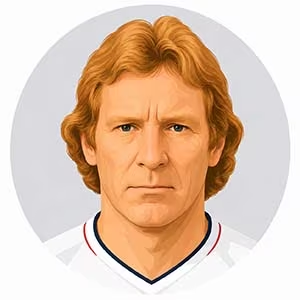
England - Left BackWilson, Ray
A former railway worker from Shirebrook transformed into the most technically sound left-back in English football history, Raymond Wilson served as the quiet, immaculate defensive foundation of Alf Ramsey’s 1966 World Cup-winning Wingless Wonders. Operating with an upright, balanced posture and surgical timing, Wilson did not rely on frantic sliding tackles or physical bludgeoning; he dispossessed wingers through sheer spatial anticipation, intercepting passes before they reached their target and immediately playing clean ground balls out of the defensive third. Forged at Huddersfield Town under Bill Shankly before joining Everton in 1964, he lifted the 1966 FA Cup at Wembley just two months before starting every match of England's triumphant World Cup campaign as the squad's oldest outfield player. Across 63 caps for the Three Lions, his defensive consistency on the left flank remained essentially flawless across a decade of international duty.
His cerebral style, however, operated within specific physical boundaries. Wilson was not an explosive, overlapping athlete who bombed forward into the opposition penalty box to deliver high crosses, adhering strictly to a defense-first mandate that prioritized structural stability over attacking width. Furthermore, severe knee cartilage injuries sustained in the late 1960s rapidly robbed him of his smooth turning speed, accelerating the twilight of his elite career at Oldham Athletic and Bradford City.
Unassuming, disciplined, and thoroughly professional, Wilson approached professional football with workmanlike humility. He shunned media self-promotion and celebrity fanfare, taking immense pride in the quiet neutralization of world-class attackers like Garrincha and Ferenc Bene. On the pitch, his body language was calm and economical: he never lunged unnecessarily, rarely conceded cheap fouls, and managed high-pressure defensive scenarios with quiet competence. Inside the Everton and England dressing rooms, he was an elder statesman whose understated authority and spotless technical habits commanded absolute respect from younger stars like Bobby Moore and Alan Ball, leaving behind an immortal legacy as the definitive English master of positional defending.