We use Google Analytics to understand how visitors use this site. Analytics cookies are only activated with your consent. For details, read our Privacy Policy.
Profile lensThe same player, read from a different angle.
Athletic81
Acceleration
70
Pace
78
Agility
67
Strength
91
Balance
82
Jumping
92
Stamina
85
Fitness
85
Technical79
Dribbling
74
Short Passing
77
Long Passing
76
Finishing
64
Shot Accuracy
64
Shot Power
85
Shooting Technique
66
Heading
88
Tackling
90
Crossing
69
Free Kick
60
Penalties
66
First Touch
75
Mental82
Composure
85
Aggression
90
Consistency
80
Creativity
63
Leadership
84
Work Rate
82
Tactical81
Vision
71
Off the Ball
60
Defensive Positioning
89
Teamwork
76
Anticipation
82
Marking
91
Player Traits
Attacking69
Crossing
69
Finishing
64
Heading Accuracy
88
Shot Accuracy
64
Off the Ball
60
Technique71
Dribbling
74
Free Kick
60
Short Passing
77
Long Passing
76
First Touch
75
Shot Technique
66
Movement74
Acceleration
70
Pace
78
Agility
67
Balance
82
Physicality88
Shot Power
85
Jumping
92
Stamina
85
Strength
91
Fitness
85
Defending90
Marking
91
Tackling
90
Def. Positioning
89
Mentality & Game Reading78
Aggression
90
Composure
85
Penalties
66
Vision
71
Leadership
84
Work Rate
82
Teamwork
76
Anticipation
82
Consistency
80
Creativity
63
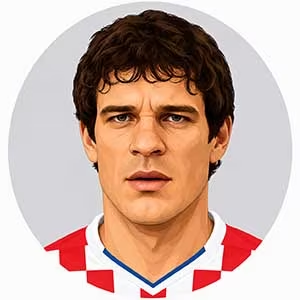
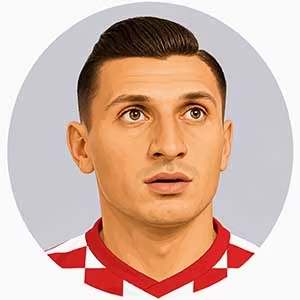
Croatia - Centre-backHorvat, Ivan
The calm, cerebral center-half who could dispossess the world's most ferocious forwards without ever dirtying the pristine white shorts of Dinamo Zagreb brought a sense of pure classical order to post-war European defending. Ivan "Ivica" Horvat was an aristocratic stopper and sweeping pivot whose game was built entirely on anticipatory reading, pristine spatial geometry, and an elegant, cultured distribution out from the backline.
Operating as the defensive anchor of Dinamo Zagreb throughout the golden era of the 1940s and 1950s, Horvat combined a tall, upright frame with flawless timing on aerial headers and ground interceptions. Over 500 appearances for Dinamo between 1945 and 1957, he captained the club to two Yugoslav First League titles (1947–48 and 1953–54) and the 1951 Yugoslav Cup, before moving abroad to anchor Eintracht Frankfurt's backline. For Yugoslavia, across 60 caps between 1946 and 1956, he was the undisputed defensive general of the immortal Olympic Team, winning the Silver Medal at Helsinki 1952, anchoring the side across two World Cups (1950 in Brazil and 1954 in Switzerland, where he served as captain), and representing the FIFA World XI in Belfast in 1953.
Horvat’s refined, anticipatory approach, however, was deliberately stripped of crude physical friction. He was not an aggressive, bone-crunching enforcer who enjoyed engaging in muddy wrestling duels with physical target men; he relied on stepping in front of the pass before it reached the forward. When matched against hyper-direct, explosive sprinters in chaotic, end-to-end transitional games on heavy pitches where his initial positional read was bypassed, his linear recovery pace over forty yards could be tested.
Gentlemanly, highly cultured, and carrying the natural diplomatic poise of a Zagreb intellectual, Horvat led through moral authority and immaculate technical example rather than screaming intimidation. Over a long, grueling career facing the most cynical forwards of the post-war era, he maintained an extraordinarily spotless disciplinary record, viewing sportsmanship as an absolute professional obligation. On the pitch, his posture was calm, upright, and unflappable: sweeping up danger with effortless composure, directing the offside trap with subtle arm gestures, and initiating attacks with pinpoint ground distribution. Inside the Dinamo, Frankfurt, and Yugoslav locker rooms, his tactical wisdom was revered—a respected leader who later translated his tactical brain into managerial triumphs, cementing an enduring legacy as one of the most intelligent, elegant central defenders European football has known.


 All Time CroatiaNT