We use Google Analytics to understand how visitors use this site. Analytics cookies are only activated with your consent. For details, read our Privacy Policy.
Profile lensThe same player, read from a different angle.
Athletic81
Acceleration
73
Pace
77
Agility
72
Strength
87
Balance
86
Jumping
87
Stamina
82
Fitness
81
Technical78
Dribbling
72
Short Passing
77
Long Passing
77
Finishing
54
Shot Accuracy
57
Shot Power
73
Shooting Technique
67
Heading
84
Tackling
87
Crossing
73
Free Kick
60
Penalties
64
First Touch
74
Mental81
Composure
82
Aggression
89
Consistency
87
Creativity
63
Leadership
70
Work Rate
87
Tactical80
Vision
68
Off the Ball
58
Defensive Positioning
86
Teamwork
84
Anticipation
82
Marking
86
Player Traits
Attacking65
Crossing
73
Finishing
54
Heading Accuracy
84
Shot Accuracy
57
Off the Ball
58
Technique71
Dribbling
72
Free Kick
60
Short Passing
77
Long Passing
77
First Touch
74
Shot Technique
67
Movement77
Acceleration
73
Pace
77
Agility
72
Balance
86
Physicality82
Shot Power
73
Jumping
87
Stamina
82
Strength
87
Fitness
81
Defending86
Marking
86
Tackling
87
Def. Positioning
86
Mentality & Game Reading78
Aggression
89
Composure
82
Penalties
64
Vision
68
Leadership
70
Work Rate
87
Teamwork
84
Anticipation
82
Consistency
87
Creativity
63
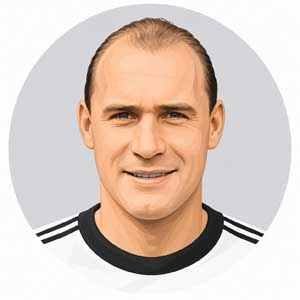
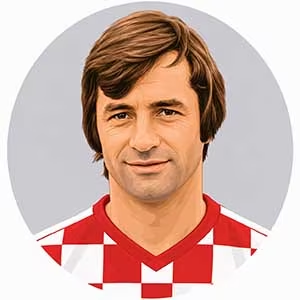
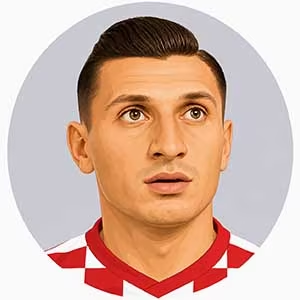
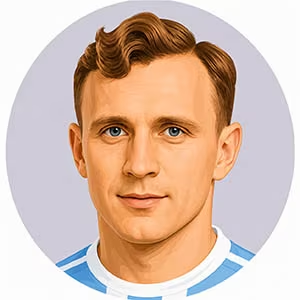
Croatia - Centre-backCrnković, Tomislav
An uncompromising, hard-hitting left-back who treated every yard of the touchline as a personal frontline earned the fearsome nickname Crni Čelik (Black Steel) from terraces across the Balkans. Tomislav Crnković was the ferocious, athletic man-marking powerhouse who provided the uncompromising physical muscle, tireless running, and defensive bite for both Dinamo Zagreb and the golden Yugoslav national side throughout the 1950s.
Blessed with explosive short-burst acceleration, exceptional upper-body strength, and a bone-jarring sliding tackle that wiped out both ball and opponent with clinical legality, Crnković was the nightmare assignment for outside-rights across the continent. Across 439 matches for Dinamo Zagreb between 1950 and 1961, he formed an impenetrable defensive partnership alongside Ivica Horvat and Branko Zebec, lifting the 1953–54 and 1957–58 Yugoslav First League championships and two Yugoslav Cups (1951, 1960). For Yugoslavia, across 51 caps, he was an irreplaceable defensive warrior during their historic international peak, capturing the Silver Medal at the 1952 Helsinki Olympics, starting every match at two World Cups (1954 in Switzerland and 1958 in Sweden), and playing in the final of the 1960 European Nations' Cup in Paris.
Crnković’s aggressive, physical game, however, walked a permanent tightrope with refereeing boundaries and technical simplicity. He was an orthodox, defensive-minded stopper rather than a modern, cultured wing-back who delivered curling crosses from the corner flag; his distribution under pressing was strictly pragmatic clearances into the channels. Furthermore, his fiercely combative nature and front-foot tackling style occasionally resulted in bookings against elusive, low-gravity wingers who anticipated his physical charges and drew contact in dangerous areas.
Boisterous, fiercely loyal, and carrying an irrepressible, colorful personality off the pitch that often clashed with rigid club directors, Crnković was the ultimate warrior on it. He feared no reputation, famously stepping onto the pitch to neutralize global icons like Garrincha, Raymond Kopa, and Helmut Rahn through relentless physical intimidation and unyielding stamina. On the pitch, his body language was all kinetic aggression: clattering into challenges with full commitment, staring down opposing wingers after every clearance, and urging his teammates forward with passionate roars. Inside the Dinamo and Yugoslav dressing rooms, he was an indispensable, beloved enforcer whose raw courage, defensive hardness, and clutch tackling under pressure made him an immortal cornerstone of Balkan football history.